CONTENTS
ARMY TO ENGLAND – EUROPEAN ADVENTURES MARRIAGE and LAST MONTHS IN ARMY ARMY DISCHARGE – FIRST JOBS – WESTERN TRIP JOB AT SCINTILLA – FARM BOUGHT – RENOVATIONS
BEGUN BUILDING
THE CABIN AT WILDWOOD, 1966 Obituaries
of Arnette Royce Lawrence and Arnette Odell Lawrence
|
|
Another reference to Lawrence family early history
in the US is found in the account of Slim Lawrence’s life on one of the
ranches that became part of Grand Teton National Park near Jackson Hole,
Wyoming. The story of Slim Lawrence’s life is told in, A tale of dough gods, bear grease, cantaloupe, and sucker oil:
Marymere/Pinetree/Mae-Lou/AMK Ranch (1986) by Kenneth Lee
Diem, Lenore L.
Diem, William C.
Lawrence, University of Wyoming-National Park Service Research
Center. The chapter, “Lawrence Era,” includes this paragraph: |
“Like the Sargents, Johnsons and Berols, the
Lawrence family ties were strongly Eastern, beginning in Yonkers, Westchester
County, New York. The Lawrence name in Yonkers was old, descending from three
brothers who came to the United States in 1635. Slim's father, Sidney Herbert
Lawrence, was one of 12 children born to William H. Lawrence and Maria V. Back.
He was almost a "New Year baby" being born, along with his twin
brother, Cecil, on December 31, 1852 (Fig. 56) (Scharf, 1886; St. John's
Church, No date). Sidney's father's occupation as a coroner was recorded in the
U.S. Census (1860b) and in a later census, as a lumber merchant (U.S. Census,
1870).”
Slim’s father Sidney Herbert and Arnette Odell are brothers – their parents
are William Henry Lawrence and Maria Back (Bach). Ken’s father, Arnette Royce
(A.R.), is one of Arnett Odell’s children. Thus, Slim is a first cousin of A.R.
Lawrence.
Phil’s oral history continues: “I will provide some information from
memory. My father (Arnette Odell Lawrence) had several brothers and a sister,
ages and sequence unknown: James, Frederick, Sidney, and Cecil. Isabelle
married a Baker in Los Angeles. I remember James and Cecil only. Uncle Jimmy’s
wife (Aunt Lottie, nee Charlotte Southworth, was the daughter of Mrs. E. D. N.
Southworth, a well-known novelist of her day.
“Two of the brothers, James and xx, formed the Lawrence Brothers
Building Supply Company in Yonkers. They were well-to-do, and each had a very
fine large mansion overlooking the Hudson River. Of course, they also looked
over the main line of the New York Central, but they were as close to the river
as you could get.
“My father and a man named Conklin ran a woodworking mill where they
made doors, cabinets, moulding, trim, things like that. They were not as
prosperous as the other two, and we lived in rather modest circumstances at 57
Caroline Avenue. When I was two years old we moved to 55 Caroline Avenue. Then
when I was about 12 we moved to a much better house, 81 Hamilton Avenue, which
had electric lights and central heat, which we didn’t have before.”
Ken
Lawrence added, “The bookcase at our home in Granby, Connecticut, with the
glass panels that lift up, was probably made at this woodworking mill.”
Phil continued: “When I was
about 14 years old (about 1916), my father suffered some financial reverses,
the cause of which I don’t know. His company went bankrupt and he lost the
business. In those days there was no backup of any kind, so he went to work for
his nephew Jamey, who had taken over his father’s business.”
Ken
Lawrence remembers seeing from the dock of the Hudson River Dayline a large
warehouse on a pier, with a large sign “James Lawrence” on it. Also in Yonkers
was a street named after the family, Lawrence Street.
Phil: “We moved to a lower-priced apartment at 12 Lawrence Street.
(I’ll tell you, when you went to a store and ordered something, it caused the
clerk some confusion that the customer’s name and address were both Lawrence!)”
Phil’s mother had a stroke in 1920; she became an invalid and was handicapped.
His father had a stroke in the office a few months later. Both died in
1920. Phil went first to the Smiths’
farm in Dunraven, NY, then to the home of his older brother Kenneth (wife
Elena) in Providence, RI, and finally lived with his older brother Arnette
Royce Lawrence (A.R.) and his wife Gladys in Richmond, Virginia.
Ken’s father A.R. Lawrence was also born in Yonkers. He was the first
in the family to go to Stevens Institute where he got a degree in mechanical
engineering. His brothers Ken and Phil also graduated from Stevens. Also, there
was a sister, Dorothy, who had an office job in NYC working for the railroad.
Dorothy Lawrence married a Van Klebe (Dutch or German), who also worked for the
railroad. (Uncle Phil Lawrence’s wife was also Dorothy – Dorothy Rebecca Reed.)
A.R.’s first job was working for an electric power company. A. R.
first worked on a workmens compensation (insurance) program for the state of
Pennsylvania, then subsequently for state of Virginia then eventually for state
of New Jersey. (Kenneth H. Lawrence, our dad, was born in Richmond, VA in
1920). In New Jersey, A. R.’s title was Commissioner of Insurance (there was
another Commissioner of Banking). His job was to set the insurance rate that
would be charged to manufacturers whose workers worked on big projects such as
the George Washington Bridge and the Holland Tunnel and the Lincoln Tunnel. To
set the rate, A.R. or his staff would have to inspect the project and assess
the hazards and risks of working on the project. He brought home paperwork –
accident records. Ken Lawrence says they used punchcards on an
A.R. took his responsibilities seriously. Half his salary was paid by
the manufacturers associations and half by the state. Every year there was a
convention in Atlantic City for the banking and insurance industries, and A.R. had
to give a speech. He had a fear of public speaking – he lay awake at night
thinking about these speeches -- but managed to deliver them.
During this period when workmens’ compensation programs were being
developed, medical science was learning about silicosis – disease from rock
dust. One project was to survey the building of the tunnel for water supply
piping from rural New Jersey to Newark. A caisson would be used for working
into the rock as it was drilled, to keep the men and equipment dry. Water was
pumped out. A.R. took Ken and Richard to see some of these projects, including
going into the tunnel. (A.R. never learned to drive. Because Ken’s older
brother Richard had bought a used car, the boys would drive him to some of
these projects – to Perth Amboy and to the Raritan River.)
A.R. was very involved in outdoor activities. He was captain of his
track team in college and also did a lot of hiking and canoeing. His parents
and his brothers lived about a mile from the Hudson in Yonkers, so he could get
his canoe down to the Hudson. He had an outdoor-loving group of friends that would
take the train to the Adirondacks and paddle the lakes and rivers.
A.R. died in 1942, before Ken graduated from Stevens.
Allen family,
Ohio
Gladys Elizabeth Allen left the Allen farm in Ellsworth, Ohio, to
attend secretarial school in NYC. Her siblings included a brother Martin that
died young and an older brother, Alfred, who worked for many years as a front desk
clerk at Battle Creek Health Sanitorium (health facility) developed by the
Kellogg family in Battle Creek, Michigan.
In NYC, Gladys may have worked at the state insurance office. She
shared a room with Irene Mitchell and another lady. Irene’s family was
good friends with the Lawrence family. Irene’s husband Edmund Mitchell worked
for A.R. Lawrence for some years.
Gladys played bridge and Scrabble. A member of St. James Episcopal
Church in Montclair, New Jersey, she sewed cloth bandages as part of the church
ladies aid group; some of those bandages were sent to Puerto Rico.

Right to left: Gladys
(Allen) Lawrence with small boy; Arnette Royce Lawrence; Gladys’ father,
William Hoyt Allen); (back row) man that looks like Gladys’ brother Alfred
Allen; others unknown. Location: unknown
Date: unknown, perhaps
around the time Gladys and A.R. were married (1916)

L to R: Adelaide, Gladys, Richard and Ken, about 1922.

101 Inwood Avenue, Montclair, New Jersey, was Ken Lawrence’s high
school home. Anne, Dick and Sally remember Thanksgiving gatherings with Grandma
Lawrence, aunts Jean and Adelaide, and cousins in the 1960s.
CHILDHOOD
I was born in Richmond, Virginia, on
Besides my mother and father, our Uncle Phil had come to live with us.
He was my father’s younger brother. About the time I was born, their parents in
Yonkers had died within six weeks of each other, while Phil was still in high
school. Phil lived first at the Smiths’ farm in the Catskills, then with Uncle Ken
Lawrence and Aunt Elena in Providence, RI, before joining A.R.’s family in
Richmond, VA, where he started high school.
In 1921 my father was asked to set up the New Jersey Workmen's
Compensation Rating and Inspection Bureau in Newark, N.J. So he was in Newark
most of the time, but the family did not actually move there until after Phil had
finished the year in high school. Phil went back to Yonkers and lived at the
YMCA, finally graduating from high school in January 1922. My family moved into a new house at 55 Park
End Place, East Orange, in December, and then Phil rejoined the family.
Adelaide was 5-1/2, Richard was 3, and I was 1-1/2. My sister Jean was born
As a baby, I had a case of rickets, which resulted in my having a
caved-in chest and a very small lung capacity. I don’t remember my infancy. I
do remember an incident when I was 4 or 5 years old. I was playing on the floor
with cars or trucks, and my mother tripped over me. The pot of hot soup she was
carrying spilled on my shoulder, burning it badly. I still have the scar.
My earliest recollections are of our home in East Orange. Park End
Place was a street a quarter-mile long that ran east and west between Sanford Street
and Harrison, which bordered a county park, a large green area with lovely
trees and a pond and swings and slides and walking paths.
Two-thirds of the way up the street from Sanford was a cross street that
was built after we moved there. We called it New Street -- it had a name, but we
never called it anything else. It ran two blocks from Kenwood to Elliott. It
crossed Park End Place at the bottom of a small hill (the rest of the street
was pretty flat). That was where we played since there was very little traffic
on it; also, it gave us access to friends.
When we moved in, there was a fair number of vacant lots. Some stayed vacant
for many years and had a place in our activities. The lots were very small,
about 50 ft wide and perhaps 80 to 100 ft deep. The houses in the neighborhood were
all new, two-story homes built on a small scale. In those days, garages were not
attached to houses but built at the back of the lot, with a driveway running
down the side. (But our house had no garage, no driveway, and no car.)
My first interest in building things may have come from watching the
new houses going up. My mother and father enjoyed looking at the construction,
and I would go down to the Sanford end of the street, figuring out all the
framing, picking up nails, and being curious about the procedures.
Two blocks to the west, beyond Elliott Place, was a section of town we
called the Italian section. (Remember this was almost 70 years ago; people had
different ideas about ethnicity; civil rights hadn’t been heard of.) The
families were Sicilian, mostly very recent immigrants with their own close
family relations--extremely clannish. Most still spoke Italian and didn’t mix
with the WASPs (white Anglo-Saxon Protestants), and we didn’t mix with them. There
were no black families within walking distance of us in any direction.
Washington School, our elementary school, was about three blocks away
on Sanford Street. It had a big playground in back that was not improved --it
was just a bare, gravelly lot with weeds.
Across the street from the school was a greenhouse. On the corner nearest
us was a delicatessen, our nearest store, probably a quarter mile from our
house. Two blocks further was our neighborhood shopping area, with a National Grocery
store that sold dry goods and canned goods. There was also a meat market, a
vegetable market, a hardware store, a pharmacy, a dry cleaners, and laundry.
Milk was delivered each morning to the homes, initially by a wagon
drawn by horses, but later by a motor vehicle.
At the National Grocery store, Mr.
Ford waited on us, piled the meat on a piece of brown wrapping paper, wrapped it
up, tied it neatly with string, and added a wooden handle to the string for
carrying, because no one had a car. Across the street was the hardware store
whose proprietor was Mr. Coffin-- an old Nantucketer, from the Nantucket Coffin
family. He used to tell us stories. He met his wife on Nantucket when he was a
boy. Later my parents took us to Nantucket occasionally for a vacation, and we
came to know and enjoy the place very much.

Adelaide, Ken, Jean and Richard, about 1926

Ken and Jean

Ken, Adelaide, Jean at Nantucket
My first recollection of school was the kindergarten, which was a big
double room just as you entered the front doors of the school. The kindergarten
teachers were Miss Davis, who I thought was pretty elderly – although she
really wasn't -- and Miss Osbourne. Miss Osbourne eventually shocked us kids by
getting married! There was a large set of building blocks we could use to build
a little room that we could play in. We made a post office. I remember sitting
around in a circle, playing games. Not everyone was under control -- every once
in awhile one kid would wet the floor. There was a cloak room at the side where
we hung our coats, jackets and hats. Quite a few of us needed help putting our
coats on.
Upstairs was an auditorium with a little stage. Occasionally it was
used to show movies or hold a dancing exhibition, perhaps similar to ballet.
The girls would get up and flit around in little costumes, and all the parents
would come to watch.
In good weather we went out to the vacant lot behind the school and
played a sort of soccer. It was kind of frustrating - I wasn’t very good at it.
I felt I had a lot of handicaps that affected my relationships with other
children. I was painfully skinny, which lasted right through college. My eyes
were not good and my right eye was injured by a rock; I had to get glasses. At
that time not many children wore glasses - wearing glasses was sort of a
handicap. Children can be cruel although they may not mean to be. I was called
“four eyes.” In junior high I was called “bones.” So even if you are not
naturally shy, it can make you shy.
I was plagued by annual bouts of ear and sinus infections – every year
I had a long siege. I would be taken to Orange to Dr. Timeson, who pierced and
drained the ear and generally made me miserable. When I was about eight years
old, I had an ear and mastoid infection that wouldn’t clear up and I was put in
Orange Memorial Hospital where it was operated on. At the time I didn’t know
how serious it was -- a child living on the next street had a double mastoid operation
and died.
And I was left-handed. In those days this wasn't acceptable, and the
teachers pushed me day after day to try to write right-handed as we practiced
penmanship. We didn't have ballpoint pens (which don't smear). We used a wooden
penholder with steel replaceable nib, and dipped into an inkwell on the desk. I
had to learn to arch my wrist and arm far enough around in order to leave about
three lines for the ink to dry.
In our neighborhood there were four families that we thought of as
being like us – mostly white Anglo-Saxon Protestants. There were the Saylors,
the Kempfs and the Lightners. The families above us were the Stevensons, the
MacDonoughs, and the Dempseys and below them the Vincents and the Brickets. The
MacDonoughs had relatives on Elliott Street with a very large house. The
MacDonoughs and the Dempseys were Roman Catholic. We had four children, the
Saylors had four children, the Kempfs had three, and the Lightners four.
The Vincents, a bit further down the street and next door to the
Kempfs, had two – Gordon and Shirley. Adelaide and Shirley Vincent were good
friends. Gordon loved to tell jokes and had a booming laugh; he was considered
the neighborhood comic. Mr. Vincent was a dentist. A very tall, large man, he
had a jovial attitude and smoked a big cigar.
Between the Kempfs and the Lightners there was a large house with a vacant
lot which was considered a mansion. The people in it were very distant and had no
association with any of our parents. The lot was lawn, well kept and the yard
was completely fenced. Fences were common, I suppose, a little like the English
with their small lots with walls around them. There was a desire for privacy.
And where there were no fences, as with our yard, there were hedges of
barberry, with sharp thorns. They tended to get so dense that we couldn't get
through them. If we lost a ball in them, it was gone forever.
Relationships with the neighbors probably sound strange today. It was
during Prohibition and also a time when many immigrants were moving in. European
immigrants that were Catholic were used to having alcohol, while Protestant
families like ours didn't have alcohol. The view was that the Roman Catholic church
was very strong; most people took the Catholic church seriously. None of the
parents mixed socially. We knew they were there, we greeted each other, but we
generally didn’t go in their houses.
Neither the Kempfs and nor our family had a car. The Kempf family
situation was rather strange. Mr. Kempf was a Singer Sewing Machine salesman
who spent most of his time in China, which was months away. We saw him only a few weeks every few years.
This left Mrs. Kempf with the job of raising the three children. They were a
handful. She was from Virginia, I believe. She was overweight and had a temper.
When the kids misbehaved she gave them a short hard slap and that straightened
things out. But it kind of shocked us because we weren’t used to that. I spent
a lot of time there with the children, but was always uncomfortable with their
mother.
I was comfortable in our own neighborhood. But I had to go to the
store for groceries (not for milk, which was delivered). Down the street were a
couple of other families, one of them had a shop in the commercial district.
Those two boys were rather mean, and since I was a small, thin, frail
eyeglasses-wearing boy, they picked on me. I was really reluctant to go down
there.
On another side of the street was another family called Smith. The
boys were Tume and Deforest. While Richard got along okay with them, I was the
youngest. They were mean also.
When it came to athletic games there was street hockey. I was always
picked last. It was embarrassing that right up until junior high school my
younger sister Jean could run faster than me.
I remember struggling to learn the alphabet. To me it was a lot of
work and quite difficult. But when I
reached 3rd and 4th grade my mental capacity seemed to
grow pretty rapidly and it became easier.
Our elementary school was in the middle of a white-settled area so
there were no black children in our classes.
However, about three blocks to the south beyond Elliott Place there was
a large settlement of Italians, mostly Sicilians. So there were quite a few Italian
children in school. There were real differences in clothing and customs. Our
principal, Mr. Brady, was a WASP and didn’t appreciate it when the mothers
would come in and harangue him about the children’s problems.
When I got into the 4th, 5th and 6th
grades I started to get proficient in mathematics. But one Italian girl –
Concetta Maitilasso -- was brilliant. She could do everything so fast. I tracked her all the way through junior and
senior high. She was always on top of things.
All four Lawrence children did well in school. When he got to fourth
grade, Richard was jumped a grade, which was common at the time. This turned
out to be a mistake. In high school he had to stay back a year. Richard was far
more adventurous and aggressive than I was. That was true all of our younger
lives. He made friends farther way from home and engaged in activities that
frequently got him into trouble.
One time he went with two boys from the next street – the Bemis brothers
-- who had heard of a way you could bring fish back to life. They went to the Orange
Park pond, caught a bunch of sunfish, and brought them home in a pail where
they were pretty thoroughly dead. They went down to the basement, filled their
mother’s laundry tub with water, dumped them in, added salt and waited for them
to come back to life.
Another time Richard (and the Bemis brothers) ended up down in New
York Harbor in an area north of Bayonne on a raft and risked getting drowned. I
don’t remember how they got home, maybe by the police. My mother got gray hair
from Richard.
Yet another incident involved the corner lot just above New Street,
which some of us neighborhood boys had appropriated as a place for our
so-called "club." We dug quite a deep hole in the middle of the lot under
a tree, built a scrap-wood roof over it, and made a secret entrance. Then there
began some kind of rivalry regarding the use of it, and we used to have little
gang fights, I guess, but they were pretty harmless considering what goes on
nowadays. The lot was not kept clear; it was full of small trees and brush. At
some point in the fall when it was very dry the lot caught fire. The fire department
showed up with a lot of noise and turmoil and it turned out later that Richard
had set fire to it. I can’t remember whether it was deliberate or accidental.
In the late 1920s and 1930s fireworks were beginning to be outlawed in
different towns and counties in the state. East Orange outlawed them fairly
early so we began looking around in neighboring towns. We’d take long hikes before
the Fourth of July to find out where to buy fireworks. We enjoyed making tremendous
noises, nearly blowing our fingers off, shooting cans up into the air and
driving the neighbors crazy.
My parents were very liberal about this kind of thing, they just sort
of let us find our way, didn’t tell us not to do these things, make our own
mistakes.
At this time, our Uncle Phil, 14 years younger than my father, lived
with us in East Orange and for four years was commuting to college at Stevens
Institute of Technology in Hoboken. The house was pretty cramped with seven
people and just four bedrooms; Uncle Phil had the smallest room. Jean and I shared a room, then as we got
older, Richard and I.
Phil graduated in 1926 when I was six years old. Then he was away for
awhile; he had trouble finding work and had some flighty ideas like I did
later. He went up to the Smiths' farm in Margaretville, New York and spent at
least one year up there working at the dairy and helping Harold Smith with
building projects.
Phil also made a trip across country with Selwyn Smith, one of Olney
Smith’s sons, in a Model T Ford. They drove all the way to California, then eventually
both got jobs on a freighter and shipped back to the East Coast through the
Panama Canal. So he was quite an adventurous person.
In my early years I had interests that took me in two different
directions – academic and athletic. I spent a lot of time with Jack Kempf,
reading his books and talking about more culturally-oriented things. Jack had a
lot of books and was interested in them; he was also overweight and a bit
effeminate perhaps. At the same time, in spite of my inadequacy at many sports,
I had a great desire to improve in athletics. We played softball in the middle of the street
and occasionally broke the gas lights that lined the street.
One of Mrs. Kempf’s rules was that her children were not permitted to
cross the street for any reason whatsoever (this by today’s standards seems
laughable, since there was very little traffic on our street). The street was
lined with pin oak trees which we used for games like Hide and Seek. One of us would hide his eyes on the oak tree.
Another kid would pat him on the back and say “Buck, buck, how many fingers am
I holding up?” “It” would guess a number, and if he guessed wrong he had to run
up the street that number of trees and return while the other children hid. But
if he guessed correctly, the one who had patted his back became “It” and would
have to run to that number of trees and return, while the rest hid.
The Saylor family, across the street from the Kempfs, were quite
sports-minded. The father was the principal at Barringer High School in Newark.
He was a pretty straight arrow, a strict disciplinarian, into education and
sports-oriented, and the children were also athletic.
In later years, as we got more adept, we played street hockey using
roller skates and regular hockey sticks. Richard and I played with kids from
other streets – the Hoskings and Smiths and others. In one of those games Richard
fell and broke his leg. He was in the hospital for two weeks. When I had the
mastoid operation - I was in hospital for over a week. It must have been early
spring. When I was admitted, it was winter, and when I came home the leaves had
burst out. I was amazed. I also remember
how patients were treated then. At the hospital they didn’t let me out of bed
for several days. When I did get out of bed, I couldn’t walk; my muscles had
begun to atrophy.
Richard and Adelaide went to Elmwood Junior High on Elmwood Avenue, about
a mile from our house. But by the time I got to seventh grade, they had replaced
the ancient building with a new school – ultramodern -- with a special room for
typing, a gymnasium, and an auditorium.
At the new school (the Vernon L. Davey school) we had an entirely new
bunch of kids. For the first time there were black kids, but they were a minority.
I remember in 7th grade there was a girl from Harrison Street. Her father
owned a candy store and she wore very nice clothes, dressed up more than the
rest of us. One day she came to school wearing a brassiere, she was the first
girl we had ever seen who wore a noticeable one. We were all astounded.
In my eighth grade English class there was one black student named
William Taylor. Nicest boy you could ever meet. But he couldn’t do the work--it
was just so sad. I remember trying to tutor him, trying to help him do the
work.
Junior high was my first taste of organized sports. We had a
basketball court and soccer fields, and opportunities to play sports in gym
class. Here again I felt my lack of acceptance as an athlete. Whenever they
chose up sides, for basketball or soccer, I was always the last to be
chosen. But we also began learning to
use the parallel bars and springboard. After some work at it, I became fairly
proficient.
Nothing quenched my desire to do well in sports – it just seemed to be
in my blood. I remember playing games in the streets with Roger Saylor. He was
kind of peculiar. Even though he was big and strong he seemed a bit sissified.
Some hassle arose where we got real irritated. I remember going up to him and
punching him in the nose, then running away as fast as I could.
While we were living in East Orange I started singing in a church
choir. Jack Kempf had joined the boys’ and mens’ choir at St. Andrews Episcopal
Church in South Orange, and encouraged me to join. My parents were happy about this.
Neither family had a car, and it was about a mile away so we had to walk. There
were two rehearsals a week, one on Tuesday afternoon after school, and then the
full choir on Thursday evenings. We walked back and forth from our homes
through the winter on snow and ice. I sang soprano and enjoyed the singing. I
wasn’t singing well at first, but I was learning to read music. (Adelaide and I
had taken piano lessons--under coercion--for two or three years with Miss
Grant. However, they didn’t take--I didn’t have talent at the piano.)
Our choir master was Mr. George Blake. He was young, a good instructor,
and I began to really get a feel for the chords and enjoy classical music. The
choir loft was rather small and crowded. It was raised above the pews and in
hot weather it got very hot, and of course there was no such thing as air
conditioning. On hot days it was almost routine, one of the boys would faint. Frequently,
it was Jack Kempf, because he was a bit overweight. That caused a little
turmoil and made the church services more interesting.
One thing that intrigued me about serving in the choir was that we
were actually paid. At the start you were just an apprentice and you could only
sing in practice, not during the church service. As an apprentice, I got 75
cents a month, a princely sum. When we graduated to the choir, it was $1.35 a
month. (At that time my allowance was 10 cents a week and remained until about
fifth grade; it was all I needed including saving for Christmas and birthdays. When
we got to junior high there was a cafeteria so I took lunch money to school. Of
course I could save a little bit out of my lunch money.)
My most harrowing experience in the choir was when a notable in the
church died, and they insisted that the choir sing for the funeral -- a
terrifying thing for us young boys. We processed as usual down the side aisle,
and turned to come back up the center aisle. But now the open casket was there,
with the dead man in plain sight. We had to march in single file, singing, past
the casket. I was perspiring and trembling and it’s a wonder I didn’t faint.
We moved in the summer of 1934 to Montclair. (My father was Manager of
the Compensation Rating and Inspection Bureau and Special Deputy Commissioner
of Banking and Insurance for the State of New Jersey. The country was in the
middle of the Great Depression, so he felt fortunate to be able to move us to
Montclair, an affluent town.) At the time I felt we were abandoning our friends
in East Orange. Our new location gave us a lot more to do. We had a two-car
garage, a driveway, and a privet hedge all around the yard. I was considered
skillful or artistic and got selected to prune the privet hedge.
It was obvious I had to have a bicycle. We pooled our money and bought
a simple, straight-arrow bicycle. It was uphill to… and downhill all the way home.
Adelaide had to start in a new high school as a senior, Richard as a
junior, and I as a freshman at another junior high school. By this time I was
gaining a little weight. My sharpest recollection of Mount Hebron Junior High was
when I was inadvertently seated behind Karl Greff, considered a genius in
mathematics. The teacher kept me after class, because nobody was as smart as
Karl and I was getting good grades so I must be cheating.
The next year it was on to high school, two and a half miles away,
walk and bicycle or just walk. By this time my inclinations were directed to
scientific things – math, science, language. I was also pretty good at English.
With my friend and next-door neighbor, Alan Diefenderfer, we got
involved with little pickup teams that played basketball and touch football. We also found the track team at the high
school. I got reasonably good at track but never outstanding. The team was a
powerhouse in the state. I got to run in a lot of meets and even placed in some
of the smaller meets but never in the larger meets. After graduation from high
school I came back for the Fourth of July and ran in the mile run and won the
race. The only reason I won was because all the good runners were out of town
that day.
In my sophomore year the school band owned three sousaphones, and all
the sousaphone players had graduated. They put out a call for sousaphone players.
Sousaphones can be slipped over your shoulder for marching in the band, and are
brass. I weighed about 115 pounds so this was a big weight for me to carry. Fred Appleton and I practiced with the junior
high for a whole year before we were good enough to play at the senior high
level. Occasionally we even got to play with the county band when they played
at our high school. During the games my friends in the bleachers would throw
peanuts into the bell and fill it up.
I enjoyed playing the sousaphone in high school very much but didn’t
own an instrument. The band director
offered to get me a baritone horn (or possibly a tuba), which plays in
the same key as the sousaphone. He bought it for the princely sum of 85
dollars. Also, there was a glee club in the school. So I joined that, although
my voice had changed. This increased my familiarity and love of singing.
Richard had become friends with the Carver boys, who had moved out of
East Orange to Short Hills where they bought a small farm, maybe five or six acres.
They were enterprising boys who liked to do far-out things. Richard would ride
over there on his bicycle, 15 or more miles. They picked up an old Model T Ford
and got it running, and used to race it around the hayfield. On one of these
trips he was riding home at night on his bicycle. He was hit by a car and injured
– not seriously, but was bruised and battered. The police brought him home.
Richard and I had saved up our dimes and amassed enough money to buy
BB guns. These were illegal but we managed to buy a couple; we walked all the
way to Orange, about two miles, where there was a hardware store that sold BB
guns. The clerk had to wrap them up in plain brown wrapping paper. We walked to
a place fairly close to home and then hid them in the bushes. When night came
we retrieved them and put them in the cellar. You might wonder when we ever got
to use them. We would plink at the gas light and leave broken glass around. As
far as we knew, our parents never found out.
I was always interested in airplanes. Although it was a long bicycle
ride to Caldwell Airport, I would ride my bicycle there, one time to see Jimmy
Doolittle fly.
I talked my parents into letting me take a bike expedition with my fat-tired
bicycle. I packed up food and water and a little canvas bag and set out for the
hinterlands of New Jersey. At one point I was going so fast down Green Pond Mountain
it stripped the mile counter off the bike. I covered myself up to keep the
mosquitoes off and thought about what was in store for me, so I turned around
and went home.

L to R: Richard, Adelaide, Ken and Jean, about 1935
COLLEGE
Richard chose to go to
Middlebury, located way up in the boondocks of Vermont, turned out to
be kind of a lark for me. I had to take the train to get there. I lived in Hepburn
Hall. When you got off the train or bus, you had to carry your luggage all the
way to the dormitory.
I started at Middlebury just a week or two after the great hurricane
of ’38. Bridges were out and roads were out. In Keene a good many city blocks of
trees had been destroyed.
At Middlebury, half the students were women and half were men, but
there were very few women in the science classes. The schoolwork was not very
difficult. My toughest subject was English, this was at a very high level.
Although it was co-ed, it was a strange social situation. Most of the men came
from modest or poor families in New Hampshire or New York State. Most of the
women came from more upscale families in New York City or New Jersey.
I had lots of spare time at Middlebury, so I spent a lot of time on
the moors between the college and Lake Champlain. I ran cross country and the
skiers were required to run cross country. I never really liked running cross
country. It was exhausting – too long a course.
Richard was at
I took up skiing but never was very good. In the fall, there was a
mountain club to go hiking. The College had several cargo trucks. On weekends,
they would load the kids on the back of the truck with a cold lunch from the
cafeteria. They drove us up to the Green Mountain Trail which went up the ridge
of mountains east of the college which had a great many places to hike. This
was very enjoyable with men and women both. Occasionally you would get to know
somebody a little bit better.
On one occasion we were taken to Breadloaf Mountain which was the ski
team’s downhill racing course. I thought I was learning to ski. We didn’t have
any lifts at that time, we had to walk up the mountain. I looked at their
downhill course and decided I could do part of it. Nobody else was around. I
walked up probably less than one third of the way to the top and then turned
around, deciding I better not go any further. So I put on my skis and let her
go. Within about 5 seconds I had gotten going so fast I was scared to death and
just had to flop down and slide the rest of the mountain. It was really frightening.
On that day we had a number of people “digging bathtubs” and breaking
their skis. It’s a miracle there weren’t any broken legs.
I was assigned a roommate at Middlebury. Our dorm rooms were fairly
luxurious; there were two tiny bedrooms, each with a desk, off the livingroom,
and one bath. For the two of us the living room was essentially unused because
my roommate was a very solitary person. He was a solitary person, a junior, and
we just never associated, not by my choice but by his. I realized fairly soon
that it wasn’t me that was odd, because everybody had the same reaction to my
roommate.
He was on the track team and was very good. He was a half-miler, he
could do two minutes. But he was a strange person, he had a 10-speed bicycle,
he loved to get out on his own, even sometimes at night. He was also a fire engine
chaser. We were up on a hill and you could hear the sirens go off. For security,
he kept his bicycle in the room. So we would hear the whistle, he would jump
up, grab his bicycle, carry it down five flights of stairs (there were no
elevators) and take off down the hill and chase the fire engines.
Being so far north, Vermont was a very poor place for spring training
for track. The snow never left until late April, and of course track meets were
starting by then. The gym was a very old stone building, with no place to run,
just minimal facilities. Outside of the gym there was a wooden track, 12 laps
to the mile, it was banked severely, so you could build up a good head of steam
just running on the wood. But because of the snow, it had to be kept shoveled.
That was job of the manager – if you wanted to be track team manager, you had
to be able to wield a snow shovel.
I trained faithfully there in the early spring, but I was still susceptible
to sinus infections. Before track season ever started I came down with a severe
head infection. Running outside was a problem - sometimes it was zero degrees out.
My sinus infection got so bad I couldn’t continue school. I had to take a bus
home and get treatment. The doctor cleaned me out again, lanced the ears,
drained everything.
After a week, I went back to school. After a couple of weeks I got
back to track training. Our first meet was down in Williams Massachusetts, We
went right from the boards to a cinder track, this was very hard on your legs.
So needless to say I didn’t do very well.
By late spring it was pretty evident I wasn’t going to stay at
Middlebury but would to transfer to Stevens Tech. Some of the boys at
Middlebury had gone to prep school in Massachusetts where lacrosse was a common
sport. Middlebury had no lacrosse team. Lacrosse impressed me as something I
might want to do. My father and Uncle Ken had played lacrosse at Stevens. I
left Middlebury with mixed feelings, because Middlebury was a nice place to be but
it didn’t strike me as the kind of place you could learn something that you
could make a living at. I suspect most
of the boys that went there were planning to go on to study law or medicine or
finance. But what actually happened was within two years World War II began, and
most of these boys went into service and some never came back.
Just a couple more notes on Middlebury. Ice hockey was a big sport. They
had no indoor rink. They flooded the tennis courts down the hill in front of
our dormitory and put up boards and goals. It was a professional regulations
hockey rink, except that it was outdoors. So they had their intercollegiate
hockey matches there, and put up a little grandstand except some times it was
so bitter cold you couldn’t stay out there. When they weren’t using the rink,
we were allowed to skate there. I began to be able to skate fairly well.
You could also skate on the river – Otter Crick or Otter River -- that
flowed through the middle of town and under a bridge. In the wintertime it
froze up solid. It was fairly wide, averaging 50 - 60 ft and fairly level for
long distances, probably a mile or two.. We would go down there occasionally on
weekends and ice skate on the river. It was my first experience skating on a surface
that had no end to it – you could just go and go and go. But over the winter
the water level would drop gradually since there was no inflow during the
winter – and when it did, the whole surface of the river would drop, just a
half inch or an inch.
Naturally there was an occasional romance at Middlebury, but they were
the exception and not the rule. In my hiking around, sometimes I would run
across an amorous couple behind a tree. Someone lent my roommate a 12-gauge
shotgun, and he loaned it to me. In the fall or spring when woodchucks were
still active, I would roam around the farm. Occasionally I would scare an
amorous couple just by letting the gun go off.
The nearest farm had a lot of sheep. That was something I was not
familiar with. And I found as I wandered around the pastures, the sheep would
follow me. They were very persistent. Pretty soon this whole flock of sheep was
dogging my footsteps.
Spring at Middlebury was the mud season. I had never run into such a
season -- it came and went. It would freeze and thaw, freeze and thaw. The Champlain Valley, between the college and
Lake Champlain, had a thick black gumbo mud. It was like glue, and I would
track it all over the place.
Downtown was an ancient movie theater. The balcony that hadn’t been
painted in years. But they showed movies through the school year. Since I had a
lot of time on my hands I went there with one or two other fellows, we would
sit up in the balcony and toss peanuts on the people below.
My closest friend at Middlebury was from West Winfield, New York,
which is a country crossroads. He was a real nice guy, tall and gangly,
probably six ft-two or three inches, named Park Wright. He suffered for that
name, all kinds of nicknames were applied to him.
Although the college ski courses were all up at Breadloaf ski resort in
the mountains, there was a ski jump near town on Chipman Hill. They used the
slope of the hill as the base for the jump with the runout on the bottom. The
takeoff is a wooden platform which is built up at a very very steep angle, at
45 degrees and it flares out at the end.
In the fall or spring sometimes we would walk down there when there
was no snow on it. We would climb up the jump. It was a frightening thing to
get up there and imagine somebody zooming down it on skis. I was frightened just
to be climbing around on it in dry weather with no snow.
There was a defunct marble quarry in the middle of Middlebury with a lot
of scrap and waste. Just about all the steps and sidewalks at Middlebury were
of marble – a nice choice.
At this point I’m going to break the chronological order – and go back
on a parallel course, because this is very important.
SMITHS’ FARM
My experiences at Smiths’ farm go back to infancy and what occurred
there in my early years had considerable bearing on my later life.
The Smith Farm was a family farm in the Catskill Mountains of New York
state on the Platykill Brook, which is on the east branch of the Delaware River.
The farm’s history goes back 150 to 200 years -- several generations. At one
time I guess almost the entire valley belonged to the Smith Family. This would
have consisted of several square miles of the valley. The farm lies on a county
road which runs from Rte 28 up the hollow to New Kingston and ends at the top
of a mountain. Route 28 is the main road
from Kingston to Delhi and eventually to Oneonta. When I knew it, the farm
consisted of 350 acres running from one mountain ridge across the valley, across
the brook up to the opposite ridge, with the road running through the middle of
it.
Around 1920 or 1922 the farm consisted of two houses. It was a working
dairy and also a tourist guest farm where they took in boarders in the summer. The
main house was where the family lived and served meals; the adjacent guesthouse
was where guests stayed. There was a large barn and an assortment of
outbuildings, and a sawmill run by water power. The farm buildings all stood on
a little hillock which projected up above the road and the brook. There was a
steep cliff from the houses down to the road and then on down to the brook, a
drop of probably 50 feet. Beside the road was a sawmill run by water power from
the dammed up brook.
My family’s association with the Smiths goes back to my grandfather on
my father’s side, who boarded there, and then after him my father and his
brother Philip visited there frequently and brought the family up for short vacations
of a week or two. In those days we had no car, and the farm, at Dunraven just
outside Margaretville, was accessible by train.
Usually people came to the farm from the city by train. But my father
felt that this was boring, so his practice was to take us by the Hudson River
Dayline (a steamboat that made stops along the river). Since we had no car, we
got to Newark by bus. Then we took the tubes under the Hudson to Manhattan.
(When I was small, I worried that water would come in if they left the windows
open in the train.) We walked to the wharf of the Hudson River Dayline,
carrying our luggage.
The boat left late in the morning. The first stop was Yonkers. From
that pier we could see a warehouse a few docks north with a big sign, “LAWRENCE
BROTHERS.” The owners were cousins of my father, but I never met them.
According to Uncle Phil, they had a successful building supply company, and
lived in a mansion on the corner of Lawrence Street and Broadway. It was in
this family homestead that my father was born.

Hudson River Day Line steamboat PETER STUYVESANT heading downriver
from Kingston, New York c.1933
The trip to Kingston took three to four hours. On the boat there were
concessions, so we could have something to eat as we enjoyed the scenery. When
we got off at Kingston, we walked to the train station which was right next to
the steamboat landing. Then we boarded a train on the Ulster and Delaware line,
which paralleled Route 28, through Shendaken, Phoenicia, Fleischmans, and
Arkville. We got off at Arkville; the train continued north up through Grand
Gorge. Sam Smith, one of Pa Smith’s sons, would pick us up and take us to the
farm, about eight or nine miles away. So it was an all-day endeavor to go the
150 miles to the farm.
My earliest recollections were that our parents would bring me with
Uncle Phil, Adelaide, Richard, and Jean. We usually stayed a couple of weeks;
my father would not stay the whole time but would go back to New Jersey to work,
and then come back to get us later on.
The two houses at the Smith Farm were connected by a “Porte-Cochere”
through which a car would drive. There
was a steep, winding driveway going down to the road below. Below the houses
was a large level area for playing croquet; it was used a great deal in the old
days. The main house contained a large diningroom where as many as 30 guests
could be served. Behind it was a huge kitchen, and a small diningroom where the
family and hired hands ate. In the front of the house was an entryway and a
parlor with a lovely old player piano. We spent many happy hours playing the
rolls.

Smith farmhouse with “Port-Cochere” – photo from 1970s or 1980s
In the kitchen was a huge old iron cookstove that used wood as fuel.
It was big enough to cook eight pots at a time and was in constant need of
replenishment of fuel from the woodshed out back.
Behind the house, and extending down to the level grounds below, was
the dairy barn. It was a huge barn with four different levels. The ground level
was the dairy stable with concrete floor and a milk house. The latter had fresh
water constantly running from the spring, about half a mile up the mountain.
Above the dairy barn was the hay mow, where hay was stored for the winter. A
small section of this level was a carriage shed, which could be entered from
the sides only. The level above, at the level of the houses was the entrance to
the barn, consisting of a driveway that the horses would pull the wagon into
and extending a little beyond so that the wagon could be even with the mows.
The hay storage went from the ceiling of the dairy barn about 12 feet to the
driveway entrance, and another 15 feet up to the roof, so that if you wanted to
work that hard, you could store 27 feet deep of hay.
Just over the entrance to the barn was a partial upper floor, with a
stairway reaching it. Behind that was some stored equipment and also supplies
of old butternuts that they gathered in the fall.
By the time I was exploring parts of the barn, the front part over the
entrance had been converted into sleeping quarters for Sam, one of the sons.
The Smith family, in my earliest memories, consisted of Olney, whom
everyone knew as Pa, and Ella, his second wife. I never knew his first wife. I
suspect she died of fatigue – she had borne 12 children, of whom about 10 were
living when I was becoming acquainted with them. There were three daughters
whom I knew well – Florence, Elizabeth, and Dorothy.
Florence never married; she stayed at the farm and ran the kitchen and
managed the household. Elizabeth married a man who ran a gas station in Walton.
They had one son, Kenneth (Parker), a little younger than me. Dorothy became a
school teacher. She married John Giehm, who was born in Denmark; after coming
to this country he worked for Standard Brands as an executive in the sales
department. They had no children.
The Smith family in general had no church affiliation, but Elizabeth
and Dorothy turned to Christian Science, and Elizabeth became a practitioner.
The Smith sons that I knew were those that had stayed in the area. Sam
was a veteran of World War I. He had been wounded and retired on a pension, but
was able to do much of the work on the farm. In the summer he mowed the grass
and did repairs and maintenance of some of the buildings. He also shopped for
food and was sort of manager of the boarding house. But in the winter, he
disappeared, going to Florida.

About 1951: Pa (Olney) Smith; Anne, Ken and Dick; Maurice Smith
Harold was about Sam’s age, and was in the service briefly in World
War I. He didn’t like farming, and took up carpentry. On the farm he did
carpentry, plumbing repairs, and construction. Then he bought several houses
and rebuilt them, as well as building new houses. He married Rhoda, a city girl,
and they had two boys, Arthur and Irving, and lived in the house he had built
on the farm. Eventually he started an appliance store in Margaretville, selling
stoves, refrigerators, air conditioners, and general plumbing. Rhoda did the bookkeeping. They moved to a
house he had built in Margaretville. He was enterprising and a very likable
person. At one time he must have owned eight or ten houses that he rented out.
Maurice was a son who was slightly retarded. He stayed on the farm all
his life and did chores for his father.
Selwyn broke away from the farm. He studied dentistry and began his
practice in Delhi, NY. He married and had two daughters, Susan and Anne.
Lloyd also left the farm at an early age and went to work for Hudson
Gas and Electric Utility Company, working out of New Paltz, NY. I hardly
remember him.
Morgan had gone out west. I didn’t get to know him until his much
later years, after he retired and returned to the farm. He told us a lovely
story about why he left the farm. He and Pa were in the woods in the middle of
the winter, using a two-man saw to cut logs to a length that could be hauled
out with the horses. It was so cold and miserable that he said, “I quit!” and
dropped his end of the saw and stamped off. He decided he would get into some
sort of indoor work, like the jeweler in Margaretville (the father of a girl he
was interested in). He went to the man to get advice on how to become a jeweler
and was told there was an excellent school for this in Philadelphia. So he went
to Philadelphia and took two courses, jewelry making and watch making. Then he went to Arizona and set up a jewelry
business. At one point he owned two large stores in different cities, and did
very well. He became well known, purchasing and selling Indian jewelry,
specializing in turquoises.
It’s difficult for me to tell whether the farm experience had a
profound effect on me, or whether it was just part of my nature that was
attracted to the farm. In my early years, I always hated living in the dense
suburbs, and it was a tremendous relief to get out to the country, even out in
semi-rural New Jersey.
When Uncle Phil was living with us in East Orange, he had a Model A
Ford Roadster. Occasionally we would be lucky enough to take a ride out in the
country, around Pompton Lakes and Lake Hopatcong, areas that were, at that
time, very rural. I so looked forward to
those rides and always hated to come home.
So for me Smiths’ farm was another world – a place where I felt
totally independent. Of course there was a lot of pressure and deadlines, with
Pa trying to run a dairy, and his children trying to run the guest facility.
There was constant friction and lots of swearing and shouting. Since I was a
sensitive person, it made me uncomfortable. You might think that that would
have turned me off, but the beauty of the mountains and fields, and the feeling
of independence when I got away from the hubbub, was just so attractive that I
wanted to be there as much as I could.
Sometime during the 1920s someone on the farm came up with a scheme
for raising muskrats. Muskrat fur was a valuable business, and some promoters
from New York City came up to the farm and sold Pa Smith on the idea of damming
up a swampy stream to the north of the farmstead and stocking it with muskrats.
Muskrats are hard to keep in one place, so it was necessary to fence
the entire area with a wide sheet-metal band the muskrats couldn’t climb over.
It was built successfully and there was a nice pond there for a time.
Apparently a caretaker was necessary, so they built a shack below the dam and a
man was hired to live there during the summer to manage the business.
I saw a few muskrats in the early years, but the business never
amounted to a hill of beans. The muskrats all got away somehow and the project
fell apart.
However, the caretaker didn’t leave.
He made friends with Ella, Pa’s wife, and she protected him against
anyone who tried to pressure him to leave. “Muskrat Harry” we called him. He
was a retired longshoreman from Jersey City, not tall but stocky – a gruff old
guy with weird tales about the waterfront in Jersey City.
At first he lived there only in the summer. Later on he was there
during winter, too. He did little jobs, mowed the grass around his house, and
made his own beer. That was my first experience with beer. However, it wasn’t
the best. There may have been flies in it, and it smelled terrible. Harry was
an adroit manipulator – he was always playing one person against another,
usually to his own advantage.
In later years he couldn’t spend the winter there so would retire to
the poorhouse in Delhi for the winter. He was on welfare, in other words. But
he came back every summer until he died.
Our family boarded at the farm for a week or two every summer, and I
became fascinated with the operation of the place. I would pitch in and help in
the kitchen and barn.
Making ice cream for the guests every week was a real pleasure. The
Smiths had a 12-quart hand cranked ice cream freezer. First we had to get the
cream – Sam would drive about three miles to another farm to pick up cream. (It
couldn’t be skimmed off the milk that was being sold, since that was frowned
on.)
Then we got ice from the icehouse, a wooden shed a few hundred feet
from the house. The shed had a drive-through, but one side was boxed up about
10 feet. It was full of sawdust, and buried in the sawdust was ice that had
been harvested the winter before from the muskrat pond. We would dig into the
sawdust with shovels until we found a good-sized cake of ice. We pulled the cake
out with ice tongs, then dumped it on the ground, tied a rope on the tongs, and
dragged it to the steps going down around the house to the basement. There we
would get it into a wooden box and chip and break the ice, mix it with salt,
and put it in the tub around the ice cream drum.
We then took turns cranking this 12-quart monster. It was easy at
first, but as the ice cream got stiffer, we children didn’t have the strength,
and Sam would have to step up and finish
cranking. Someone would go upstairs to Florence to get fruit, like crused
peaches or raspberries, or some other fruit from the farm. Then we took the top
off the freezer, dumped the fruit in, and continued cranking. Naturally we all
got to take a little dish of it before we sent it upstairs to the guests.
Preparing chickens for the dining room was another weekly chore. The
Smiths raised their own chickens, and I frequently had the job of feeding and
watering them. On Saturday someone would
catch the chickens and pen them up, and Sam would behead them. This was my
first experience in killing things, and the blood and gore was pretty
unpleasant at my young age. We helped Sam pluck the feathers. Sam could pick a
chicken like magic – he would pick three or four in the time one of us could
pick one. A few swipes of his big hands and the chicken was dressed down bare.
In the summer Sam lived in the room above the front entrance to the
barn. But he hated staying at the farm in winter, so he would drive to Florida
where he took up with people he met. Apparently he sponged off people all
winter long; he was kind of a gigolo. He told us great tales of his adventures
in Florida, and we didn’t know whether to believe them or not. In his room he
had pictures of many celebrities plastered on the walls. The room also was a
museum of items from World War I – bayonets and helmets and gas masks and a
collection of guns. There were several 22s and shotguns, and a Savage Model 99
in which he used 30-06 ammunition dating back to World War I.
Occasionally he would get out his Model 99 to demonstrate his skill.
As we stood on the back porch of the house, we could see, about a quarter of a
mile up the hill, a flat rock standing on end. Sam would fire at the rock. The
gun made a terrible boom, and in a fraction of a second there would be a puff
of rock dust where the bullet struck. When I was much older I was allowed to
fire the gun, and it was an exhilarating, scary experience.
In my middle teens I had become adept enough at farm chores that
sometimes my family would leave me at the Smith farm in Dunraven and I would
work for my board. That exposed me to a multitude of farm skills. Even though I
was skinny as a rail, I got strong enough to do an acceptable job at most
chores -- I could bunch hay, pitch it up
on the hay rack, and work out in the woods with Pa, occasionally felling trees.
Pa Smith kept a fair number of pigs. He bred them, and raised a few,
but sold off piglets. One of the jobs was to castrate the males. Pa wasn’t
afraid of anything – he was his own doctor, surgeon and so forth. I would hold
the pig for him and he would take his knife and castrate the male pigs just six
weeks old -- such squealing you’ve never heard. He kept a little bottle of
cocoa butter to seal and protect the cut place.
I recall a particularly nauseating experience - once one of the sows
died with no warning. Pa Smith discovered this on a Sunday morning. (Nobody at
the Smith farm went to church, we just did the usual chores.) He asked me to
come help him. He got a stone boat out, and hitched up the horses, and we
dragged the pig out of the pen and rolled it onto the stone boat. We took
shovels and his trusty knife and we drove the horses out onto the flats, where
he said, “I got to find out what happened to this pig.” This was just before
Sunday dinner. He took his knife and opened up the pig and examined all the
entrails and organs. After he had seen enough he dug a hole and rolled the pig
over into the hole, and then went in to dinner.
In the early days, cauliflower was a big crop in the region. Pa had
special machinery in the sawmill for building cauliflower crates. He also made
railroad ties for the local railroads. By the time I was helping on the farm,
cauliflower was on the decline and the millpond over the years had silted up so
deeply there was no big reservoir of water behind the dam. So the only time he
could saw was after a big storm, when there was a huge runoff that would fill
the dam up to overflowing, and then he could saw for a few hours. On a few rare occasions I was able to help
him in the mill, rolling logs down onto the carriage and locking it into place.
At that time the mill was so ancient it didn’t have the power to drive the saw
continuously through the log. So he would run the log onto the saw for a few
feet and then back off and let the blade speed up, and then run it on again,
and again until he got through the log.
The blade was driven by a big leather belt that went down into the
guts of the sawmill. There was a pulley
underneath and a shaft that ran all the way across the lower part of the mill
to a water silo. It was a vertical water wheel in which the water came in to
the top of the silo and filled it up until the flow gate was open. When the
flow gate opened, the weight of the water would go down through the water wheel
turbine, and drive it as it was discharging out the bottom of the silo.
One time Pa was having trouble with the gearing and we went over to
the top of the silo where the right angle gears were and he showed me how to
repair it. Believe it or not, the gears were replaceable wooden teeth. He would
just saw and whittle down a piece of hard wood, probably hickory or ash, and
insert it into the gear wheel as a new tooth.
The time in the 1920s and early 1930s was before there were any
significant dams on the Delaware River. Consequently the eels had a free path
from the ocean all the way up to Dunraven.
One of my jobs on the farm was to dump the garbage. The road going by
the farm snaked along a narrow path between the brook below and the farmhouses
above. There were several sharp bends in the road. At one time the County tried
to make the road safer and brought rails from some of the old railroads that
had been abandoned, and drove these rails in along the edge of the road to hold
the bank up. So, there was a dropoff from the road to the brook below of about
30 ft, so I would take the garbage down the driveway to the road and drop it
over the edge! Talk about the environment! Nobody seemed to be bothered by
this. I guess in reality because of the wildlife – squirrels, rats, crows,
owls, skunks-- any edible material in the garbage would get cleaned up in a day
or two, and the tin cans would just rust and rust and rust. The brook was
offset at the base of this incline about 20 or 30 ft so the garbage didn’t
actually reach the brook. Eventually after a deluge some of it would reach the
brook.
In the 1920s Harold bought half an acre from his father out in one of
the hayfields alongside the cow lane, and built a house there for himself and
his wife. Harold and Rhoda had two sons and I occasionally babysat for them
when they were small. My Uncle Phil had the same kind of attraction to the farm
as I had. After graduating from college he spent over a year there, just
working, doing construction work for Harold, rather than taking an engineering
job, or perhaps he couldn’t get one.
I recall they built a luxurious log cabin for Harry Goldberg, about
two miles up the highway from the farm.
A little while later, they built another log cabin, a very large one,
on a hill back of the farm overlooking the entire valley on land that Pa leased
to relatives (cousins of the children– Sam, Florence, Maurice and Selwyn) from
Chicago. This was around 1928. I was never real clear as to who actually owned
the cabin, because it was two sisters, Ruth Mitchell and Dorothy Beckwith. I
assumed Ruth Mitchell owned it and she let Dorothy use it.
Ruth Mitchell was very liberated, college educated, smart as a whip
and quite pushy. Actually I was a little bit afraid of her. She had been
married to a physician named Reichman who had died some years before I met the
family. She remarried Ray Mitchell who was in the accounting business. She had
4 children, Jean, Susan, Ruthie and Freddie. Freddie was considered a little
bit slow and needed special schooling. Today you would call it learning
problems. Later I found out he did quite well and didn’t seem to have any great
handicaps. Dorothy Beckwith had a husband but I don’t recall meeting him. She
had two daughters Gail and a son who I don’t recall.
On the farm on the later years, I was alone. Naturally I was attracted
to the girls up on the hill from the cabin. Jean was particularly attractive.
Even though in high school in Montclair, I didn’t have any girlfriends,
circumstances were different at the farm and conducive to establishing a
relationship. So we got along very fine. Her mother had given her ample
warnings about boys and men and nothing serious ever happened. The children had
kept their father’s name and didn’t seem to get along too well with their
stepfather.
In my working around the farm and odd jobs I frequently helped out on
little jobs like rebuilding the chicken house and so on. So at one point, with
the Mitchell children at the cabin and not a great deal to do, I offered to
build them a play house if their mother would supply the materials. She was a
fussy person and grilled me to make sure I knew what I was doing. She did go
out and get a load of lumber and shingles.
Over the pasture wall behind their cabin I found a shady spot under
the big maple trees. I set about setting up a stone foundation -- we didn’t lay
any foundation of concrete or anything. We just laid stone until we had four
level corners; on this we built a playhouse about 6 x 8 ft with a couple of
windows and a door and shingled roof.
I think what gave me the idea was there had formerly been a playhouse
built in the orchard a few hundred yards from where the cabin was. This was
built by a couple of young fellows named Bobby Reinel and Bobby Lexo. One of them
eventually went on to build and found the Jugan Inn in Egremont, a ski resort
in western Massachusetts.
One of our favorite pastimes was to walk to town over the mountain,
and then get a ride home with whoever came to town to buy groceries. By the
highway, which went around the mountain, the distance to town was six miles.
There was a trail leading up through the cow pastures, through the woods and
over the top of the mountain and down the other side, and it was a little over
two miles.
In the late 1920s and early 1930s when the guest business was still
prospering, on hot days we’d frequently organize a picnic at Perch Lake, an
80-acre pond about 12 miles from the farm, up on top of a mountain. Several of
the Smiths owned lots around the lake. Harold and Selwyn both owned lots, not
adjacent to each other. In the early days a lot was bare, just woods and no
buildings, and the kitchen help would prepare a picnic meal and we’d all drive
over to the lake—the guests, and if I was lucky, I could go along.
Sam had a 1925 Lincoln Fayetton, a Lincoln touring car. It had a
canvas top that was never up. There was a muffler cut out in the instrument
panel; you could pull on the ring to bypass the muffler and the car would sound
like an airplane going down the road.
Of course in those days, cars had running boards, and there was a
section between the front and back seat on which you could sit. I remember
counting as many as 14 people in the car. We would be going 80 miles an hour
down the road, and nobody seemed very perturbed by this.
It was during one of those visits to the lake that I ruptured my
eardrum. We kids were playing one of those games to see who could reach bottom
just by letting themselves go down vertically. One time as I was doing this,
there was a sudden burst and my eardrum ruptured, causing a great deal of pain.
Later I was taken to a doctor in Margaretville. Incidentally the doctor was
killed in later years when he was hunting.
In the early 1930s Selwyn was putting a roof on the cabin at Perch Lake.
At the time I was visiting they were about to roof the cabin and so I went up
and helped. That was one of the first times I was allowed to do adult work.
The Smiths usually had a hired man. There was a red-headed character
named Romaine Fields. For a good many years he was there when we went up to
visit. He had a drinking habit and chewed tobacco. He was allowed to live in
the woodshed in the upper story. Romaine was very helpful to me. He never
belittled me even though I was small and weak. He taught me about as much as I
learned about farming -- how to bunch and pitch hay and how to use your
leverage to offset your lack of size and weight.
One summer we kids found an old cider mill stashed away in the
carriage house. This consisted of a little hand operated grinder and a press
with a slotted barrel where you put the apple pulp and screwed it down and
squeezed the juice out. The only apples we had were in the old orchard, and
since this was summertime, the apples weren’t ripe when I was there. However
that didn’t stop me. We gathered a goodly supply of green apples and washed
them and ground them up in the mill and then pressed them and collected the
apple juice. The next day we tried to drink it. Most awful stuff you ever
tasted …turned to vinegar. So we were going to throw it out, but when Romaine
heard about it he said, don’t throw it out, I’ll take care of it. It had turned
hard and Romaine apparently drank it.
Good help was hard to find because the work was so hard and it was
seasonal. So they were always looking for somebody. One summer Romaine was
there, but a young stocky, rugged Italian fellow showed up…his work history was
that he had worked for a
That summer they decided to re-roof the barn. This was horrendously
hazardous work because the barn roof was 4 stories up and close to being a 45
degree angle. As I recall, they were using roll roofing, so there wasn’t a
great deal of nailing but the joints had to be tarred. They must have used
ropes and some sort of roof brackets to keep workers from falling. Somehow I
got talked into going up on the roof and helping. I only lasted a few minutes
and I was scared to death. Never went back up again.
One of the Smith girls, Elizabeth, married Floyd Parker and they
settled in Walton, New York, about 50 miles from Dunraven, where Floyd had a
service station. They had a son named Kenneth. He was 2 or 3 years younger than
me and was sort of a thorn in my side. I met Kenneth frequently when he came
over to the farm to visit. The parents didn’t get along and got divorced, so
Kenneth lived with his mother. The father was living elsewhere, a garrulous,
drinking and womanizing man.
I mentioned that Kenneth was sort of a thorn in my side. I suppose he
was nice enough – perhaps he was lonely. I liked being alone but he used to tag
along after me. Because he was a blood relative of the Smiths he could do and
claim all sorts of things that I couldn’t.
(At some point Sam had taught me to drive his Chrysler convertible
which was fine although the car was not in very good shape and didn’t have very
good brakes. Of course, because I didn’t
have a license, and was only 15 or 16 I wasn’t allowed to drive any distance
away from the farm. Occasionally I’d
drive to a nearby farm to get supplies such as eggs or vegetables.

Smith Farm, about 1927. L to R: Jean, Adelaide, Maurice Smith,
Kenneth Parker, and Ken Lawrence.
Kenneth Parker claimed to know how to drive, and one day we were asked
to run up the road about a mile and half to get some eggs from the farm. Sam
let me take the Chrysler convertible. I
was supposed to do the driving. When we returned we happened to drive right
past the farm by mistake and so had to turn around. Kenneth Parker had been
bugging me and nagging me to let him drive, and because he was Sam’s nephew I
felt I had to give in. So finally when I turned the car around, I let him take
the wheel. (If I had been really smart I would never have let him drive.)
The driveway into the farm was down a little slope from the highway
and across a wooden bridge with no railings. This would be no problem for an
experienced driver. We got to the bridge and I hollered, “Slow down, slow
down.”
The car turned to make the 90 degree turn on to the bridge and he
barely stayed on the bridge on the first edge, and then he never straightened
his wheel out on the other side, so we swirled around on the bridge and the
nose of the car landed on the bank of the brook which was 5 or 6 feet above the
water. Then the back part of the car dropped down into the brook and slipped
backwards into the brook. Of course we were petrified. I remember we straggled
back to the farm. I had to tell Sam what happened.
Sam was totally angry, fit to be tied. So they got the horses and
tackle, and went up the road with the horses. I must have gone along with them
because I remember what they had to do with the horses. The car wasn’t badly
damaged, the underside was a bit bent, but they had to put the horses down in
the brook and drag the car backwards till the front end dropped into the brook.
Fortunately the brook bed was kind of flat. Then they put the horses on the
front end of the car and dragged it up the brook and out of the water. I can’t
actually remember if the car could run at this point. I think they had to drag
it all the way back to the farm. Then Sam did a bunch of repair work and
eventually got it running again.
Well, we boys were so mortified, we were the bottom of the heap. We went into hiding more or less – wouldn’t
come out for meals and so forth. Eventually time healed these wounds and things
went back to normal. But it was never forgotten. And years later, people would
bring it up and remind me of our foolishness.
Kenneth Parker was a gun nut just as I was. With all the guns around
the farm this was kind of dangerous. He liked to borrow Sam’s gun and it was
always, well, he’s my uncle, so I can use it. It was a source of worry.
Kenneth and I were sitting on the side of our bed in the bedroom. We
were cleaning a .22 rifle – Sam’s – and of course we knew all about loaded guns
and unloading guns. But somehow one of
us made a mistake and the rifle, which was lying right across our laps, suddenly
went off and fired right through the wall of the room. We hurriedly put the gun
away and I can’t recall whether anybody questioned what it was all about. At
any rate we got away with it without any inquiry and after that we were much
more careful.
Sometimes I got so tired of Kenneth tagging around after me, I did
some devious things like going into the barn or going up or down stairs and
coming out another door and so forth in order to lose him. I felt kind of bad
about it, but I just couldn’t take that kind of close association.
When he was a child Kenneth had had rheumatic fever. His mother was a
devout Christian Scientist which was probably one reason for the split up of
their marriage. He had never had appropriate treatment for this and it had damaged
his heart.
Halfway through my college years, Kenneth had started to go to college
at Alfred University in upstate New York and apparently was doing quite well
when he fell ill. I heard he was in serious condition. I made a special trip to
the farm. I borrowed a car to do this, and I saw him, I believe in the fall. A
few weeks after I visited him he died. It seems his mother had not called a
doctor until he was in very bad shape. That was my first experience with having
a young acquaintance die.
One of my years in college I had the summer relatively free, and I
spent almost the entire summer at Smiths farm. Pa had owned some land in
Arkville. A very enterprising man, using lumber from his sawmill, he had built
some 6 or 8 two-story houses for the railroad workers. The houses were probably
pretty good when first built. But when I came into contact with them in the
late 1930s, they were petty deteriorated and mostly occupied by ne’er do wells
who never paid rent.
One day, Pa asked me to go with him to Arkville to repair one of his
houses. So we loaded up a bunch of tools and building materials and went over
in the model T Ford. Because these houses were built in the old, old days
before sheetrock, they had plaster walls inside, and these were in terrible
shape. So Pa had decided we would plaster the walls in one of the rooms. It
didn’t matter that I had never plastered walls before – Pa just gave me the
tools and showed me how to go at it, and we plastered walls.
Pa also owned another farm about 12 miles away, called the “Cross
Mountain Farm,” located over the hills in the back of Arena, New York. Arena no
longer exists because it was flooded out by the dam built at Downsville on the
east branch of the Delaware River. This lake also obliterated the towns of
Union Grove and Shaver town.
I think we were working in the fields, bunching up some hay that Pa
had had cut earlier but at the same time I remember having been over there at
the Cross Mountain Farm with Kenneth Parker. We had cornered a woodchuck that
was living in the house and I realized how vicious they can be when they are
cornered. We eventually let him go.
While we’re on the subject of woodchucks, we ought to talk more about
guns.
We were down in the cellar with our toy guns. We played cops and robbers and cowboys and
Indians. (There was an incident with the BB guns in East Orange.)
I began by borrowing Sam’s .22 or his shotgun and would go woodchuck
or crow hunting. In later years I bought my own .22 and eventually bought a
Savage with replaceable barrels because it could be taken apart, I could pack
it in a suitcase and nobody would make an issue of it. I also had a .22 caliber
pellet pistol. This was a compressed-air pistol that you had to pump up. I also
had a rifle that used compressed air and had to be pumped up.
At this time, in the 1930s, farms were more isolated than they are
now. Nobody questioned you if you were walking around with a rifle under your
arm. And that’s one reason I really enjoyed the farm because you were almost
totally independent. It may seem out of keeping with my physical stature (or
perhaps because of it-- it would take a psychologist to figure it out.) At any
rate I enjoyed immensely going out alone at 5 or 6 in the morning, trying all
sorts of devious ways to outwit crows and woodchucks, crawling and hiding and
waiting behind walls and waiting for the fog to lift and interpreting their
calls and whistles.
Fortunately most people change when they grow up, because I’m sure
such behavior today wouldn’t be considered acceptable. At that time there was
not much concern about the environment and not too much worry about species
going extinct. I was always careful about carrying a gun in areas where people
were likely to be.
I remember one incident at Mitchell’s cabin. I was working near a wall
and firing in such a way that it would go across the wall…whatever it was I was
aiming for, I didn’t hit it. After firing, I walked up to the wall and looked
around, and found there was a horse on the other side of the wall. I was really
shaken up by that and vowed to be much more careful in the future.
Living in East Orange, my relations with the opposite sex were
non-existent. There really was no social life. Our high school was officially
integrated (boys and girls) but there were no affairs. I remember occasionally
having a crush on a girl, but it was all in my mind.
But at the farm it was different. There were various girls who showed
up as guests. I recall a particular girl who would visit frequently with her
mother, who was quite attractive in a feminine way. Her mother was Jewish and
her father was French, although I never met her father. She was developing
nymphomania. It’s probably as well I don’t remember her name because it’s
possible she could read this someday and recognize her name. She always
welcomed a liaison in the hay mow and at the time I wasn’t experienced at all
with women. When I got down in the hay mow with her, I really didn’t know quite
what to do, which was just as well. At any rate she was very exciting. I still
came out of that a virgin, but I think maybe my brother didn’t.
I think Dorothy Giehm was able to follow her progress in years later,
I recall mentioning it to her once, but we’ve lost track of her now.
Sam always was a thorn in people’s sides when it came to women. He
always operated as a Don Juan when in Florida for the winter and he tried to
operate the same way at the farm. Not too many women welcomed his attention. He
wasn’t married. He had terrible problems keeping his hands to himself. I
remember my older sister didn’t enjoy staying at the farm because of this.
During college I was introduced to the wonders of beer drinking,
although I drank very little because of the pressure of work and athletics. But
at the farm it was different, it was a vacation even though I worked hard, and
it was a relaxation and a relief after a hard day. I used to take several cans of beer and bury
them in a spring, down by the sawmill but across the brook. In order to get to
the spring one had to walk across the dam and into the woods. It was very cold
of course. Sometimes after a hard day’s work and just before supper I would get
a can of beer and drink it by myself. Sometimes on an empty stomach after a
hard day’s work and just one beer I got kind of tipsy. It was tricky walking
across the dam. On one occasion I had drunk several beers. I can’t recall why,
maybe I was supposed to babysit for Rhoda and Harolds’ two boys. I went inside
and just collapsed on the sofa. Rhoda came home and she woke me up and there I
was, half inebriated. She remembered that for the rest of her life.
Some time in the early 30s, the Smith boys, Harold and Sam, and my
uncle Phil had made a survey and decided they could improve the reservoir at
the dam, if they could build it higher. Phil, an engineer, knew how to survey.
He surveyed the brook as far as the water would back up, and figured how many
trees needed to be cut and how big the lake would be. It was quite an exciting
concept. I was maybe 12 years old at the time.
They started the physical work of digging behind the stonework of the
dam and putting in the concrete forms for a new wall. They got so far as to dig
a footing down into the sill and into the silt and had put up forms part way
across the brook to the other side. I remember standing there watching the work
going on. They had a concrete mixer there and were mixing and pouring (this was
in mid-summer). A violent thunderstorm came up so they had to quit work.
Everybody went up to the house. The storm brought a lot of water down. When the
storm was over and cleared, we went down to look at it. The entire construction
work was buried in new silt. None of it was even visible. That ended the
project, and I never heard any more about it.
COLLEGE – CONTINUED
Now it’s time to go back to the main stream of my life.
Just before I left Middlebury, my folks bought our first car, a 1937
Chrysler. When it came time to come home from Middlebury, Richard drove the car
up, and we drove home in style. Having a car changed our lives considerably.
Richard didn’t do too well his second year of college so went to
summer school. I got my license, and my father, who needed to inspect workers
conditions for the office of workmens compensation, felt somewhat liberated and
used me to drive him to a number of his work locations. One destination was
Perth Amboy, where they were building the Edison Bridge over the Raritan River.
We went out in a boat to the caissons, where the men were working under
pressure down in the river bed. Another
time I drove him up into the Catskills. I was a rather neophyte driver. We went
up around the Lackawack where they were building a new reservoir for New York
City on the Neversink River. We got up in the mountains on roads that
deteriorated to nothing but dirt trails in the woods. At one point we had to
ford a stream with the car in order to keep going. The rest of the summer is
rather fuzzy to me; I was getting ready to go to Stevens Institute of
Technology to study engineering.
Toward the end of the summer I got another sinus and ear infection
just as I was starting freshman year at Stevens. The infection got so bad that
I made my excuses and went home. I saw the local doctor, Doc Timeson, who put
me in the hospital and performed some kind of an operation. He cut a hole in
the sinus wall and after it healed then he went back in with an electric
cauterizer and burn out the scab. This was a serious procedure, and I had to
take some time to recuperate. Adelaide and I drove up to Dunraven to Smith’s
Farm and I spent a couple of weeks up there. It was September and October, dry
and warm and sunny, and I recovered.
At this point I had missed six weeks of freshman year at Stevens. My
dad and I talked to the dean, who wanted me to give it up for the year. But I
was already a year behind because of my year at Middlebury. They agreed I could
try staying at Stevens, but it was tough sledding. I had to study and study and
lean on people for help.
(When I missed those few weeks in freshman year, my absence was well
noticed. People started referring to me as Lawrence of Arabia. So there were
many references to it when I finally showed up.)
Nevertheless by the end of the first term I had recovered practically
whatever I had missed, and I worked myself up to the top 50 or 60 students in
the class so that was pretty good. Middlebury and Stevens were like night and
day -- there was no comparison in workloads. At Stevens we took 30 credits a
semester. On top of that we had a gym program, it wasn’t just a place to
exercise, it was an actual course of physical challenges that each student had
to take and pass, or they couldn’t graduate.
I recall a few students who were overweight and who had a terrible
time, in effect had to stay after gym class and continue exercising or they
wouldn’t graduate.
I had made my mind up to play lacrosse. My track experience was
helpful. Stevens seldom got new students that had already played lacrosse, so I
was starting on a fairly even footing. Most of the freshmen did not have any
experience at lacrosse. I knew with my light weight I would have to work hard
to compete. By spring of freshman year I was playing with the JV team, which
was really a freshman team. We mostly played private schools and some high
schools but also two military schools. These had a reputation of being private
schools for difficult boys –delinquent boys from wealthy families – rough and
tough. I played quite a bit in these games and developed a sense of
responsibility for the game. So in sophomore year…
Half of the summer (six weeks) between freshman and sophomore year was
devoted to surveying at a camp in western New Jersey out near Allamoochee,
Tranquillity, etc. The camp, on a very small lake, had been built by
Stevens. It was a typical camp with
cabins and a dining hall and several classroom buildings that were two stories,
with drafting rooms and lecture rooms and so on. We spent our six weeks
surveying, learning to do highway layouts, contour layouts, dam layouts for
building a dam across a ravine. It was very interesting work.
We worked mostly mornings and evenings after dinner. The afternoons
were free for swimming and athletics. We put together some makeshift lacrosse
teams, and the staff of the camp was other students from the upper classes, and
some of them played lacrosse, so I had a chance to play lacrosse that summer.
And I improved considerably.
I can recall, looking back on life at Stevens, that it was the hardest
work I ever did, and the most intense, continuous work, with lacrosse on top of
the studying. At the time I weighed between 120 and 125 pounds, and that just
wasn’t the way for an athlete to be. But
I had made up my mind that I was going to succeed at something that nobody
thought I could do.
So, on top of all the class work and laboratory work and so on, I
spent hours and hours at lacrosse, Saturday and Sundays, any time I could play.
And it paid off, by the sophomore year I was a substitute on the varsity. I
remember my first trip. We went on the train along the Hudson River north to
Schenectady, to Union College. I had never played on the varsity team at this
time, and Coach Sims put me in as a substitute. I was kind of nervous it was my
first varsity game. We kind of milled around, and I didn’t have any real
concept of how to handle myself. At one point someone threw the ball to me, and
before I could make a real move, someone hit me on the head and whop I saw
stars. Well I didn’t stay in very long. But that was just my first experience,
and after a few more games I began to feel more at ease and more effective.
I got better and better, until finally as the best players graduated I
became first string varsity on attack. My specialty was getting the ball and
running around behind the goal where players usually didn’t follow. We had two
basketball players who were 6-3 or 6-4 ft tall, good athletes, they were the
rest of the attack. They would move around in front of the goal, until they got
a clear position and would throw up their stick. I would pass right into it and
wham we got a goal. So we made a pretty good combination. These two players
eventually became all-Americans in lacrosse. Of course this was during the war,
and many of the other colleges lost their best athletes to the military. So in
my own mind that dimmed our accomplishments a bit.
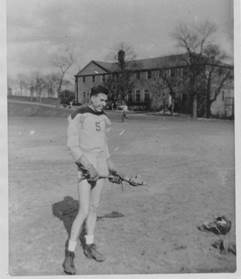
Ken in front of Jacobus Hall, Stevens Institute of
Technology,
early 1940s
Sophomore year was supposed to be the hardest year. My pattern over the school year was in
spring, I would practice lacrosse strenuously 2 or 3 hours a day so it would
wear me down so that I would go to my room and fall asleep. So, my grades would
suffer. Then in the fall I would really work hard and bring my grades back up.
My position in class standings would oscillate back and forth. The best I would
reach was 6th in the class in fall, then in spring season it would
go down as low as 30 or 40.
In sophomore year I also took an interest in playing baritone horn.
They had a small band that played mainly during the basketball season, which
was a good thing. In addition they had a
rifle team. They had a small range down in the shop where we did our heavy wood
shop/truss work for our shop courses. Adding these two distractions during my
college years just put more pressure on me and made it hard to keep my grades
up.
At this age, of course, your juices are really working, and I did some
things when you look back on them, are really crazy. My friend Frank Goodwin
and I decided we had better learn to dance. So we found an ad in the paper for
a dancing class over in Manhattan. So for a couple of months on a weekly basis
we took the subway train to Manhattan and take dancing lessons in Miss So-and
So’s dancing school.
Back to the surveying camp
We were broken up into surveying parties of three, in with Bob Welte
and a little Italian boy whose name was unpronounceable. Our instructor for
summer camp was an upper classman, a Russian expatriate whose name was Igor
Benson. He was very serious and didn’t have a sense of humor. Over the years I followed his career because
he worked for Kaman and Sikorsky and eventually became a well-known person. He
was the developer of the gyro-copter, a one-man helicopter. He manufactured
these for years and years. It was only in 1989 or 1990 he finally ceased
production. During one of our trips N or S from New England to Florida we
stopped in Raleigh, Durham NC airport and stopped to see him. He was also a minister in the Russian
Orthodox church and had a congregation and ran church services.
At the end of sophomore year, I applied for a job in the summer surveying
camp. They chose me to be the lead driver of the station wagon for the entire
summer, which surprised me since I had driven for less than two years. This
summer camp was not only for the 6 weeks of engineering camp but also had a
program for high school students who wanted to be assessed for their ability to
go on to college and choose a career, using a psychological testing service.
In conjunction with this summer session for high school students,
there were visiting lecturers. In many cases it was my job to pick them up from
the railroad station and drive them to camp. This was before there was a
superhighway so this was a strenuous activity. These visiting lecturers were
highly educated, with Ph. Ds, and it was an effort to keep a conversation going.
I was also pressured by the other students to to drive them places.
They pushed on me and pushed on me to take them somewhere at night, which I
wasn’t supposed to do. The camp director had a home not too far away so he
didn’t stay at camp at night, he went home …so these guys convinced me to take
them to Palisades Park over on the Hudson River, miles and miles away. I drove
them, the boys were rambunctious. When we got to Singack on Rte 23, going
through town, a woman was backing out of her driveway, I blew my horn but she
didn’t stop, and her bumper grabbed one of my fenders and damaged it somewhat.
Those were the days when people didn’t get so involved with insurance
claims, so we just ignored it and went on. The next day I had to dream up a
story about what happened, and it couldn’t include the truth about going to
Palisades Park. It’s something you never forget; it preys on your mind, but
there’s nothing you can do about it.
We got lots of good lacrosse practice that summer and it put me in good
shape for the fall season. So junior and senior years, I was a starter on the
varsity both years.
There were other activities I would have liked to have done. But what
I did was all I could handle. There was glee club, which Frank Goodwin was in,
and the dramatic society. In addition, there were the school publications, the
‘Stute and the yearbook, the Indicator.
I suppose from a psychological standpoint I wasn’t very sociable. The
things I took part in most were individual athletics, such as the rifle team
and the lacrosse team. In addition there were intracollegiate athletics such as
soccer and softball teams, and I participated in those somewhat.
This was during the Depression and most of the students were local,
from the New York and New Jersey area. Most of the students received some type
of financial aid, including a program in which they were paid for doing work
around the institute. The aid was for students with real need.
Fortunately I had no real need…however the College did have a point
system in which you were awarded points for grades and college activities. If
you accumulated enough points you were awarded money against your college
tuition. Over the years I got awards 3 of the 4 years. The total was less than $300, but that was
significant; it was about a semester’s tuition.
Frank Goodwin had some dimples on his face so he was universally known
as Kewpie. He and Ben Lewis lived in “the Castle.” I lived in Jacobus Hall,
just a few yards away. Ben was an
excellent athlete, a 3-letter man in his freshman year and was quite smart. But
unfortunately the pressure from so much athletics interfered with his studies,
so he flunked out of college after his sophomore year. It was a great
disappointment to all of us. In addition, he had a foot problem which saved him
from being drafted into the military.
We had our meals in Castle’s basement which was fixed up into a dining
room. Because I had a room facing east over the Hudson River, and it was cold
in the wintertime, I could keep some food on the windowsill. We had a strange
bunch living at the Cloves. Guy next to me named Sandblom a big rugged
Scandinavian, he played lacrosse, had strange habits, would often sleep during
the day and would wake up at
Down the hall from me were Jesse Boyce and Paul Schwinn. Jesse had
been a seaman and had his pilot’s license. He was very much a man of the world,
but also a loner. He worked very hard, very serious, before he had a girlfriend
on campus, one of the secretaries.
Down the hall was a tall lanky young fellow who was just not bright or
mature enough for an engineering school. He was in scholastic trouble all the
time. The guys in the dorm helped him when they could but it wasn’t enough. He
flunked out.
Bob Stanley was the son of the head of International Nickel Company
and was very wealthy. His father was a Stevens graduate and had been on the
board of directors. He was a playboy and extremely strong; did a lot of
weight-lifting and could do a pushup with one arm. He had a boat and spent a
lot of time in the boat out on Long Island Sound.
Bob flunked out but in later years went into some kind of mining work
in Canada. He kept in touch with the college and contributed money to the
college, and eventually was on the Board of Directors, believe it or not.
Kewpie’s family lived on Long Island, but his father had bought a
considerable amount of farmland with a beat up house north of Poughkeepsie. One
winter Kewpie got the idea of going up there during the winter. He got me and
Ben Lewis and Almond, who was a senior, to go. We drove in Adolf’s car and
spent a night or two. It was miserable. It was cold and there was lots of snow
and ice and the house had very little heat.
Kewpie was a social individual and joined a fraternity. I never
understood why, since he didn’t live in the fraternity but continued to
socialize with those of us in the Castle. He was in the Glee Club which had
concerts with girls’ schools and that was his way of getting to meet some
women. He was always trying to get to know a girl well enough that he could go
to bed with her. However, I don’t think it ever happened.
We had a machine shop professor named Mackenzie. He was a strange
character, very austere and serious. He didn’t care for our jokes and humor. He
was very proud of his car, a Cadillac. Most of the boys smoked, unfortunately.
He would remind us, quite frequently, that if the boys would give up smoking,
they could have a Cadillac, just like his. He also had a watch that was very special,
some type of chronograph. So we played jokes on him. We would collect a bunch
of loose metal and in the middle of class would drop it on the floor with a
great clang and say, “Oops, dropped your watch!”
One of our professors was named Apuhun; we called him Prunes. He was a
very direct, outspoken person. During lecture classes if a student fell asleep
he would toss a piece of chalk very accurately at him to wake him up. Apparently he didn’t get along too well with
the college management. His relationship with the college was strained over the
years, but we liked him very much. After our senior year he was separated or
was fired from the college.
Although Stevens was an engineering school, the students were required
to take an abbreviated English class all four years. It was only one or two
hours a week, and some of it was pretty basic, like rules of grammar and
reading a list of books. One of our professors was named “Fife.” He was very
effeminate and the rumor was that he was homosexual. He was nicknamed “Fifi.”
Another course, called Social Studies, revolved around history and
current events and met for just an hour a week.
There was a course in Economics that included reading annual reports and
balance sheets. The curriculum was so jammed tight that some classes, like the
engineering camp in Johnsonburg, had to be scheduled outside the normal class
schedule. In addition there were shop classes and we had to come back during
Christmas week to cover the extra work.
When the war started, a lot of change took place. Even before the war,
because of our Lend Lease program with England, I could see some change taking
place right outside my window. Ships were all repainted -- no more bright
colors. The cruise ship Holland America line got repainted dark gray or
camouflaged. When the U.S. actually joined the war, it changed college too.
Normally there was a senior trip to the industrial northeast to visit
manufacturing and industrial operations. But by our senior year that was no
longer possible. All the facilities were restricted.
In normal times, a senior thesis was required. Because they wanted to
speed our year up, this was dispensed with, and we graduated about a month
earlier than normal. I remember looking out my dorm window and seeing the Queen
Mary or Queen Elizabeth (ships) go by, painted a drab gray, and seldom sailing
in broad daylight. This was all part of the secrecy of shipping. Ships would
sneak in under cover of night. From my window I could see most of the piers
belonging to the big liners. We could see when they were in dock and when they
were not.
Gym classes were strenuous events. I had to take gym all four years
except during the seasons I was on the lacrosse team. We had a prescribed
series of accomplishments to make during the four years; to run around the
track above the basketball court in a minimum time; climbing a rope up to
rafters of the gym; parallel bar exercises; horizontal bar exercises and the
horse (gymnastics) and we had floor mat exercises where we had to do various
types of flips and rolls. Those were difficult for me, because I was long and
angular and didn’t have the short density spring needed to do these. During the
fall and spring when the weather was good we were required to play games and
become somewhat conversant in soccer and baseball, not so much lacrosse or
basketball. Students who were not athletic had a very difficult time.
There was a Jewish fraternity on campus, and even though Jewish
students in those days usually went into social sciences and the arts, some of
our smarter students were Jewish. The
Jewish students mostly kept to themselves, but not entirely, it depended on
their personality. At that time there
was considerably more anti-Semitism than in later years, particularly in the
cities. No one said any thing officially, and I could be wrong about this, but
I had the feeling that Stevens may have restricted the number of Jewish
students enrolling.
Right below my dorm there were two tennis courts. You would have
thought I would have played tennis, however I never did.
I earned a little money in the summer after my junior year by working
for Curtis Propeller over in Clifton. And I had had the driving job in the
summer after my sophomore year. So I took some of this money and during the
summer bought an old 1934 Ford convertible. It sounds very exotic, but it
wasn’t. I think I paid less than $100 for it. It was in really poor shape. It
had a fold down canvas top, also in poor shape.
Richard helped me work on the engine. Ford had a transverse leaf spring
which ran across the front underneath the engine, and was nestled in a stamped
out channel that was part of the frame. It was typical of these Fords that
after bouncing around for a few years and rusting, the top of this channel
would break out and the spring would come up through. You could still drive it
that way, but it obstructed the hole to reach the crank, the one used to crank
the engine over by hand if the starter didn’t work. I didn’t know that when I
bought it. I decided to fix it, and took the whole front end apart. I bought a
replacement channel in a parts store, then we found the old channel was riveted
into the frame. I had to cut all the rivets away with a cold chisel and hammer,
and bolt the new one into place, then rebuild the whole front end. It was a
learning experience.
Alan Diefenderfer and his sister Ruth lived next door in Montclair.
One evening he and I and Ruth went to the movies. A thunderstorm came up while we were inside
the theater, and a huge bowl of water collected in the sagging top of the
convertible. By the time we left the theater, there were 7 or 8 gallons of
water stored in this sag. We got in the car and tried to roll the water off by
pushing up on the canvas top -- and it ripped right down the middle, and the
whole load of water came down on our laps.
I can’t remember exactly when I got rid of the car, but it was after
Madeleine and I started dating. One
weekend I visited Madeleine at Poughkeepsie. Going there, the car drove fine.
But it was old and the wiring was going bad. Driving back that night, all of a
sudden the headlights went out. I couldn’t drive at night without headlights,
so I pulled over. I had had trouble before and had some substitute fuses, but I
couldn’t make the lights work, so I stopped at a gas station on the highway and
slept in the car. I didn’t do too much driving anyway because being wartime,
everything was rationed, particularly gasoline. I didn’t really need a car.
While Richard and I were both still in college, he bought an old
motorcycle, which my parents had not allowed him to do. He rode it home from
Troy. It was a piece of junk. When he got about 15 miles from Montclair, it
started leaking gasoline and caught fire. There was nothing he could do but get
off and let it burn out. This was after we had bought the old Chrysler, so we
had a car at home. He called home and we went out to get him. Richard rode the
motorcycle and we towed it all the way home. The motorcycle was badly damaged,
but we took it apart, set it up on blocks, without a muffler of course, in the
back of the garage, which was right near the Diefenderfers house and would run
it in the garage as we were fixing it. I
guess we were a real pain to the Diefenderfers.
In the middle of my senior year, just a year after the war started, my
father died suddenly of a heart attack (December 1942). I was at school and I remember Paul Schwinn
had to give me the bad news. I immediately went home. It was a difficult time
for the whole family -- Jean and I were still in college, and Richard and
Adelaide were working. I still have the papers from the time we sat down and
worked out a budget. Because of the war and the rationing, everyone had to be
very careful about spending. It’s hard to realize how tight things really were. We set up a grate in the fireplace in the
livingroom and burned coal in the grate; we didn’t have any firewood to speak
of. According to Richard’s calculations, they had to keep the temperature in
the house around 65 degrees in order to make the oil ration last. It was very difficult or impossible to buy
tires. Meat was rationed and sugar was rationed.
Adelaide did some babysitting on the side. She babysat for a couple and in the course of
the babysitting she discovered the husband had a storeroom in the cellar full
of tires and other rationed goods. This really upset her, although there was
nothing she could do about it, or nothing she did do about it.
During the summers when the war was on, some of the time I was up at
Smith’s farm working, and we would see these MD licensed doctors every week
going from New York up to the Catskills with their rationed gasoline. That also
irritated a lot of people.
Jean and I were far enough along in college that with Richard and
Adelaide working, it was possible for us to continue and graduate without any
interruption. In spite of this tremendous change for my family, the spring
season of lacrosse was a great accomplishment for me. Our team was undefeated
all season, and of course all the members of the team got these little gold
lacrosse sticks. It was probably the first undefeated team they’d had in
decades.

Lawrence family reunion, about 1943: L to R (standing) Harvey Andrews,
Elaine Barnes, Richard Lawrence, Uncle Ken Lawrence, unknown woman, Madeleine
Hulst, Ken Lawrence, Phil Lawrence. Seated, L to R: Bobby Sue Lawrence Andrews
holding Sharon, Aunt Elena (Uncle Ken’s wife), Dorothy (Phil’s wife), Gladys,
David and Roger (Phil’s children). Front: Adelaide.
Graduation was sort of sweet and sour. Because of the war, everybody
had to jump right from their studies either into the service or to work. There
were no vacations. And most of the seniors were in the navy program – V12 I
think they called it – so that they had to go immediately into the naval
service for the duration of the war. I had already signed up to work for
federal telephone, which was a division of IT&T. In preparation for that,
in my senior year I took a course in electronic engineering that I scraped
through. There was not a lot of choice of what you did after graduation,
because you almost arbitrarily had to go to work in a defense industry and if
you didn’t have a car, you couldn’t buy a car. So you had to go work somewhere
that you could reach by public transportation, and that was quite limiting.

Ken’s graduation from
Stevens Institute of Technology, 1943. Left to right: Jean Lawrence, Adelaide
Lawrence, Gladys Allen Lawrence, Richard Lawrence, Aunt Dorothy Van Klebe, Aunt
Elena (Uncle Ken’s wife), Ken in graduation gown, Uncle Phil Lawrence,
Madeleine Hulst.
FIRST JOB and JOINING ARMY
I started work in May, and commuted by bus from upper Montclair to
Grove Street and then took another bus down Bloomfield Avenue to – I don’t
remember the name of the street – but a bridge that crossed over to east Newark.
The federal telephone plant was in the old Clark thread mill. These were old
brick buildings with wooden floors all soaked in grease from years and years of
operating in fabrics and threads using machines driven by leather belts and so
on. It was summertime so it could’ve been somewhat pleasant. Lunchtime I went
out and sat on a bulkhead on the Passaic River and watched the dirt flow by. It
was a strange situation where there were a few engineers and I was working for
a guy in his seventies who had worked for Western Electric and he just came
back to work because of the war. He was long retired, a very laid-back,
intelligent individual. Most of the women working there were relatively young
and they were doing sort of, I don’t know, piece work or what. At any rate they
were very unskilled. The product we were making was called telephone repeaters
for the signal corps. These were field telephones that were used by the
military for transmitting messages. These women were paid something like 13
dollars a week as I remember, which today is ridiculous. Anyway, the strange
part of it was, down the street there was a bookie, some shop where they would
take bets, gambling bets on horses or whatever was running, and these women,
getting 13 dollars a week, would go down there and put down some of their money
on gambling.
I was by nature a very conscientious individual, and of course very
interested in the progress of the war. There was a steady diet of going away
parties for young men who were working in the plant where I was. This kind of
got on my nerves. And every one in a while we’d be asked to work a little
overtime or do emergency work to produce more of these telephone repeaters
sets. And the women would waste the solder which was a dear item, very hard to
get. I was sort of given the responsibility for working as the liaison between
the drafting engineering floor and the production floor, back and forth with
engineering changes and trying to get the women to be less wasteful and more
accurate.
Many times, however, these telephone sets that we built would start
piling up in the corner somewhere and you’d wonder what was going on; we worked
overtime to create these things, of course spend extra money, and then they
didn’t go anywhere for some time, a week or two weeks at a time. So I got the
feeling that we weren’t really accomplishing a whole lot. And I had the
mistaken notion that I could make a difference somewhere else. So eventually,
around October, I got fed up with being deferred for this engineering job so I
volunteered to go into the service.
Well, early in the summer I had gone down to Newark, where they were
recruiting SeeBees for the Navy. The people being recruited were middle-aged
men, physically past their prime but experienced in construction work. I
figured I ought to be able to fit in there somehow. So I went through the
interview and testing. I knew wearing eyeglasses might be a problem. So when
the guys lined up and took the eye test, I watched the eye chart and tried to
memorize it so I could read it without my glasses. It worked right up until I
was next in line, and they changed the chart. So at any rate, for either that
reason, or being underweight, or having ear problems or something, I wasn’t
accepted, and that depressed me.
This situation continued till October, and I volunteered for the
military, and I sort of assumed I’d get the same treatment. They came and they
called me to go down to one of the recruitment stations – I think it was an old
armory. I didn’t take anything special with me; you didn’t need anything if you
were going home again.
I found I went right through with flying colors – ears, eyeglasses,
underweight. Apparently they didn’t give a damn. Or they needed people badly,
one or the other. So anyway I went through and decided not to bother going
home. I went right off with the recruits’ boss and I think they took us
straight to Fort Dix. And there of course they issued all of our clothes, so
you didn’t need any clothes, and I began to get my first taste of the way they
do things in the army. They interviewed each man to find out where he would
fit, where his experience would be most useful. When they came to me I found
that they used a manual, a huge thing, like a telephone directory, which listen
occupations. However, this was for
enlisted men, not for officers; there were two different books. I said I was a
mechanical engineer, and they looked through the book, but there were no
mechanical engineers listed because normally they would be officers. The
nearest thing they could find was “mechanic,” so they assigned me to be a
mechanic – that meant ordinance and going to Aberdeen.
But things move slow in the army, and I was stuck at Fort Dix for a
week or two. They tried to get you oriented to things – you know, stand in line
for meals, and more physicals. They had a project they wanted to do: they had a
field they wanted to use for some kind of training exercises and they wanted
somebody to survey it. Naturally I volunteered for that. We had some ordinary
little transits and levels and stadia rods and I had one or two guys helping
me. We went out and surveyed the whole field and laid out contours so that you
could make a map of it. And I guess that was the last bit of engineering work I
ever did in the army.
Of course, my mother and Madeleine were very upset at me going off so
abruptly, but eventually they got over it.
New recruits were assigned to training companies,
and that meant getting into a a company that was starting basic training -
that’s probably why it took a while. Eventually I was assigned to Aberdeen. I
can’t remember just how we got there but I assume it was on the Pennsylvania
Railroad, which ran right by both camps. When we got to Aberdeen, I was
processed and assigned to a basic training company. These training companies
were situated around a huge athletic field, in buildings that resembled
tarpaper shacks. They were one-story long like a big chickenhouse, just wide
enough for two bunks end to end with an aisle down the middle. There were
probably four barracks to a company and probably 30, 40, 50 men to a barracks.
They were heated by coal stoves, the coal stoves of course were in the middle
of the aisle – three or four of them for the length of the building. Of course
they weren’t insulated. We were given a box for a footlocker and a bunk, and a
little shelf overhead and that was it. At one end of the building I guess there
was a shower – I can’t remember it too well – a shower and toilets.
By this time it was around November, and getting
cold. You slept with your head under the window and your feet by the coal
stove. If you were lucky you weren’t right there, you were further away, but
some people really had a bed with a hot foot and a cold head.
It was hard getting used to the army. Most people
are used to making their own decisions and thinking for themselves, and that
was what was forbidden. And in addition, this army was sort of left over from
the Depression, when the only people who were in the army were people who
couldn’t get any other kind of a job. So it was a strange conglomeration of
men, mostly between twenty and thirty-five years old. Pretty raw people -- crude, arbitrary, dictatorial. And of course
the idea was to break you and make you succumb to everything, and they worked
at it hard – they worked at it overtime. Our first sergeant in charge of the
company, under a lieutenant, was kind of a psychotic individual. He would start
out in the morning in a bland sort of a way, and as the day went on, things
would irritate him. Somebody would do something wrong and he would shout at
him. Somebody else would do something and he’d shout louder. And I’ve seen
times where, over an hour’s period, he would just fly into a rage and his face
would turn red and he’d cuss and shout and threaten, and then put penalties on
everybody, make us run around the field, all kinds of …
The training itself didn’t bother me, because I
was in relatively good physical shape, though I didn’t like the cold weather.
But we got plenty of exercise. You’d be doing something physical for an hour of
two, and then you’d be in a class building for another hour or so. The biggest
problem there was that you’re out in the cold for an hour or two and your body
would adjust to it, and then suddenly you went into a warm building and sat down
and were supposed to listen to a lecture.
ARMY – FIELD TRAINING – CADRE SCHOOL –
Then we went into war, long before D-Day. By this
time the people being drafted were not typical of the early ones – I was
twenty-three and most of the other were even older. There were a few young ones
but not too many. They were all people with work experience, and because it was
ordinance there were people from car repair shops and gas stations and so on.
And there was a smattering of bank clerks and shoe salesmen and teachers and
whatnot. Some of them were pretty sad.
Training was only six weeks. It was very rigorous
-- there was the daily training and classes, and learning to handle the weapons
and clean them. The classes were repair – engine repair – and maintenance. We
learned small arms fire and were taken out to a rifle range, where there was a
spirit of competition amongst the companies. At the rifle range they gave us
basic instruction, and then there was testing, through a competition between
the companies.
The rifles we were using were model ‘03 – in
other words, designed in 1903 and used in World War I, and we were still using
them in World War II – so there was bolt action. The bolt was operated from the
right side and this was very awkward for someone left handed. So they tried to
make me use the rifle right-handed. Well, I explained that I was left-eyed,
left-handed, left-footed, and there was no way I could shoot from the right
position. They would have persisted, except that I told them that if they
wanted to make a good showing on the range, competing with other companies – they better let me do it my way because I
was a good shot, and I had been on a rifle team at college. So they let me
operate that way. The only problem was when you got into rapid fire, the breech
of the rifle got hot, and when you reached over with your left hand, you tended
to burn your wrist.
Aberdeen was a permanent station, a huge place of
many square miles. It had the training areas with temporary structures, and
also a research area where they did ordinance testing of vehicles, guns, heavy
weapons, machine guns, and so forth. There was an engineering section, and a
permanent residential area for the “powers that be” that ran the station were housed.
These were, in many cases, individual homes just like any suburban, very nice,
with lawns and so forth. ‘Course they used the enlisted men to keep them up.
So we saw very little of that part of the
station. The rifle range was in an entirely different area, so far away that
you had to take a little train to get there. The train pulled wooden cars that
must have been built around 1880. They had a little head – they had a wood
stove or a coal stove at one end of the car.
Another area that we eventually got into was
along the Chesapeake Bay. The train runs on several miles of bay front with a
shoreline characterized by a series of little inlets and gullies – deep gullies
– kind of high bank, and these gullies went down and up and down and up –
thirty, forty, fifty feet. So they made an obstacle course, in which they’d
hang nets down over one gully and ropes up the other side. The guys had to
shimmy down the ropes, climb up the nets and over the top, in and out. Some
guys could hardly handle it, and there were stories that fellows had got to the
top of one of these nets and then fell off, cracked their heads, and were
disabled. So it was a bit scary.
Another scary area of basic training was what
they called the infiltration course. This was a very large field with sort of a
bunker set up on one side, and platforms with machine guns scattered across
this edge. And at the far end of the field was a trench, in which you could get
down and be protected from any machine gun fire. So the procedure was for the entire
crew, maybe 30 or 40 men at a time, to be let down into this trench at the far
end of the field. The field was relatively level, except that it had shell
holes here and there, and barbed wire other places, and pieces of logs strewn
across here and there. So the machine guns were fixed by horizontal plates, so
that they could not go up or down, and they were set to fire so many inches
above the ground – I don’t know exactly what it was, I don’t want to scare you
with how much it was – but there was enough clearance apparently that you could
slide on your belly over a log and back onto the ground and still not get hit.
So we went through that, and it was pretty scary -- at one point I was crawling
over rough undergrowth. In addition they planted little blocks of explosive,
wired so they could be exploded remotely, in some of the shell holes, so we
were warned not to go into the holes.
From so many ear infections over the years, and
with the infiltration course and the rifle range, any time I went through that
stage of training, I ended up deaf for about a day or two. And you crawl, crawl
over this business – and of course we had helmets on and all our equipment. It
took five to ten minutes to get across the field. You came right up into
another trench right under the muzzles of the machine guns.
So I never had any particular trouble with this,
but some guys were so scared they’d lose their helmets and of course they had
to be very careless – some of them would get hysterical and stand up, and they
just stopped shooting.
One of the men I remember in particular was a
bank clerk, he was of normal physique, but very unathletic, and apparently
never did anything strenuous. So with cold weather coming on – we were getting
into December, and we were outside a lot – in fact one of our trainee exercises
was to go out for two days into a remote part of the camp and put up our pup
tents and eat field rations and somehow survive the cold. Most of the guys,
like myself, were trying to make the best of the situation. So we’d scout
around and we’d scour up some old newspapers, cardboard, cardboard boxes and
all that, and we’d try to fix ourselves up a little more comfortably. Well, it
turned out this was forbidden and no matter what we did to make things better
they would come and take it away. This one fellow went out on the rifle range.
He had a cold, and I guess he got the flu, and he got sicker and sicker. They
forced him out on the rifle range, and forced him to shoot, and the poor guy
was so sick he could hardly shoot the rifle. ‘Course he couldn’t hit anything.
And we complained, but they would just beat down on the guy. Finally he had to
go to the hospital. He never recovered enough to stay in the service; they
discharged him. But that was another example of pushing people beyond their
limits.
At all training camps they had the usual routines
of assigned duties that were rotated among the men. The main ones were KP duty
and guard duty. Guard duty was just boring, tiresome, and if you had a real
cold spell, of course you’d freeze your tail off. These were always at night,
and that meant wandering around with a rifle on your shoulder for two hours on,
four hours off. And every once in a while some officer – smart aleck - would
come up and challenge you, make sure you knew your orders and were doing your
duty, and so forth. These were not right around camp; these were out in the
woods somewhere.
KP was terrible. There were various parts: one
was peeling potatoes, and it was all done by hand, with a knife. After we fixed
the potatoes and served the meal, we cleaned up afterwards. These buildings
were all wood – wood frame, barn frame type of things – huge things where you’d
sit several hundred men at a time. They had wooden floors, and every day – in
fact maybe it was every meal – they would scrub down the floor. Well, you can
imagine scrubbing down a wooden floor several times a day, year after year.
What a mess.
Food preparation was done in huge volumes, some
of the vats that we prepared food in, potatoes and so forth, would probably
hold twenty gallons or more. And the worst job of all was cleaning the grease
traps. All of the effluent from the kitchens trapped through grease traps to
take that out before it went to the septic systems; there weren’t any sewers as
far as I know. That was used as a punishment – if anybody acted up or got in
trouble with the noncoms, they were assigned to clean the grease traps.
There was a young guy who was, well, just a wise
guy, but there was nothing wrong with him; he could’ve developed as a normal
individual. But he just couldn’t keep his nose clean: he would talk back to the
officers, he would object to this and that. And so they started riding him and
riding him, and instead of backing down and not going under, he would get more
obstinate and more obstinate. Well, this finally just about destroyed him; they
sent him to the – not the brig, it’s called the brig in the navy. Well anyway,
they put him in jail, and I never heard later what happened to him. But they
turned a guy who might’ve been a good person into a bad person.
At the conclusion of basic training, we were sent
to technical training, which was actually working on the vehicles, engines,
carburetors, you name it. So there wasn’t nearly as much outdoor work as in
basic training. At the conclusion of technical training was what they call
field training, when the whole company was assigned – I can’t remember the time
element, but it seemed to me like it was three weeks, maybe that’s too long –
we were assigned to convoys of military vehicles, and we took off for Camp
Picket, Virginia, which was probably a hundred and fifty miles away And of
course, they wouldn’t let you go through Washington and Baltimore, so we went
by back roads, down through Port Royal.
Along the way was a very rudimentary camp. It had
a few permanent buildings but was mostly just pine woods, named after some
general, AP Hill. We parked the trucks in a line on a very rudimentary road in
the woods, and found a place to pitch the pup tents. The way the pup tents were
made, each man was issued essentially a half, and if you put two halves
together there was room for two guys side by side. If you put four halves end
to end, four guys could sleep in it and be out of the weather. But of course,
with four guys there wasn’t room for anything else – you couldn’t even get your
bag inside.
At AP Hill, we learned another training exercise
where one company was pitted against another to fight each other and rout the
other one if possible. We started out on foot and our commander had some bright
idea to go down what was essentially a wood road or a trail, parallel to the
main road, and just a few feet away from it. But unfortunately, the opposing
company commander had decided to make things hot for us, so they installed explosive
charges in the trees up and down this wood road. And our commander didn’t know
that. So we’re out there – this is all at night – and we’re going more or less
single or double file down this road. And all of a sudden all hell broke loose:
bam, bam, crash, explosions, the helmets flew off the guys heads. It was just
an utter rout and everybody ran to get away from all this. Needless to say, we
lost that battle.
Camp Picket was a permanent base with a big army
prison. But we didn’t see any part of the base while we were there. They took
us in convoy; we parked in the pine woods and set up the field kitchen, where
they prepared food for most of the meals; and parked our repair trucks around a
certain area. Our job was to go on and do what kind of repair work we would be
doing overseas. This wouldn’t have been too bad; of course if it were summer it
would have been mosquitoes and flies; this was winter, so it was ice and mud
and snow and freezing. And we’d line up for meals, and we had these little
field eating utensils: a pan and a knife and fork and spoon, a canteen, that
kind of stuff. We’d get our food; even if it was hot, by the time we got ready
to eat it was cold. And then of course, every once in a while it’d be raining,
and it’d rain right on our food. And there was no place to go, no building, no
big tent, nothing. You’d just go back and hide in your pup tent. Well, several
weeks of that was more than enough.
And another strange thing happened during this
one – you know, at that time the military was segregated, black and white, just
like the old days; we were not integrated. As I recall, going through basic
training, there were no blacks in our company. But then in field training, I
was assigned to three other guys – put our four halves of pup tents together –
and one of them was black. Well, didn’t bother me any, but it was just very
strange, because it was strictly out of the pattern of their operations. I
never found out how that happened.
One of the problems in the winter was –
especially because this was Virginia, which is a miserable place in the winter,
it’s either mud or ice – and during the night, it’d rain and sleet and freeze.
One morning, we couldn’t get out of our tent; it was frozen – everything was
frozen together. We had to tear it apart.
One of my favorite GI’s at this point in the
training was a fellow older than I named James Lawrence, a schoolteacher from
Kentucky, very level-headed, serious, intelligent – ‘course he was a college
graduate; he was a rarity in the whole company; there weren’t more than two or
three college graduates.
When we finished field training we were done with
the fundamental training and next would be assigned to a permanent company. At
this point in the war, at Aberdeen they were not forming any new companies to
be shipped around the world as a unit, rather everyone would be sent as a
replacement for someone in existing companies. Some were sent to Camp Reynolds
in Greenville, Pennsylvania. Those who had superior rating from their training
(‘course with my college background I did well on all the written stuff) had
the option of going on with training at what they called cadre school; it was a
school for noncommissioned officers. I decided to try it, see whether I could
handle that. So I was sent to a new area in Aberdeen for training
noncommissioned officers. It was very intensive; there were numerous
instruction buildings, teaching aids and so forth, since these people would
become then, for the most part, instructors, or replacement noncoms in other
companies.
I think that training was eight weeks, from
around the 1st of February or March – to the 1st of May.
And it was intense. A lot of it was learning how to train people. We had to
conduct drill training and marching and rifle handling and so forth. That meant
you had to learn to give commands. Well, I didn’t have a very strong voice, so
that was a real strain; I and other people would be out there, after training
hours at night, out on this huge football field, barking orders, back and forth
and back and forth till we were hoarse.
Another part of it was giving instruction. We had
to pick a subject and then, as a test, stand in front of a class and instruct
the class. I found that very difficult, but somehow I squeaked through. And at
the end of it, I passed the course, got whatever little piece of paper they
give you. I had a chance then; I could have gone on to officers’ training
school, although I doubt I would have passed the physical. But at the same time
while we were training, officers’ training school was in the adjacent area to
us, so we could see them training daily, and the things they went through were
even worse than ours. By that time I’d had so much training I was just fed up
with it, and I was looking for something different.
Part of our training was a little field work – we
went out in the woods on the base and were instructed on handling explosives.
After the instruction, we were each handed a block of nitro starch and a fuse
and a plastic cap, and told to go off and blow something. Well, you know, we
did this, and one of the things the guys learned to do was prime a cord, which
was an explosive fuse. You could wrap it around a tree several times, and when
you detonate it, it would cut the tree off; the tree would fall down.
We were living in the woods, and so there were no
toilets; we had what they call a slit trench for a latrine, and this was just a
long trench dug in the ground – and you stood over it and did your bit, and you
know, it was a stinky mess. So one enterprising soul put his block of nitro
starch in the slit trench, and blew it up. And of course, that was a stinky
mess too.
Another option we had at this point was a special
bomb disposal squad training school right next to our – or very close to our –
cadre school. So we had watched these fellows train, and there was a certain
beauty to that arrangement, because … like six or seven men, every one of them
was a noncommissioned officer, and then there was a commissioned officer in
charge – a lieutenant. And these people were together permanently, and they
took leave together, when they had a vacation they took it together; any
assignment they did was together; they trained together; and they went overseas
together. There was a certain beauty to that. But being as I pictured myself as
somewhat of a nervous nature, I thought and thought about it quite a few
nights, and finally decided that it wasn’t very smart for me to go into that
because I figured I’d have a nervous breakdown.
So I was assigned to a training company in field
training but this time it was about May, and so the weather here in Maryland,
Virginia was getting very warm. The field training company I was assigned to
had a routine of going down to Camp Picket for three weeks and doing their
field work and coming back. Well, I had done mine in the winter, so that’s all
I knew about. And then I had to take a group, be in charge of a squad, and go
down there in the summertime. Well, it was quite different and just as bad as
winter in the other way: hot as blazes, mosquitoes and flies; we camped in the
woods.
We were supposed to be doing mechanical work on
the vehicles. I had all the mechanics training but a lot of the men in the
group – the instructors – were ex-garage mechanics, and particularly the
sergeants and master-sergeants were typical of garage mechanics: they always
knew the answers and they were never wrong, and this was not my nature.
Consequently, there immediately developed a friction between me and my superior
noncom because I would sometimes say “I don’t know,” or “I’m not sure,” and
this was not acceptable. So we argued a lot, and I went through two encampments
in two three-week periods. Finally I had enough of that; I couldn’t get along
with this guy. And since he was going to stay on, I was going to leave. So I
reapplied for overseas, and at this point I was sent to Camp Reynolds,
Pennsylvania.
I did get home off and on during training, and
saw Madeleine and the family.
Camp Reynolds, since it was all replacements
going to other companies, the only thing you did at this place was get ready to
go. That meant they would check your eyes, your eyeglasses, and your teeth in
particular. Any physical handicaps had to be taken care of at this point,
before you could go anywhere. In fact, there were a few people who didn’t speak
very good English, and they had to study English. You could not go overseas
unless you could read and write.
Well, this camp was just a miserable, long,
drawn-out affair. There was no training, you were just there until you got
everything fixed up or until you were given an assignment. There was nothing to
do except there was ____ movie theaters. So I spent the whole two, three weeks
there, pulling guard duty, KP, and going to movies. Guard duty, KP, and going
to movies. We’d get a camp bus – there were about six or eight movie houses –
we’d go from one to another to another, trying to find a movie we hadn’t seen.
Finally I was assigned to a company in Fort Sam
Houston, Texas, [medium automotive maintenance company]. And it turned out that
because I had been in the army longer than any of the other guys being shipped
to the same place, I was put in charge, even though I was still a private. At
the academy school, the ranks we got were temporary, and when we left we lost
them, unless we got the same rank in our final assignment. So I was put in
charge of about eight men, going into this company 35-47th and the
end company at Fort Sam Houston. Most of them were younger than I am, one of
them was older: Paul Cignoli from Springfield, Mass. So these guys, of course,
I didn’t know ‘em from Adam, but they didn’t know me. But I was in charge, and
I didn’t know what kind of people they were. Eventually we got to know each
other very well, and most of them were from the northeast.
So we had to go by train, and I was supposed to
keep track of these guys. We had papers of course, directing us. We had to
change trains in St. Louis; well, I had never been to St. Louis in my life.
There was this huge, huge railroad station, like Grand Central. We got there (and
it was a civilian train, not military) and we had several hours of layover.
Well, there was the problem: these six or eight guys all want to do different
things, and I wanted to do nothing, except pull together. I couldn’t do
anything with them; they just broke apart and scattered; a couple of them
stayed with me, fortunately. And there were military police all through the
station, as usual.
When the time came to go, I tried to round these
guys up, and one of them had gotten into a bar and was drunk. So we got up
together, and we dragged this guy along (‘course, being drunk was against the
rules, too) and we had to practically carry this guy through the station, by
the military police, and onto the train. Well, that was the end of our problem,
once we got on the train, and we got to Fort Sam Houston.
This was now late September and San Antonio was
still quite hot; cooled off a little at night, but the days were blazing hot.
So we got introduced to this company of about a hundred and twelve men with
four officers, first sergeant, master sergeant, with a bunch of staff sergeants
and corporals so on. Since we were the last to join the company, we were
nothing, we were privates; and there was no place to go, which was kind of
disgusting. There were just two college graduates in our crew, except for the
officers. The other one was a Jewish fellow, kind of obnoxious; and he
immediately latched onto me as being a kindred soul.
Well, we went through a certain amount of
training, and as usual, apparently at each new camp we went through, no matter
what your records say, they would assume you had not been through the
infiltration course; and they would assign you to go through the infiltration
course. So we did this again. Fort Sam Houston, of course, was out in the desert,
and there’s cactus and all these other things. Well, for the first time in my
life I went through one of these courses at night. Talk about scary; not only
did you have the barbed wire and the logs and the shell holes and the cactus,
but they used tracer bullets on the machine gun. So you could see the bullets
going by, and that added to the terror of this thing.
The company was supposedly fully trained; the
only thing that was holding them up was several of their members had been sent
away to learn to read and write. Almost all of the company – three-quarters –
were Southerners, and they were still fighting the Civil War, so that was a
constant irritation. And in addition, they were heavy drinkers, and carousers;
but they could sing, there were three or four that had their guitars, and they
loved to sit up and night and play and sing all these little Southern ballads,
and drink, and play cards, and that was about it. There was very little
training going on. Every once in a while we would go on a hike, and we would go
through our vehicles and go through our tool chests – everybody had a tool
chest – we’d get out there in the sun and by the numbers, they’d dump all the
tools out and put them back; dump them out and put them back; and check them
off.
One of the exercises we had was tear gas
protection. Of course, everybody carried a gas mask. Whenever we went on these
hikes, we had everything: a life pack, a gas mask, a steel helmet, rifle and
cartridge belt, and a raincoat. So here we are in October, daytime hot as
blazes, running down a trail in the woods somewhere, and then some guy would
run alongside with a tear gas bomb and spew it all the way up and down the
line; give you no warning at all, so you had to hold your breath, close your
eyes, and get your gas mask out and try to get it on before you were crying a
mile a minute. And of course, you had to put on your raincoat, too, and it was
hot as blazes.
The other exercise we had was a campout in the
boondocks, in the desert. Well, this was kind of interesting, because I had
never been in Texas before, and there were rattlesnakes and other things. We
pitched our pup tents, and this one morning I woke up and looked outside and
there was a strange creature waddling along by the tent. It turned out to be an
armadillo; I had never seen one of them before in my life either.
Some of these guys in the company were really
disgusting, even the family men. They would go out at night to a section of San
Antonio called Snake Hill, which was where a lot of women – camp followers –
lived in apartments and so on. And they would drink and they would get in
fights and there would be knifings, and so on. They would come home to the
barracks, and of course they’d pee all over the floor, and another guy set his
mattress on fire and woke us all up; we had to open a window and push his
mattress out on the ground outside. This was typical behavior of a lot of these
guys.
Finally it came time to be shipped, and we were
assigned to go east; that is to Europe. So to get there we had to go through
Camp Shanks in New York State, which is just above New Jersey border. It was
interesting traveling: they used ordinary freight cars, the kind that had a
sliding door in the middle on each side. The bunks were attached to the
stanchions crosswise rather than lengthwise on the train. So as the train
rocked, you’d drift sideways, back and forth and back and forth. Trains didn’t
go very fast, and every so many hours, they would stop at some station and
everybody would have to get out and do calisthenics, and this was how we got
our meals, also. The meals were prepared at these stops; we didn’t have any
food on the train.
There was warm weather, and the train went
slowly, so for the most part we kept the door wide open and then just dangled a
link chain across the opening so you wouldn’t fall out accidentally; but you
could stand there and watch the scenery go by.
We had to go through Chicago, and like the hogs
and the cattle, we went through the stockyards. We parked overnight, I believe,
in the stockyards, and then the next day we went east, I suppose on New York
Central. I don’t recall how long it took, but anyway we ended up at Camp
Shanks, and there we were assigned barracks, and were told that if we had more
than so many days before we embarked, we would be given a pass. Well, those
days passed, and then they told us we were ready to be shipped, so we never got
a pass.
A few of the guys, like me, were from the New
York/New Jersey area. I wasn’t about to do anything rash, but one or two of the
guys climbed over the fence and took off. When they called the roll, they
weren’t there – this was at night. They sneaked back in the middle of the
night. The next morning they were asked where they were; ‘course they couldn’t
say they’d gone out, so they said they were staying in the WACs (Women’s Army
Corps) barracks.
Just before we were ready to embark, I developed
a severe toothache in one of my wisdom teeth and I didn’t want to end up on the
boat with a toothache, so I went to medics and they said, well, go down to the
dental building, somebody will take care of you [at a] certain hour. So I went
down there. It was this long building, almost like a barracks, with about ten
or fifteen dentist chairs lined up. Nobody in there but one man, one dentist.
So he sat me down and looked at it, said “Eh, your wisdom tooth is pretty
rotten; I’ll have to pull it.” Of course, he was an officer, a lieutenant; and
he said, “Piece of cake; I’ll pull it with one hand.” Well, he got onto it, and
he pulled and he huffed and puffed, couldn’t remove it. So then he got his
knees up against my chest, both hands on the pliers, and finally yanked it out.
So I was in bad shape, and of course I couldn’t eat that night; only thing I
could take was a little bit of soup.
In the usual fashion because everything was done
semi-secretly, right, we left at night, in the dark. We had to pack everything
we owned: barracks bag, backpack, rifle, gas mask, helmet, cartridge belt,
everything; and carry them. That was just about as much as I could handle. We
walked to a nearby railroad side and got on the cars. It was so hard to get
these packs on, we didn’t dare take them off; so we hunched up in a seat, pack
in back of you and your duffle bag at your feet, and rode from Camp Shanks down
to Weehawken.
At Weehawken, we got off the train and they put
us on a ferryboat, just an ordinary, open-car ferry, the kind that in those
days went back and forth to Manhattan. But there were no seats on the
ferryboat, and no doors: both ends of the boat were wide open, with just a
chain across so you wouldn’t fall in the water. The boat went tearing down the
Hudson River, that cold air ripping through there, no protection whatever. It
went to Staten Island and at that point we disembarked from the ferryboat and
ran a gauntlet of Red Cross women who were doing their bit. And here you were,
you had everything you could handle in your hands and they were trying to hand
you a cup of coffee or a cup of cocoa.
ARMY TO ENGLAND – EUROPEAN ADVENTURES
From a long warehouse, the soldiers headed in
line to the gangplank going up to an old freighter. It was steep. With packs on
our backs and duffle bags on our shoulders, we were practically crawling up the
plank. Up on deck, there were hawsers, lines, hoses, strewn all over the deck;
it was a God-awful mess. At one point I tripped and went down, and somebody had
to help me up; I just couldn’t get back up myself, with all the gear.
They directed us to the hold on the ship where we
went down a ladder. Down one flight was the washroom-latrine, and down the
second flight was where we slept.
I found out later the boat was called a maritime
commission design C-3, developed during the war to try to improve U.S.
shipping. It was about the size of a Liberty ship and not much different. It
wasn’t built for passengers but for cargo. Where the men were bunked in the
bottom hold, there were pipe bunks – that is, pipe frames fastened from floor
to ceiling, five bunks high, and the bunks were just canvas laced into the pipe
frame. Whoever was on the bottom bunk was just out of luck because everybody
dumped on him. He had to crawl down and dig his way into the bunk. There was no
place for our belongings, we just had to pile our junk wherever we could.
I thought about the folks at home and what they
must be wondering. Here I was off on a new adventure, self-imposed but not
always welcome, and of course wondering what was next.
As was usual during the war, nothing moved in
daylight. The boats would get loaded, then pull out into New York Harbor and
just sit, sometimes for a whole day until they assembled enough for a convoy --
boats always went in convoys. We moved out at night and by the time it was
light we were out of sight of land.
Life aboard ship was a new experience, everything
was done by the numbers. The mess where we ate was down in another hold; in
order to get there, we had to climb out of our hold, through the latrine
washroom, and up onto the deck. Every deck had a combing, a six-inch rim around
every opening to keep the water from sloshing down. We’d come up on deck, cross
it, then climb down another ladder to the mess hall. The food was sort of
synthetic; potatoes were dried, powdered and mixed with hot water, not very
appetizing.
Aboard ship, we noncoms tried to take charge and
keep order. We were supposed to get certain shots for overseas work. Well, we’d
had some shots already, and at every camp they’d say, “Oh, maybe you need some
more shots; we don’t want you to miss anything.” But by this time I was very
good friends with Ed Jacket, a Lithuanian boy, and Paul Cignoli, an Italian boy
from Springfield, Mass. We were fed up with the shots. After we’d been out at
sea a few days, a storm came up, a big storm, with monumental waves -- forty or
fifty feet. I’d never seen anything so big in my life. The other boats in the
convoy would disappear behind the waves. During the storm we were told to line
up and run the gauntlet and get some shots. Fortunately, our first sergeant,
who was in charge of the company, was sickest of all, and he didn’t get over it
for the whole trip. So they didn’t really know what was going on; and Ed Jacket
and I made up our minds we weren’t going to get this shot, so we stayed down on
our bunks and didn’t go. Later on, the first sergeant checked his records and
called us up and said, “Where were you for the shots?” “We were there, we went
right through.” “How come it didn’t—” “Well, you were too sick, you didn’t see
us.” So that was the end of that.
Everyone was sick, including me. For several days
I couldn’t eat a thing; I’d go to the rail and heave, and then go back down.
After a few days I thought maybe I could eat, so we’d go up to the deck and
over to the mess hatch, and open the doors and start down the rail, and the
smell of powdered potatoes mixed with hot water would come up from the mess
hall, and we’d throw up again. So for several days I couldn’t eat at all.
We left New York around the first of November; we
were on board something like eleven days and landed on the former Armistice Day
– November 11th.
When we left the States, we left our weapons
behind --we weren’t carrying rifles. Just as well, because there wasn’t any
room for them anyway.
We landed at night at Plymouth, England, which is
west of Southampton and London, and we had to sit on the boat for at least a
day, maybe two, waiting for transportation to show up. To avoid the bombing we
left late at night. We disembarked with all our luggage and boarded a passenger
train, which took us toward the north of England. We arrived by daylight at a
place north of Manchester, a town called Ulverston, on Morecambe Bay, just
about opposite the isle of Man. It was kind of a seaport and manufacturing
town.

Ulverston is near Morecamb Bay on west side of
England,just south of the Lake District
We walked from the railway station, in the middle
of town, to our billets, which were in a public school, just an ordinary group
of buildings with classrooms. The toilets were outdoors and there was no water
in any of the rooms. All the windows were covered with paper for the blackout,
and everybody went to bed early.
It was November 12th, and being in the
northern part of England, it got dark by about
We were in a rather small classroom, with double
wooden bunks made for Englishmen; they weren’t long enough for most of us. They
had straw ticks, and the only way you could sleep was with your feet hanging
over the end. (Fortunately, at that age we didn’t have the prostate problems we
have now!) If we couldn’t last all night without going to the bathroom, then we
had to get up in the dark and find your way outside, no lights out there. We
had to feel your way to the johns. There were probably forty men in a room,
must’ve been very unhealthy-- no windows open, air circulation.
We tried to keep busy. We were waiting for our
equipment – we were going to be given all brand-new trucks, trailers, shops
trucks, mess trucks, weapons, tools, and so forth. Our mornings were occupied
with drilling and hiking out into the countryside – that was kind of
interesting. And a strange thing – we were there approximately six weeks, and
during the six weeks it rained every day for forty days. Sometimes just a
misting, but there was never a dry day the whole time. Our afternoons were
partly free, and we played a lot of touch football on the school’s fairly large
grassy play-area (it was an elementary school).
There was no place at the school to bathe.
Finally we learned there were public baths in another part of town, half a mile
away. The baths were in a concrete building, open, with no heat in it, no
doors. And no hot water, just cold. After we got really filthy, we couldn’t
stand it anymore; so we’d assemble in squads and take our towels and march down
to this place. It was the most miserable, cold, frigid bath I’d ever had in my
life. I think I bathed once or twice in the whole six weeks.
We were assigned guard duty and KP, but even this
was a relief to have something to do. As our equipment began to arrive, it was
all covered with Cosmoline, a dry, greasy substance that all tools and weapons
were dipped in to rust-proof them. We had to de-grease them, clean them, scrape
them and bathe them in solvent. In addition, once the trucks and trailers were
in working order, we began to work in practice convoys. The
It was the middle of November. Down at sea level,
where we were, it wasn’t too bad; it was cool, but it wasn’t bitter cold, and
there was no ice – yet. Most of the local people had some kind of vegetable
garden – there were still greens growing, like Brussels sprouts and cabbage and
broccoli. We got the equipment assembled and began to practice convoys. Well,
we couldn’t go too far along the coast, so we would go up into the hills. Most
of the GIs in my group were from the South and had never seen ice and snow
before. As soon as we got up in the hills, we checked the map and found we were
on the edge of the Lake District -- a lovely, mountainous area, with hills
going up as high as three thousand feet. And bare, no woods, no trees, because
they always had sheep on them. So we began to drive up in these areas, and as
soon as we got five or so miles from the coast, we began to run into snow and
ice. And we had more trouble with these guys who had never driven on that before.
They damaged a lot of equipment, we’d jackknife, and wreck the hitches, and
damage the trailers.
Somewhere in the vicinity of our town was an
aircraft assembly plant, moved way up to the north to get away from the
Germans. We could hear them running the engines day and night, assembling and
running them and testing them.
Ulverston had a movie house and sort of a public
dance hall. So we went to the movies as much as we were able, and we went to
the dance hall, fiddled around with the girls who were from that town. There
was a church, right in back of the school, a graveyard by it – of course an
Anglican church – and I went to it several times. It was intriguing, because
the entrance to the church – the tower – had been built somewhere around ten or
eleven hundred A.D. but the rest of the church was a little more modern. There
was a widow who owned a house not too far from there, and she was very kind to
the GIs. Periodically she would invite a group to her house for tea, and I went
once. Also, she would let the fellows bathe at her house – she actually had hot
water, warm water, once in a while. Tea consisted of tea and a little mutton
pie – terrible stuff, but that was the best they had. Sometimes we gave them
some of our rations because things were very short.
I’m a little fuzzy on the exact dates, but right
around Christmastime – I recall Christmas was no big deal – we got ready to
move out. We were all outfitted and ready to go; we even had the machine guns
mounted up on the truck turrets, but we had no ammunition. And we had rifles –
I don’t think they had any ammunition either. So we started our convoy south,
and I’ve never been clear exactly where we were, but because of the war, all
the road signs were removed, so there were absolutely no road signs. The only
way you could figure out where you were – they gave us hand-drawn directions to
guide us. So we drove all day and part of the night, and we came to a British
army camp and they said, well, we could stay the night there. So we settled down
in this British camp, in bunks, I guess. I remember we ate in the mess, and it
was awful, really awful. The guys could hardly eat the stuff.
Now we were inland, and it was cold, with snow on
the ground. The officers insisted that we set up a security guard. So here we
were dead tired, having driven for fifteen, twenty hours or so, and they wanted
us to march around in the dark with a rifle on our shoulders.
The next day, we took off on the final leg,
headed for Southampton. We got started all right, we drove and drove and drove;
finally we got to a point where we knew we were near the south coast, but we
didn’t know where we were and there was no road sign – we were trying to follow
some rough directions. After driving for a couple hours, I realized we’d gone
around a big circle. So we had to stop and get more directions. Eventually, we
got to Southampton and were put up in a barracks right there in the port.
Again, we had to wait on a convoy –we were to
cross the English Channel, and nobody went during daylight. We sat there for
about three days, and New Year’s Day came and went, with no big celebration.
Finally we were loaded onto a ship –a real Liberty ship – at night, and went below decks – there were
bunks down below. There was no heat on the ship, and here it was, first of
January, cold as blazes. All we could do was hunker down in our blankets. We
sat in the ship for a whole day, and then finally, one night, we took off on a
little convoy to Le Havre.
Well, it only took a few hours to cross, so we were
there the same night. At daylight, we were still there, and we couldn’t unload.
It was kind of rough, and Le Havre had been thoroughly bombed and damaged, so
there was apparently only one dock working. Ships had to take turns at this
dock. We sat there three days, in the bitter cold. I can recall the day we
would climb up onto the deck and there was a steam pipe going across the deck;
fed some winches; and we would stand on the steam pipe to keep our toes from
freezing. Worse that that, there were no toilets on the ships. Up near the bow,
they had built a wooden bench with sides on it, parallel to the railing, and it
was up a couple of feet above the deck. And it led out to a scupper – a hole –
in the side, and if you wanted to go, you had to climb up on this thing and
squat, and go. Well, that was enough to constipate anybody; I think I was
constipated for four, five days. And then once a day they would get out a fire
hose and hose down this latrine bench to clean the mess up.
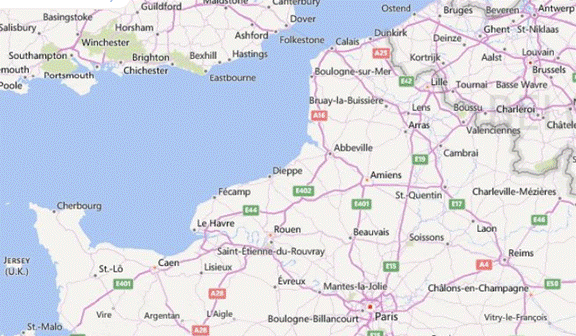
After crossing the English Channel from
Southampton to Le Havre, Ken’s company was sent to Roubaix-Tournai and
Tourcoing, cities near Lille and the border with Belgium
We couldn’t understand why we couldn’t land. We’d
see a little pilot boat come out from the dock, and the pilot would come by our
ship, and the ship was rocking and the wind was blowing, and he would shake his
head and say he couldn’t land, and he’d go back to the dock again.
After three days, we were towed to the dock, and
landed. They had to take all our trucks and things off with the crane (hoist),
which took a good day or so, but we finally got everything unloaded.
We arranged a convoy and we took off to the
countryside outside of Le Havre where there were farms. A GI kitchen had been
set up, and a big tent, a couple of tents. And that’s all there was, it was
just a parking strip along the highway. It wasn’t paved, so when it was frozen
it was okay, but when it thawed it was mud.
We stayed there two nights. For our meals we went
into the kitchen tent and got our rations – I think we had something hot at
that time. And then we went back to the trucks and there was just nowhere to
go, no way of getting any heat.
One night, the guys sat up all night in the
kitchen tent. They would take a sea ration can and put a little gasoline in it,
and light it. So this tent had all these little fires going in it, very
unhealthy. Strange, in the morning when we got to look at each other, everybody
looked like a negro because his face was all black from the carbon
Another night I tried to sleep in my truck, but
the back of the truck was stacked with engines and rear ends and axles and so
forth, all in crates. There was about a foot or a foot and a half clearance
between the top of the crate and the canvas cover of the truck. I tried to
sleep up there, but of course I was freezing – it was somewhere below freezing
with ice and snow everywhere, and I got frostbite on my toes. We’d try sitting
in the cab of the truck and run the engine a little bit, generate a little
heat. Of course, the trucks didn’t have any heaters in them, this was the good
old days. I knew I was really hurting, so the next night, I had spotted a big
haystack between our parking strip and a farmer’s house. When it got dark, I
sneaked over to the haystack with my ___ gas masks and my rifle, stuff like
that. I dug a hole under the haystack and buried myself down in there. Believe
it or not, I had a real comfortable night’s sleep. The only thing, of course, I
was afraid somebody would come along and stick me with a pitchfork or
something, so I told Ed Jacket what I was going to do and told him to call me
in the morning, so I wouldn’t be left behind.
The next day we took off for Belgium. I guess
wartime is always like this, I had the feeling nobody really knew what they
were doing. The officers were anything but leaders, they were just sort of
reacting, and guessing what they were supposed to be doing, and orders were
never very clear. Any rate, we took off with the whole company convoy, heading
for Brussels.
It’s not too far, I don’t recall whether we slept
on the way or not – but when we got there, they found out they really didn’t
want us there, we didn’t have any assignment there. So the one night, they
billeted us in a concrete grandstand, built for horse racing or soccer or
something. It was a big stadium, all concrete, and underneath the stadium there
were sort-of rooms, but they weren’t really rooms, they weren’t paved, just a
dirt floor.
The guys made themselves comfortable as they
could in these quarters. Of course, stories went around that there were a bunch
of dead Germans buried under there, and so forth. Made it more comfortable. It
was so cold that Ed Jacket and I put all our blankets together and we slept
together, as close as we could. That’s the only way we felt we could stay
alive.
Next day, we headed back to Le Havre, to some
other assignment. It was still morning, and very foggy, and we were back in
France – At one point the convoy was kind of strung out, and suddenly, behind
us, I heard a boom boom boom boom boom, and a whole string of bombs went off
across the highway we had just driven over. Fortunately, they didn’t hit
anything; they hit some people’s houses but they never hit the highway, and
because of the fog it was never clear who dropped the bombs: whether it was us,
or them, or a mistake, or what.
We had an Irish guy from Brooklyn in the company
who was a real hothead. He immediately jumps out of the cab, cocks his rifle,
and points up at the sky, says “Where are they, where are they?” Course there
was nobody there. Some civilians were injured, but beyond that, there were no
consequences.
So we went on, and we finally were assigned to a
small town outside Le Havre called Harfleur, and we were given a chateau to
live in. It sounds nice, but trouble is the chateau had been completely gutted:
there were no windows, and there was no heat, and there were no doors; just
rooms. I think there were about three floors. So they took part of it and set
it up as a mess hall, kitchen section and so on. We picked our own rooms – and
there were no beds, so we’d sleep on the floor or on blankets.
Well, GIs, one thing they do have is ingenuity,
and they don’t willingly accept everything adverse that’s thrown at them if
they have a choice. In the States, we usually didn’t have a choice; we had to
do things by the numbers. But overseas it was a little bit different. In the
first place, the officers weren’t on our backs as much, they were a little more
cognizant of the fact that they depended a little on us, as we did on them.
So we started scrounging around the town. We’d found a little scrap wood, and managed
to nail together some bunk frames, we actually made beds for ourselves. Every
big room had a fireplace in it, so we scrounged a little coal. At one point, we
were called down by the officers because the mayor of the town came around and
said we were stealing from him, which I guess we were. At any rate, we got
chewed out for that and we had to give up some of the things we had scrounged.
There was an old bombed out brass foundry not too
far from our billet, and we were supposed to work on GI vehicles, mainly the
Ducks, which were the water GMC six-by-sixes or four-by-fours – they were built
so they would float. They were used as cargo carriers for unloading ships that
couldn’t get into the port. So they were running these Ducks back and forth and
back and forth. And they would just run them until they stopped running, they
didn’t do any real maintenance on them. When they stopped running, they’d call
us, and we’d take the wrecker down to the port and drag the things up to the
foundry there and try to figure out what part had gone bad. We didn’t do any
fine repair work, we just replaced all the sections, like we’d replace the
axle, we’d replace the engine, things like that.
Again, we went weeks and weeks without bathing,
and in that cold weather, the dirt just got ground into your skin. Our skin was
dry as a bone to begin with, and we’d get black all over, it was disgusting.
Finally we heard that there was a GI bathing place somewhere in the city. So
they took us in squads to this place, it was like a steam bath – it was hot
water. Well, there wasn’t any place to put anything, you just took your clothes
off and dumped them in a corner, went in and bathed, come out, dried off, and
put your old clothes back on again.
I had one bath there, and then somebody got the
bright idea that hey, we could have our own shower at the chateau. They looked
on me as the technical expert – some of the guys knew I was supposed to be an
engineer – so we took a couple of jeeps and went down, drove down to the
waterfront at Le Havre, where there had been a lot of apartments – some of them
probably luxury apartments – bombed out, nobody living there, with all the
plumbing and wiring and everything just hanging out in the air.
So we went through these apartments and scrounged
enough pipe that we thought we could make a shower and the water heater out of,
and we dragged all this stuff back to the chateau. While we were down at Le Havre,
I got going through one apartment, and it turned out to be the home of some
gemologist. Well, anyway, he was a collector of some sort, and he had case
after case after case full of stones, seashells, and various very fancy rocks,
formations. Honestly, I didn’t know what it was, but I knew it was probably
valuable. I confiscated a few of them and I don’t remember what happened to
them. But the place was a shambles, you had to climb up and down through the
beams because the stairs were shot. Actually it was kind of dangerous, but we
didn’t worry about those things.
Back at the chateau, we had welding equipment and
guys that were good welders, so we picked out a back room and – I can’t
remember whether we had … we must have had a running water supply – but at any
rate, they depended on me to tell them how to run the pipes and hook them onto
this tank that we had salvaged for hot water storage so that it would heat and
circulate and fill the tank with hot water. ‘Course, I was technically an
engineer but I was a neophyte at do-it-yourself stuff, and I hadn’t – yet –
gotten into household plumbing and wiring so I really was guessing at what I
was doing. However, they put the thing together – and I don’t remember what
they used for heat; could’ve been coal – and it worked. So we had a hot shower,
but even then it was few and far between with over a hundred men.
It was cold as blazes working in this foundry
because it didn’t have any roof over it, and it was midwinter. Because we were
support-type troops, ordinance and so forth, we didn’t get issued the winter
clothing that the army had developed for ski troops, mountain troops, and
frontline infantry. We just had the old-fashioned issue clothing going back
probably twenty years, and it really wasn’t suitable for this winter weather.
We suffered quite a bit.
We had two or
All of this organizing and moving around was
occurring during the latter stages of the Battle of the Bulge, and in fact we
were originally starting in Texas and were supposed to be shipped over in a
hurry in order to relieve the service troops who were heavily involved in the
Battle of the Bulge. But bureaucracy and logistics and so on were just plain
slow: getting together, getting there, getting in place and so on.
Well, after a few weeks in Harfleur, we got
orders to move up north onto one of the main east-west arteries that carried
the supplies from ports in Antwerp, Brussels, along the English Channel coast,
into the interior of eastern Belgium and western Germany to supply the troops.
So it was a regular, I think they called it something like the Red Ball
highway. It was big tractor trailers loaded with supplies, equipment,
ammunition and so on, going back and forth and back and forth on these rather
poor roads. There were a lot of breakdowns, and we were sent to a town up on
the Belgian border – actually in France – Roubaix-Tournai; north of louise??
, and we were to set up a maintenance shop over there to repair all the army
vehicles that were breaking down.
So we moved up there in a regular convoy, and I
guess when we got there it was pretty much up to the officers to scrounge and
try to find places to live; the army didn’t really have things organized in
such a way that anything went automatically at all. The first night or two, the
only place they could find for us to stay was some kind of old mill, where we
were up in the attic over the rafters and everything was wood, piles of
sawdust, old wood products and whatnot. It was a terrible place.
We only stayed there one or two nights, and then
they took over a bombed-out apartment house in Tourcoing, and it seems that
area had been under the British jurisdiction; they weren’t too happy to have us
coming in there. Well, we appropriated a bombed-out apartment nobody was using,
and they had a lot of arguments about it, I remember. And sometime we thought
we were going to lose it. But we didn’t, and I think it had three floors; it
was one of many apartments all built side by side that opened right out onto
the city street. There were no windows, of course, and there was no heat except
for a few fireplaces. So we got set up with mess facilities and …
Unfortunately the quarters that we had were some
six or eight miles from the shop that we were set up in – this was an old cloth
warehouse, not clothing but fabric warehouse, that had been pretty well
damaged. It was empty, and there was a driveway into it, and then it branched
out. It was kind of tricky maneuvering the vehicles in there. We did all right
for quite a while, but we were doing all repair work, and at that time they
decided I was a better clerk than a mechanic, so I had a little office with
this blonde French girl and another guy, trying to keep all the records.
Everything that came in of course had to be done on a work order, and we
learned an awful lot.
We had tractors, tractor trailers, ambulance,
jeep, Dodge 4x4s, GMC 6x6s, and even motorcycles. They liked the motorcycles
because they could road-test them. For a while – and this was about February,
March, and April – after the motorcycles were repaired, somebody would go out
and road test them. I got to do that once or twice myself, it’s the only time I
ever rode a motorcycle. But this being an old French city, it had cobblestone
streets and trolley tracks up and down the streets, and of course they were
very slippery. And one of the officers took to road testing motorcycles, until he
had an accident and injured himself. So after that they banned the road
testing.
When these vehicles came in, in order to make up
the work orders and so forth, we would go through their glove compartment, look
over their papers, and sometimes we ran into some very funny things like the –
I think it was called – the
(audio tape interruption)
…concrete tank, supposed to be full of water, I guess they used it for
fire protection. One time we found some hand grenades that somebody had
carelessly left in their vehicle. When nobody was around, we unscrewed the
trigger mechanism and dumped out most of the powder--the explosive—and screwed
them back together, pulled the pin and tossed them into the water tank. There
was only a minor explosion, but it was interesting to see what would happen.
We took a lot of black and white photos of things. One of the drivers
was either very careless or he might have been drinking – was maneuvering the
vehicle and took out one of the main posts that supported the roof, and it all
caved in on the truck. It made a huge mess. I took some pictures of that, which
I suppose we have somewhere. It looked like the effects of a bombing, but
actually it was the effects of lousy driving. We had to clean all of that up
and repair the roof and put in new posts and try to make the place workable
again.
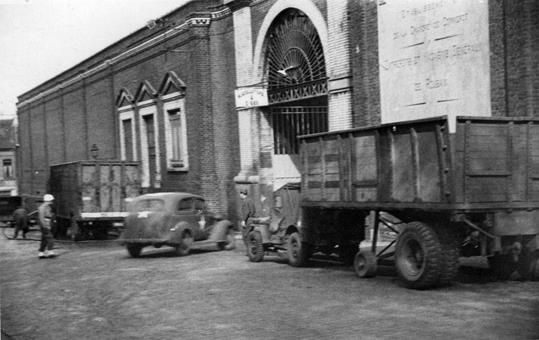
Shop, Roubaix, “Before”

Shop, Roubaix, “After”
With our living quarters so far away from our working area, the
discipline got a little bit lax; there was a lot of going back and forth and
there had to be a guard on duty at night both where we lived and at the shop.
We employed a few Frenchmen to help out around the place. Paul Cignoli could
speak a little French, so we got to know some of these guys fairly well. There
was a lot of monkey-diddling going on; of course the war was still going on,
and everybody was still trying to survive, so there were all kinds of black
market activities going on.
Near our living quarters was a public hall where they held dances and
political meetings. It’s strange, you’d have thought right in the middle of the
war, that politics would be pretty well defunct, but it wasn’t. They would hold
a public dance, and it would actually be partially a political gathering.
Between dances, somebody would get up on a platform and start to harangue all
the Socialists and whatnot, Republicans. I guess the people were interested in
it, but we just stood around and waited for it to be over.

Our billets, Tourcoing

“To work” Tourcoing
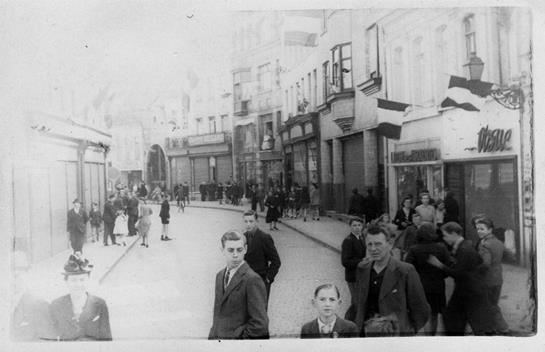
VE Day, Tourcoing
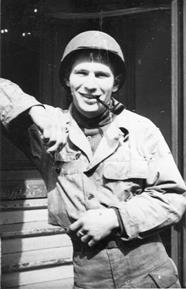
‘Jokoll’ Tourcoing

VE Day, Tourcoing
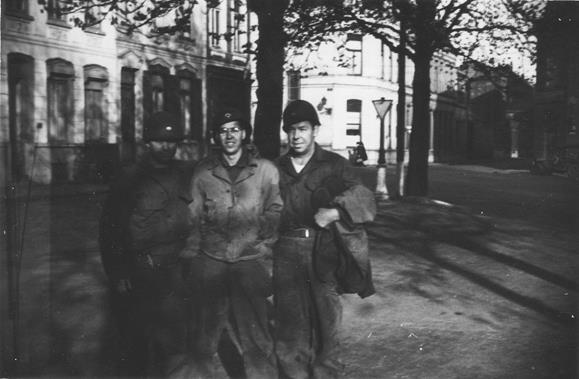
Ken with Johnny Howe, Tourcoing

Ken Lawrence
After a month or so in this area, they decided they needed more help
further up on the main route to the front, so they took part of our company –
about one third of it – and moved them to Charleroi, Belgium, which was
probably fifty miles away. This meant we had to take our small company of men,
divide our shop, trucks, and personnel; our officers and mess facilities, and
operate two places. However, that made things interesting; every once in a
while business errands would require that we run up to Charleroi, and I went up
there several times. In the middle of the war, they were still running a dog
track up there, dog racing - unbelievable.
Back at Tourcoing, some of us took the trolley car and went right into
downtown Lille. The trolley crossed the countryside on tracks like railroad
tracks. The thing that struck me was that people had been so oppressed or were
so depressed, they’d lost so much, that all the common decencies were lost. It
was particularly noticeable on public conveyances; people would push and shove
and swear, and dump people off. Just crude and rude. I probably shouldn’t
criticize, because we didn’t go through what they did.

Beer wagon, Lille
There were one or two Southerners in our company that we eventually
decided were in the army to stay out of prison. They were rough, tough, and
well, just different. After several weeks, somehow we got word from other army
units that the mess rations had included ice cream. This was at the end of the
war, about the time the Germans gave up – and we never saw any ice cream. So
they started doing a little police work, and they found that one of our
Southern boys who had been trucking the rations from a depot to our mess place,
was selling the ice cream on the black
market. That put him in a bad light! The punishment for major infractions was
to be sent to the infantry, and so they sent him up to the infantry. But since
the war in Europe was about over, I don’t suppose it made much difference.
As soon as the Germans surrendered, the U.S. military set up a series
of encampments in eastern France, one of them at Rheims. Our shop and convoy and all our equipment were soon closed
up and relocated to Camp Brooklyn – each of these camps was named after some
U.S. city. These were huge affairs, using the old square – I think they were
sixteen-foot – square tents. And we had canvas bunks so it was reasonably
comfortable. It was May so it was warm.
Our camp was located on a World War I battlefield. We had nothing much to do there, so we’d go
out and explore. We found the trenches still there from World War I, pillboxes,
shrapnel, and so forth. It had been so devastated in World War I that it was
never reclaimed, never brought back into agriculture.

Camp Brooklyn
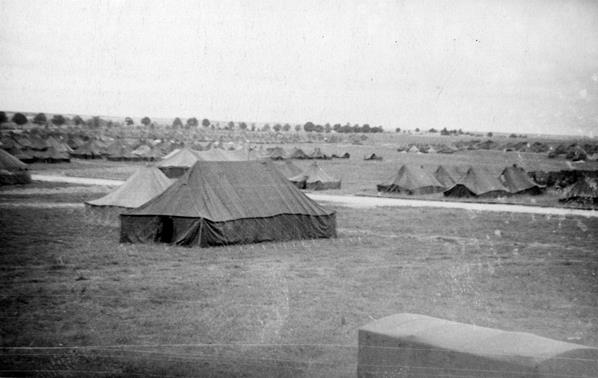
Camp Brooklyn

Ken at Camp Brooklyn
I did get off with some of the guys once to see Reims Cathedral, which
was an exhilarating experience. Also, groups of the men were given passes to go
to Paris, a few at a time, to stay three days and then come back. So Paul and
Ed Jacket and I and another guy named Coleman – four or five of us – went
together. We stayed in a famous old French hotel, and saw the usual sites, did
an awful lot of walking, all the things that France, and Paris, were known for.
The art museum at the Place de la Concorde was closed, it was all boarded up,
so we didn’t get to see that. We did get to the Notre Dame Cathedral and the
Arc de Triumph and Sacre-Coeur and Place Pigalle– that’s where the girls hang
out – and L’Opera. And then there was another, rather modern construction that
must’ve been built just prior to World War II, a very large, open, sort of
avenue extending away from the Place de la Concorde, with hundreds of steps
going up to some governmental building.

Reims Cathedral
For almost a year now, each company had been issued a couple of sets
of barber equipment, but they were hand clippers, no electric. So for about a
year I had been cutting the hair of five or six guys that trusted me. Of
course, we all had mostly butch haircuts anyways. I got pretty good at it, but
when we were in Camp Brooklyn, there was a prisoner of war camp there, full of
Germans. One was a barber, so they would let him come over to our company area
and give haircuts. I guess the guys paid him a little something, but it was
kind of a nervous experience, because this guy was an enemy, a prisoner of war,
and here you were letting him work with a pair of sharp shears and clippers and
razors.
Every French city we were in had a firehouse, and every fire
department had a tall, tall stone tower connected with it. And we found that
these were used for hanging their hoses when they were done working at a fire;
they had some hoist system that would connect their hoses and links that would
just reach to the top of the tower, and they would hoist these up so they would
drain and dry out.
This camp life was deadly, boring, there was nothing much to do except
go over your tools and go over your tools and go over your trucks. There wasn’t
even a place to play ball. After a few weeks, we got new orders to go to a camp
down near Marseilles, I think the name was Arles. We left our trucks and we were put on a train to go down to
Marseilles. These were little bitty cars, wooden cars with wooden seats, wooden
luggage racks over our heads. And I think we were on that train about three
days, but there was no place to sleep except on the floor or on a bench. Some
of the guys wanted to sleep on the luggage racks over our heads. The train went
so slow that every once in a while we’d get out in the agricultural areas and
we’d go through a vineyard. The guys could actually jump off the train, run
over to the vineyard, pick grapes and run back and climb on the train again.
That’s why it took three days.
The camp at Arles was quite a few miles outside of Marseilles, and
maybe six or seven miles from the Mediterranean coast. It was high, windswept,
and dry as a bone. There was a little more activity there: there was a USO, and
they served beer once in a while. There was kind of an amphitheater built into
the hillside where they could put on shows. And once in a while the Red Cross
would come through or something or other. And once or twice we got to go down
to the Mediterranean and wade in the water; at that time it was pretty clean.
In the meantime, we were put about crating up what little tools and
things we had, small arms and personal stuff, because we didn’t have the trucks
anymore. But we did quite a bit of crating, and because the guys’ memories was
long on what was hard to find, we found that the guys were assuming that we
were going to see these crates again someday, so they were stashing away
particular toilet paper, souvenirs, pistols, swords and whatnot.
We were finally told that we were going to be shipped to the Pacific,
to take part in the final days of the war there, and after quite a few days of
uncertainty, they took us down to Marseilles and we were loaded onto a ship by
the name of General Richardson. This was a real ship, not just a little old
Liberty ship; this was built for passengers, so it was quite large, several
decks, and a good deal better than the one we came over on. However, we still
were jammed in several tiers of canvas-type bunks. The nice quarters up on the
upper deck were reserved for the nurses and the officers. Well, this kind of
irritated some of the guys, and by this time, it was early September, and the
Mediterranean, it was quite hot. Down below the decks, where our cots were, it
was terrible, humid, hot, stinky, so some of the guys would sneak up on deck
and sleep out in the open, right out on the deck on their blankets.
At this time, of course, there were no more convoys, so a boat could
proceed at its own pace. Whereas it took us ten or twelve days to get over on
the first troop ship to England, this boat only took something like eight days
to go back. But midway across the ocean – we went through the Azores, which was
interesting, got a little look at the islands – halfway across the Atlantic,
they told us that our orders had been changed: we were still going to the Philippines
but first we were going to Boston.
Well, that wasn’t too great, but at least it was better than going to
the Philippines.
So we pulled into Boston and I don’t remember the details of it, but
we were shipped to a camp on the Miles Standish – something outside of Boston –
and we were given a leave of a couple weeks anyway, several weeks’ leave. So we
got stuck around the camp for several days until we could get a troop train
going down to Jersey.
MARRIAGE and LAST MONTHS IN ARMY
I’m kind of vague on this – but I got home and found that Madeleine
had been real busy. We had been engaged for over a year and had been serious
lovers for some time before I went overseas. So when I got back Madeleine was
in a real hurry, and I found myself getting married within a week.
That was a tough week, because I was home at my mother’s house and
Madeleine was at her mother’s house. Her mother was well-organized, and when I
look back on it, we got off real easy as far as weddings go. The war was just
over and I didn’t have any other clothing, so I got married in my uniform, and
Alan Deifenderfer, the best men, was in his marines’ uniform. Now that I see
what our kids go through to get married, I’m really grateful that we didn’t
have to go through that.
Getting married is one of those confusing times in life, where
everything is happening so fast, so many decisions to make, and so many
questions about whether you’re doing the right thing, that you really only want
to go through it once. We were married at Madeleine’s church, Reverend Schenck officiated,
and after the wedding we had the dinner at Madeleine’s mother’s house, a very
large dinner, attended by all kinds of relatives. After the wedding, Madeleine
and I borrowed my mother’s car and through her friend Aunt Irene Mitchell, we
had gotten a cottage in Simonsville, Vermont, which is probably about twenty
miles from the Connecticut River.
Going back for a minute, we were driving my mother’s car, of course,
and we went up the west side of the Hudson to Kingston – or was it Albany? I
can’t remember. At any rate, we stayed at the Governor Clinton Hotel. Although
we had a reservation, I can remember we were both feeling kind of nervous,
thinking that they would think that we were just a couple of lovers out for the
night.
The place in Vermont where we stayed was a string of little cottages,
and there was a main house where there was a dining room. Because it was late
September, we were pretty much by ourselves, and the elderly woman that ran the
place also furnished the meals. It was a pretty strenuous vacation. The leaves
were changing and it was cool and dry, and I don’t recall it raining at all.
But we hiked quite a bit, walked through the woods in general, and then came
back and rested and made love several times a day.
The only town nearby of any size was Chester, so once or twice we went
over to Chester in the evening, and there was a movie showing. And about that
time all the summer visitors had left so there was no one left but the natives.
This was before the days of fall foliage tours, so we felt very conspicuous,
being young and strangers, but we survived.
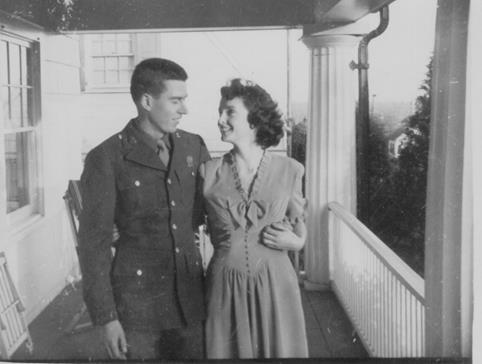
Ken and Madeleine Hulst engaged January 1944

Wedding, September 26, 1945. L to R: Ken and Madeleine; Margie Hulst;
Jeannette Hulst Johansson; Lillian and Joe (George) Hulst
After the honeymoon, we moved in with my mother because I was the
first in the family to be married, and Richard was in the Pacific by this time.
I guess Adelaide was living at home, and Jean – I’m not sure if she was working
at Buckhill Falls by that time. At any rate, it wasn’t an ideal situation, and
on top of it, my position was uncertain in the military, since they weren’t
about to let me out. They were working on a point system, which depended on how
long your service was, and how much time you spent overseas, and a few other
things. So I was still in the Army for six or seven more months.
And of course, living at home with your wife and your mother and your
sister subjected everyone to some strain and stresses, and I can recall that I
was always very uncomfortable. And I don’t recall whether Al Deifenderfer was
home next door yet or not; he’d been in the marines for most of the war but had
never left this country. Since he had become an instructor and spent
practically all his time in the South, he had acquired some bad habits,
drinking and carousing amongst them. And he was forever trying to get me to go
out and carouse with him, which I occasionally did, to Madeleine’s great
annoyance.
My orders kept changing, I guess they were trying to make up their
mind what to do with our company. They extended my leave to at least a month,
but I finally got orders to report to Camp Carson in Colorado Springs,
Colorado. This was where the ski troops had originally trained. I thought I would
do as I had heard other people succeeding in getting air transportation with
the military. I tried it, went down to the Newark airport and hung around the
military sections, trying to get an opening to go to Colorado; however, I
didn’t succeed.
At any rate, I ended up taking the train to Colorado Springs, at an
altitude of about 6,000 feet. It was now November, and the days were quite
cold, sunny and dry and our only real recreation was walking and playing touch
football. This turned out to be short-lived exercise because after a few plays
and runs we were so exhausted we would just fall on the ground, breathless.
At this camp, I made the acquaintance of a fellow Easterner, who was
very large, appeared to be slightly overweight, maybe a little bit effeminate.
But he loved to hike and climb, so the two of us occasionally took off for
Pike’s Peak, which was miles away. We never got to Pike’s Peak, but the
foothills were within walking distance. We would walk over trackless pastures
and through some rough brush, no paths whatever, to reach the mountains, maybe
two or three miles away, and we’d start climbing. We’d got up a thousand, two
thousand feet or so, pretty high, and there was no habitation there. We went
through one ranch, but there were no paths, no hikers, and no rest stops, no
water, no nothing. When we got tired of this, he enjoyed finding a boulder,
would dislodge it, start it down the mountain. It’d just be like a rubber ball,
bouncing down the mountain, wham, bam, bounce way out into the air and on down.
Fortunately, there was nobody there at all – so no harm was done.
To keep us occupied, the Army gave us some options. We were allowed to
choose whether or not to go back to school and where to go. Being in the
ordinance, one of our choices was to go back to Aberdeen and take another
training course. So naturally, since that was closer to home, I chose that, and
we were sent back to Aberdeen somewhere around December. By this time, it was
winter. We were put into a training company which was a mixture of overseas
veterans like ourselves and new recruits, not a very good mixture, really. But
they put all the veterans into one barracks, separated from the new recruits,
which turned out to be a good idea.
I took the courses in fuel injection, diesel, et cetera, and it was easygoing stuff. We did a minimum
of domestic duties like KP and guard duty. The first sergeant in charge of the
company, I believe was also an overseas veteran, and it was obvious he favored
us the whole time we were there. So we ended up getting passes almost every
weekend, and we’d get on the train to New York, and go up to either Newark or
New York, and get home for a night or two, and then back again on this crowded,
miserable, Sunday night train back to Aberdeen. The train stopped at all the
military establishments. They’d call the name out, and we’d have to shake up
the guys from the Navy so they
would get off at the right place.
When this course was finished, we got a new assignment. Rather than go
back to Camp Carson, Colorado, we were told to go to Fort Ord, California,
which is near Monterey, south of San Francisco. So I was going further away
from home, instead of closer. Again, I thought I could get air transport to
California, and I went down to the airport and hung around – in fact as I
remember I was down there for two days, fruitlessly trying to get some
transportation. Since my orders specified I was to be there at a certain date,
I finally ran out of time and had to give it up and take the train. Well, trains
were just plain miserable. I got on at Newark, and quickly the train was
absolutely loaded. This was a regular civilian train, there were no Pullman
cars, and it was about a three-day journey across the country. The train was so
crowded that people were actually standing up, going to California. They were
filling the restrooms and the back ends of the cars, sitting in the aisles and
so on.
The train made stops once in a while, so people could get some food,
and occasionally food vendors came through the train. As soon as someone got
off at a stop, his place was taken in a big rush by standees. The seats were
hard as nails, there was no room to lie down -- it was three days of misery,
and of course, it was the middle of winter. I believe we went through St. Louis,
and I recall going through Elko, Nevada, in the middle of the night. People got
off the train to get a breath of fresh air, but it was bitter cold, with snow
and ice, a barren town.
Traveling day and night and going through tunnels in the Rockies, unfortunately
we missed seeing a lot of great scenery. The train didn’t get to San Francisco at
all, it went to Oakland. And at this point I’m a little vague on what was next;
course I was traveling blindfolded, didn’t know my way or connections at all,
just had to ask as I went. Whether I got to San Francisco or not I can’t
remember, but I eventually got a train – the Daylight Limited or something, or
the Sunset Limited – anyway a train going north to south, that took me to
Monterey, and there I got a bus to Fort Ord.
The weather was nicer, but Fort Ord was a deadly place. It was full of
people not knowing where they were going, or when, or why, and while I had
rejoined most of my old companions, we had lost some along the way and we
acquired new people to fill the company up. So there were new acquaintances,
and there was nothing to do at Fort Ord except routine duties like KP and guard
duty and other stupid things, going to the movies.
Fortunately, this didn’t last too long. Our company finally was
ordered to transfer to Camp Cook (now Vandenberg Air Force Base) near Santa
Maria and San Luis Obispo and north of Santa Barbara. I believe we got down
there by train, and then from Santa Maria probably by bus out to Camp Cook.
Well, Camp Cook was the most desolate place you can imagine. It had
been a huge camp with maybe ten thousand soldiers in it, but with the war over it
was pretty much closed down. Besides ourselves, the only operation was a
prisoner of war camp for German military prisoners. Consequently all the usual
services at camps were completely missing-- there was no USO, no canteens, no
stores, no movies. All we could do in our spare time was play ball, and walk. On
a long walk we could reach a bluff overlooking the Pacific Ocean.
Our objective in being there was to dispose of excess military
vehicles. Of course we had no vehicles of our own; our company had long since
lost all of their motor vehicles. So we needed to move these vehicles to
designated places by convoy. We had lost
most of our original officers and acquired several new ones. Strangely enough,
one of the new officers was an Italian fellow that I knew in basic training
when he was a corporal. During the war he had gone to officer candidate school and
become an officer, been put in charge of various things, and been overseas and
back. It was refreshing to see how well he had done, and he was a person I had
a lot of respect for.
In our time off, we were occasionally able to get a pass and
transportation into Santa Maria, but that was another deadly town, because
they’d been busy throughout the war with the camp nearby, but now most of the
activities had died, many businesses had given up, and there was very little to
do.
I’m going to go back a minute here and describe an experience at Fort
Ord. We were near Monterey and Carmel, all well-known names in the arty
circles. We did see Monterey, visited some of the historical fish packing
houses and so on, and we also took the time to get over to Carmel and walked
around the town. Well, we weren’t very welcome. The town was probably as bad as
it is now, mostly these are wealthy or retired people, who value their privacy
above everything. Some streets and lanes, you weren’t even allowed to walk up
and down, and some of the restaurants, taverns, entertainment places like that,
would not let enlisted men in, not even in the doors. They would have a sign
out there: no soldiers or dogs permitted. Actually this rankled us a good bit.
Now back to Camp Cook. About twice a week, or maybe every five days,
they would organize a convoy to ship the trucks up to Benecia Arsenal, which
was a military base on the eastern arm of San Francisco Bay. Because we were
military and the vehicles were big and uncertain, or maybe our behavior was
uncertain, they wouldn’t let us run the convoys through any of the big cities.
So what we would do is organize, and they would give us instructions and a
route to follow, which took us over Santa Maria and up the yellow highway – 1,
I guess, Highway 1, or 99 maybe – to San Luis Obispo, Casa Robles. At that
point we would break off from the highway and go east, to what’s known as the
Kettleman Hills, which is now great oil-producing country, but it wasn’t in
those days.
And on we went through Pismo Beach: just a main street and stores on
each side and that was it, but it was a resort area.
There was also a Navy flying base between Fort Ord and Fresno. The
town was Lemoore, it was called the Lemoore Naval Air Station, we stayed
overnight there, and then reconvoyed in the morning. It went over towards
Fresno and then up the old San Fernando Valley, and I can always remember the
sequence of the cities, the towns, up that road: the four M’s. It was Madera,
Modesto, Merced, and Manteca, up to Stockton.
Since the war was over and the officers were strangers, and there was
a lot of clannishness among old friends-- so there was very little discipline
in these convoys. It didn’t operate like the normal military convoy where
everybody sticks together and there’s guys at the head and the tail end of it
and so forth. Instead they just went their own pace, and broke up into groups,
and stopped when they felt like it and so on.
Well, it had been very dry, and the roads were dry and the guys drove
pretty fast. And on one of these trips, I recall there was a sudden violent
rainstorm. Of course, this made all the roads slippery…
The water couldn’t drain off and it just lay in the road in pools. And
some of our guys were kind of wild drivers, but the consequence was a whole
series of accidents. I remember driving behind one fellow in a 4x4 or an
ambulance, and the car suddenly spun right around, 360 degrees on the road, and
then kept right on going. Some of them ran off the road, and when we got to our
final stop, which I guess was Benicia Arsenal – we only made one stop on these
trips, in Lemoore (Livermore?)– this ambulance had a ventilator on top, on the
roof, and there was dirt and sod sticking out of the ventilator. So obviously
the guy had rolled it over completely and luckily ended up on his wheels and
wasn’t hurt. No matter what he said we knew what happened.
When we reached Stockton, we turned west and drove on some secondary
roads till we got up to the lower shore of the upper arm of the bay. You know
San Francisco bay, is north and south and then it has an eastern projection.
This road was on a bluff, high above the bay, maybe a hundred feet up. It was
very narrow and winding, curved all the way, hardly a hundred yards of straight
road in several miles. Well, normally I was driving a GMC 6x6s, and of course
they didn’t have power steering in those days, and it was hard work. It was
almost endless wheeling right and left and right and left, turning that wheel,
turning that wheel back and forth. And the road was not very wide; every once
in a while we would meet a hapless civilian driving his car in the other
direction. Scared him to death, they’d usually pull off the road and let us go
by.
When we reached the vicinity of ____ there was a bridge across that
arm of the bay, and then the road turned east again to Benecia Arsenal. Benecia
Arsenal was not really a military post anymore but it was a depot for
collecting and getting rid of military vehicles. We never knew what happened to
the vehicles. There were rumors that they loaded them onto a barge and took
them out to sea and dumped them. Of course we knew some of these ended up in
used car lots and were sold to ex-military personnel.
We stayed overnight at Benecia Arsenal in a regular barracks, and then
the next day we would get loaded on chartered bus and take us back to Santa
Maria -- Camp Cook-- by the fastest means possible. The route was through San
Francisco and down the coast highway, back to our barracks to sit around a
while and wait for the next one.
We had just two breaks from this routine of going to Benecia Arsenal.
One of them was a continuation of our trip north through Sacramento to
Marysville. In the vicinity of Marysville there was a military base, on the map
it looks like Beale Air force Base. I can’t remember much about it but obviously
we stayed overnight there.
And the other diversion was in the other direction. We left Camp Cook
and went south toward March Air force Base. It was an interesting place, quite
different from any others we had been in, loaded with permanent buildings; we
actually slept in permanent barracks, concrete buildings. And from there we
through Los Angeles by bus to Camp Cook.
While I was at Camp Cook we had a chance to go to Los Angeles for a
visit, and in Los Angeles there were some permanent accommodations available to
the military on leave while they saw the sights in Los Angeles. However the war
had been over for so long that most of these accommodations had sort of fallen
apart, and it wasn’t very pleasant. I went down there once, and I think for some
reason I was alone, which seems very strange. And I stayed there just a day
over one night. It was hot, we didn’t have the right clothes, it was very
uncomfortable. So I got a bus back to the camp again and that was the end of
our Los Angeles tour.
ARMY DISCHARGE – FIRST JOBS – WESTERN TRIP
I finally had enough points to be discharged so I and several others
who had reached that level got orders to be shipped back to Fort Dix, New
Jersey. We had hoped to be sent to Spokane Washington, where there was a big
discharge center handling thousands of GIs. However, we were not that lucky, so
we had to go all the way back East as military under orders. By this time, they
had Pullman cars for long journeys – these were the old-fashioned ones, of
course, just like double-deck bunks. And we were traveling with civilians. It
turned out that I had to share a bunk with another GI, who I knew not very
well, he was not one of our original company. And I discovered the first night
that he was either extremely frustrated or he was homosexual, and he annoyed me
all night long, drove me crazy, trying to sodomize me. Fortunately he was no
bigger than I was and I was able to keep him under control. But considering the
fact that I was on my way home to be free and to go to bed with my wife, this
was a very unpleasant experience.
Fort Dix was another exercise in total frustration. Here were
thousands of GIs being brought in and processed in a slow manner. Each day
you’d line up and wait for your name to be called, wait for your orders, hoping
you’d be discharged. And they’d go by and your name wouldn’t be called, and
you’d be back at it again. Eat in the mess halls, lining up for drill, checking
out your belongings. They had all kinds of things, they didn’t want you to get
away with anything, any military equipment of course they’d take away from you.
The barracks were in terrible shape, ancient wooden things, deteriorating, some
of the floors were torn up.
Finally my day came, and I was processed and discharged and I was a
free man. I got on the train for Newark and came home. Normally, one would
expect a person to take a long vacation after these years of alternative
living, but I was so tired of doing nothing that I went out almost immediately
to some employment service, or answering an ad, and I got an engineering job
with New Jersey Bell Telephone in Newark. As soon as I started I discovered
that two of my Stevens classmates had also got similar jobs at the same place.
The work to begin with, at least my work, involved trying to find
places to put new equipment in the telephone offices across the state. The
drawing, blueprints, of these offices were sometimes fifteen, twenty years old,
and had been marked up so much that sometimes they were unreadable, and in
order to be certain whether there was room for new equipment on the racks
behind the switchboards – these were manual switchboards in those days – I
would have to take a car, a company car, and drive out of Newark and all the
way across New Jersey out to the boondocks, places like Newton, Singac, and so
on.
It was a welcome break from working in the office, and these
substations were all run by women, there were no men at any of these little
ones. So it was interesting for them and for me.
Eventually I caught on to the fact that the other engineers and I were
not being paid on the same basis. It seems that because of the Depression, they
hadn’t hired any new engineers for fifteen years, and they had no real policy,
so they fell back onto a military rank policy, which meant I was getting paid
less than my classmates, who in school were below me in scholastic rank. This
didn’t set very well with me and eventually I took it up with my boss, and we
took it up with their management, and they allowed as how they weren’t going to
change their policy for me. So after a while I told them I wasn’t going to work
under those conditions, and then quit. And that apparently raised a lot of
consternation because nobody had quit the telephone company for years and
years.
I answered an ad for an engineer at a plastic company in Kenilworth,
New Jersey, Gering Products. This was a company that, in the main, collected
and reprocessed old plastic into new molding powders. And it was quite a
complicated business, they had an engineer running the mechanical things, and
he was the one that hired me and two other young engineers. They had a chemist
who did all the dye and color matching of these molding powders. At that time,
there was a big fad in polished vinyl, and many things, women’s handbags, even
shoes and ___ and old belts and so on, were being made from polished vinyl
sheet. So the company would buy rough vinyl sheets and process them in heated
pressers, where the vinyl sheets were sandwiched between chrome-plated steel
sheets, and heated and cooled, and then this would put the polished finish onto
the vinyl sheet.
And then they had a business of burning all the old polystyrene scrap
materials. It was run through high temperature worm extruders and through dyes,
and came out like spaghetti. It was cooled and then run through choppers, which
then reduced it to little pellets. In the process, colored dyes were added to
it to create any color that was desired.
They also were beginning to develop equipment to supply vinyl
phonograph record stock. This was a new thing at that time, and of course it
grew into a very large business. This required large mill rolls where the
material was heated and mixed and calendared and run out in sheets, and then
cooled and scored and broken up into biscuits.
Well, all of this plastics handling required a lot of mechanical
devices, cooling baths, rolls, and slitters and choppers and so on. And because
this was soon after the war, none of this equipment had been made for years,
there was nothing on the shelf, you just couldn’t buy it. So we had to design
and build our own, and since we were three young engineers, there was a lot we
didn’t know, there was a lot of cut-and-try.
It was interesting and challenging work, and our boss was a real smart
cookie, very aggressive, and we could learn a lot from him. I might’ve stayed
there, but we would have had to, sooner or later, buy a house or rent an
apartment somewhere outside of my mother’s home. Living at home with Madeleine
and my mother and my sister, of course created inevitable strains, and
comparisons of ways to do things, and so on. It was hard on all of us. And in
addition, this Gering Products where I was working was a family corporation,
and most of the people in the office were related in some way or another, it was
a Jewish family. It was hard to know who was related to whom, and there was
always a chance that you would say something out of order or offend somebody,
step on someone’s toes. And eventually that happened to me, it was very
awkward. Also they were a very loud and outspoken family. We engineers had our
own office, with our own desks and tables and drafting tables, drafting
machines. The accounting and ordering sales and payroll and all this was in the
other office, and frequently there would be loud differences in opinion,
shouting, screaming, swearing and so on. This happened frequently enough that
it was unpleasant working there. For these reasons, I thought I had to make a
change.
By this time it was the middle of August. Madeleine had been working
at the Hillside School in Montclair, and she was learning a great deal too from
the teachers and parents that she encountered. So we decided to take a break
and we both quit our jobs. With my mother, we planned a trip to the West Coast
and back in her car. This was before the days of motels around every corner and
a multitude of campgrounds available, so we were going kind of cold on this. We
bought a small tent, seven by seven feet, turned out to be much too small, and
three used army canvas cots, wood frame.
We planned our trip to take advantage of all the relatives along the
way. My mother was visiting her brother Alfred in Battle Creek at the time, and
so Madeleine and I loaded the car up and took off, up to Syracuse and stopped
overnight with Richard and Elaine, and then crossed the St. Lawrence at the
Thousand Islands through Ontario, to somewhere near Detroit where we crossed
back into the U.S. and drove to Battle Creek where we stayed one night, I
believe.
After visiting the various relatives in Battle Creek, we turned north
and headed for the northern peninsula. On the way, we stayed in our first
campground, and set up our tent. This was a public campground, there were a lot
of people there, and we set up the tent and cots and so on, went to bed. Got up
in the morning in our nightclothes, brushed our teeth, ate – forget how we got
breakfast – but anyway, it turned out we had locked ourselves out of the car.
And since there was no locksmith around and no town, I finally had to break it
– a wing of the window – in order to get at the door latch and get the door
open. That was our first disaster.
Now going back a little bit, when we crossed the St. Lawrence into
Ontario, we stayed one night in Canada at the Quintuplets Camp Motel, which
turned out to be a little family project with five tiny wood cabins, each one
named after one of the Dionne quintuplets. They were so small that when you
wanted to get from one side f the bed to the other, it was easier to climb over
the bed than to try to get around the bed. And the toilet was elsewhere, so if
you had to get up in the middle of the night, you had to go out in the dark to
the outhouse. So that was a little rudimentary.
When we reached the Straits of Mackinac, there was of course no bridge
at that time, so we had to wait for a ferry, car ferry, and took that across
the straights, quite a long trip.
There were no interstates in those days, just the old two-lane
highways, really not in very good shape because no work had been done since
before the war. We left Mackinac City on the south shore there of Michigan,
crossed over to St. Ignace, and toward the other end we could see Mackinac
Island to the east, about five miles away. So we followed the shoreline, on
Route 2, left into, well it was still in Michigan – through the ____ National
Forest, and the town I remember, I remember going through Manistique, which was
a shoreline town, and then Escanaba – we spent a little time looking around
there, probably had our meal there, that was a pretty town, had a lot of waterfront
park development.
From Escanaba we headed straight west across Wisconsin. Strange, I
can’t remember anything of Wisconsin, but obviously we had to stay at least one
night somewhere in northern Michigan or Wisconsin before we got to St. Paul. I
do recall when we got near St. Paul we saw our first glimpse of the Mississippi
River, the origin of the river. We were parked on a high bluff overlooking the
river and looking west toward the city.
We were going to visit Mother’s cousin, Everett Kirk, in St. Paul and
have a date – have dinner with them. And when we got to this park we were a bit
early, so we sat in the park for a couple hours. Madeleine asked somebody what
the river was down below, and that’s how we found out it was the Mississippi.
We found the Kirks’ home, it was a very large, ancient and somewhat
dismal house, because Uncle Everett was blind, and he was married to his cousin
Beth, it was a marriage of convenience. Uncle Everett was one of Mother’s first
cousins.
They kept all the curtains and drapes and blinds drawn in the house
because Everett didn’t need any light anyway.
Madeleine and I stayed in a nearby hotel, and the next day, we washed
clothes at Kirks’. We toured St. Paul and drove to Minneapolis and visited some
other relatives and the college and the university and the Minnehaha Falls and
so on.
Uncle Everett was a partner of a very large hardware firm about the
size of the Sears Roebuck store, and they took us on a tour of the store
including the paint factory where they manufactured paint.
After two days of St. Paul, their chauffeur, Johnny, guided us out of
the city and we headed southwest across the state. We drove through Windham,
Minnesota; Sioux Falls; and Chamberlain, South Dakota. It was ninety degrees in
the shade, and we slept in a new tourist cabin above Chamberlain, which is on
the east bank of the Missouri River.
In Chamberlain we took a ride in a Ferris wheel. We left at
The Badlands were worth a lot of film, but unfortunately, this was
before the days of color film, so we couldn’t do justice to it. We drove on
through Rapid City, and then into the Black Hills National Forest, where we
stopped for a while at Mount Rushmore National Monument, got some pictures.
We had supper in Keystone, and went on and got directions to a
campsite. It was getting dusk already, and when we got into this campsite, we
found ourselves going down, down, down into this deep glen. We kept going until
we could go no further, and this apparently was the last tent site left, so we
parked the car there and pitched the tent. On one side was a roaring brook, and
on the other side was a little cliff going up, so that we were trapped on this
little level spot. Well, we set up camp, and Mother was a good scout about all
this. It got quite cold, and in the middle of the night we heard a car coming.
We peeked out of the tent and there was a car with headlights heading right for
the tent. I went out and stopped the guy and talked to him. Well, he was drunk,
and I managed to help him get turned around in this little bitty spot. He finally
left and that was the end of our disturbances that night. In the morning we
washed and shaved in the water from the brook, and as I remember there were no
toilet facilities so we just used the woods. And then we took off to the
southeast, on into Wyoming.
The Black Hills were beautiful, in several places the road went
through tunnels and it wound up and down the hills. Eastern Wyoming was flat
and desolate, consisting of cattle ranches, and towns were about fifteen miles
apart, consisting of one store. Finally we saw snowcapped mountains in the
distance, to the west. We found a cabin at Buffalo and stayed there the night.
During supper, a perfect windstorm came up which tore down a few trees.
We followed Route 16 west, which went through the Powder River Pass,
almost 10,000 feet elevation, and then Ten Sleep Canyon. This was a beautiful
wild area. Little did we know at the time that the whole area was underlain
with vast deposits of oil and coal.
At the top of the pass we got out to make snowballs. It was really
spectacular scenery. We followed 16 on through Waltman and into Cody. After
Cody we entered Shoshone National Forest, full of beautiful, jagged cliffs and
spectacular rock formations. There was a dam at Cody, the Shoshone Dam, and a
reservoir. The road past the dam was very slippery from condensing water from
the falls over the dam, and they wouldn’t let trailers go up there unassisted,
they had to have a truck tow them.
We ate dinner in a crowded cafeteria at Fishing Bridge, and there was
no room to put the tent there, so we went north and pitched in a campground
that was densely populated, on the west bank of the Yellowstone River. There
were a great many people fishing there, and they were having great luck,
catching so many fish they didn’t know what to do with them. People came by and
offered fish to us.
It’s hard to believe, looking back, that in 1947, Yellowstone was
crowded. It was a very hot day, we drove north through the park, saw the
Yellowstone and the Grand Canyon of the Yellowstone. We also saw two eagle
nests with eagles, and six bears, chipmunks, gophers, and watched a cow moose
feeding in the reeds.
When we came to Mammoth Hot Springs at the north entrance, the camping
area was jammed, and so we were directed to another camping spot called Indian
Campgrounds, which was deserted, there was one other car there. We had all the
privacy in the world; of course there were no facilities either.
The next day we drove south and viewed the geyser basins and Old
Faithful.
We drove south and left Yellowstone through the south entrance to
enter Grand Teton National Park, which also has outstanding views of the
mountains. We were looking for Cecil (Slim) Lawrence, who was a cousin of my
father’s, and we didn’t really know how to find him, but as we drove along we
saw a road crew working on the highway. So we stopped and asked them about
Cecil Lawrence, and right away they knew who we were looking for.
Unfortunately, he had broken a leg and was in the hospital in Casper, Wyoming.
So we found the ranch where Cecil was the caretaker, and just looked in on it.
It was a private ranch owned by a Chicago couple, and it ran right down to
Jackson Lake. Although there were bars and some gambling in the town, this was
still a town where they rolled up the sidewalks at night, and we stayed in a
private home in Jackson.
[This ranch became part of Grand Teton National Park. Cecil Lawrence
lived in the town of Moran, became the town historian and perhaps documented
history of the area becoming the national park.]
The next day we drove west over Teton Pass, elevation 8400 feet, and
entered Idaho, and drove west all day through desert country, mostly Indian
reservations. We stayed at Glen’s Ferry that night. The farmland in that area
was well-irrigated, the water was carried from the Snake River.
The next day we left Glen’s Ferry and drove on to Boise, Idaho,
stopped at the ___ Airfield, pretty much a deserted place, and saw the outside
of the chapel where Bobby Sue and Harvey Andrews had been married; it was all
locked up.
We followed Route 20 through the desert until we reached Bend, Oregon,
about
We stopped at Mackenzie Pass and looked at the lava beds that had
erupted in prehistoric time, leaving masses of rock where there’s no
vegetation. From there we could see Mount Hood, far to the north. And we came
down about 3000 feet through beautiful lush forest, tremendous Douglas fir and
cedars.
We arrived at Cousin Jetty’s; she was not home yet so I apparently
went in through a window and let us in to the house. When Jetty arrived home we
all went to dinner at Jesse Hanson’s house. Jesse was off fishing, and his wife
Laura was there with three howling babies. Jetty and Jesse were cousins of my
mother’s, they were brother and sister. With Jetty we drove to the Pacific
coast at Waldport and ___ and saw the handsome summer cottage.
We spent one evening with Bob Conrad. He was a soldier I met at
Aberdeen after the war, and his home was in Oregon. I believe he was going to
college in ___ or something.
When Jesse came home, he took us on a tour of his ranch, where his
main business was raising white leghorn breeding chickens. Jesse had originally
studied to be a doctor, but because he stuttered, he switched into biology. He
had developed a strain of chickens with very high egg-laying ability, and in
his office he had numerous stuffed chickens and big silver trophies and world
records that they had set for egg-laying.
Leaving Corvallis, we drove north with Jetty, crossing the Willamette
and Columbia Rivers, and left Jetty at Portland. Then we drove east along the
north shore of the Columbia, to the Bonneville Dam, where we saw the fish
ladders. We continued east up the river to Route 97, which then turns north to
Yakima. Up to Yakima the whole area is mostly desert. In Yakima there is
considerable agriculture, fruit trees and so on, and it’s done with irrigation.
We stayed overnight in a cabin in Yakima.
We continued on through the desert to Ellensburg and Vantage, and
crossed the Columbia again. We passed through the Columbia irrigation basin
project, which consisted of a huge area of dry land to be irrigated from the
Coulee Dam reservoir. We saw the Dry Falls and Grand Coulee ___, which is now
underwater, and finally to the dam itself, overpowering in size. We ate lunch
there and took a tour through part of the power plant.
We continued east through Spokane and then into Idaho, where we turned
north, and as night was approaching, we found a campsite. As we went into the
entrance we crossed railroad tracks, but thought nothing of it. We were the
only people in the camp, and the owner showed us a place to pitch our tent,
which was right close to a very large lake.
We pitched the tent by flashlight, set up the cots, and went to bed.
In the middle of the night, we heard a roaring sound. It came closer and
closer, and woke us all up. It was a railroad train, a freight train, and it
sounded as if it was going right through the tent. Well, come morning, we
looked out and realized we had pitched the tent just a few yards from the
railroad.
To the west, there was a beautiful lake with nobody around to enjoy
it. We had breakfast in Sand Point and then continued north through Bonners
Ferry, and up into the mountains and into Canada. We followed Highway 95
northeast through Cranbrook, and the highway parallels the Kootenay River. The
water is a beautiful blue-green from glaciers, and the mountains in the area
range from seven to ten thousand feet.
At Radium Junction we turned off on Highway 93 into Kootenay National
Park. The scenery was just gorgeous, rugged mountains all snowcapped, and dense
woods, evergreens, all around. We saw cow moose, black bear with three little
ones – Mother got out of the car for
some reason and I don’t know whether she wanted to feed the bears or not, but
anyway the bear cub came up to Madeleine and then put his arms around her.
Well, the mother bear was up the road at another car, so I dangled some grapes
out the window of the car and the cub left Madeleine and went back to her
mother.
At this point, we were in Banff National Park in Alberta, and we came
to the junction of the road to take to Lake Louise, and we took that side road
and proceeded up the valley toward Lake Louise. On the way we passed Mount
Eisenhower, which was named after the war for General Dwight Eisenhower. It was
a stupendous formation, it used to be called Castle Mountain.
At Lake Louise, we looked around, admired the gorgeous setting and we
did have lunch in the lodge. The lodge was very upper crust and we felt ill at
ease there, in our old clothes and disheveled appearance.
After leaving the lodge, we headed southeast, toward Calgary, and we …
…became violently ill, with throwing up and
diarrhea, so the whole night was spent nursing ourselves, and during the night
we ran out of toilet paper. We were out of Kleenex so we had to call the desk
for an emergency supply of toilet paper. The next day we were about over this
but were too weak to go on so stayed a second night in the hotel.

Lake Louise in Banff National Park, Alberta,
Canada 1947
I suspected that we might have become ill from
carbon monoxide fumes from the car, so I went to a garage and had them do
something to check on that but I can’t recall what the result was.
We proceeded south towards the United States and
Glacier National Park. Ideally, we should have spent some time at Glacier Park,
but we were not feeling very spry and there was only one road going into the
park even then, even now it’s that way. So we just barely went into the park
and out, got some nice views of it, and headed out of the park to the east. I
recall going through a series of rather dismal towns, Cutback, Chester,
Moscow. It was very hot – there was a
heat wave, and it took us three days, I believe, to get to Duluth. Every day it
went over a hundred degrees. We drove with the windows wide open, it was just
like standing in front of an oven.
Other cities we went through were Minot,
Williston and Grand Forks; as I recall we stayed overnight in Cutbank, and
possible in Minot. One of the places was kind of a flea-bitten motel, and
apparently there were bedbugs, but we didn’t know it until the next morning,
and I had bites all over me. In the heat, it just made us miserable.
Eventually, we reached Minnesota and were
crossing the state toward Duluth. The road was on a high plateau, for hundreds
of miles. When we got near Duluth, the road suddenly began to descend toward
the lake, and as we came down, the weather changed completely. It got cooler
and cooler and cooler, and when we got to Duluth it was so cool we had to put
on jackets. It was very strange to see people wearing top coats in Duluth, just
as a matter of course. We had lunch in Duluth, then proceeded east across the
northern fringe of Wisconsin. We spent the night at Ironwood, a town on the
Wisconsin-Michigan border.
We then proceeded east to Escanaba in Michigan,
on Lake Michigan. For the first time we were retracing a few miles of our
original trip west. Proceeding east from Escanaba, we stopped someplace on
shore and waded in the waters of Lake Michigan. Then we turned north to
Sioux-St.-Marie.
In Sioux-St.-Marie, we got a room in a tourist
home, a very nice one, and had dinner in a hotel overlooking the locks, spent
the evening watching the locks operate for the ore boats passing through. We
took a little ferry across the water to Canada, and started up east on King’s
Highway number 17, a gravel road. We spent the night in the mining town of
Sudbury; this is a big nickel mining area. It was a very desolate area, a few
Indians and no farming to speak of. We stopped once to pick blueberries and
raspberries. Eventually we passed through Calendar, Ontario, which is where the
Dionne quintuplets live, but we saw nobody there.
We spent the night in a cabin near Brighton and
Coalburn. It even had a flush toilet but no hot water. Driving south, we
traveled through a very pretty area with many lakes with summer places.
We crossed back into the U.S. over the Thousand
Islands Bridge. Madeleine was happy to be back in the U.S. where she was sure
they would have flush toilets. We stopped for lunch and then arrived at Richard
and Elaine’s in east Syracuse about
After two days at Rich and Elaine’s, we continued
south to Binghamton, Carbondale, and then turned east to Montclair, arriving
home August 11th. The front end of the car was worn out from all the
rough gravel driving, and I had to have it rebuilt.
JOB AT SCINTILLA – FARM BOUGHT – RENOVATIONS BEGUN
In order to make this trip, both Madeleine and I
had quit our jobs, and the idea had evolved (in my head, at least) that I
really didn’t want to live in New Jersey; at least, not in the commuting area,
where it was a daily rat race to and from work. So I began looking around for
other places to settle and work. I had known some people from around Smiths’
farm who during the war had worked at Scintilla, a division of Bendix, in Sidney,
New York. Somehow I made contact with the people at Scintilla, and arranged an
interview. I went up there and probably spent a night there, and eventually
they offered me a job, a very poor job that was pretty much on the drawing
board, a junior engineer. However, it was an area of the country that I loved,
and I was going to make sacrifices for it.
While living in Montclair I had built a small
cargo trailer that could be towed by a Model A Ford. It was about four by six
feet with a trailer hitch.
Madeleine and I went up to Sidney, where we found
a room; then we managed to find a housekeeping room where we could stay for a
short time while we looked for an apartment. Eventually through people at
Scintilla, we learned there was an apartment available in Paul Houghtaling’s
farmhouse, to the south- southwest of Sidney, out in the boondocks. Paul was a
Ford dealer in town, quite well-off.
The apartment was unfurnished, all it had was a
sink. Even though this was a year and a half after the end of the war, there
was practically nothing new in the way of home furnishings for sale. So we
found secondhand stores, one on the islet (?) and one in Norwich, and we
bought an old gas stove that we had to have converted from city gas to bottled
gas, and then we bought a brand new so-called Devino (?) bed from Sears
Roebuck. Looking underneath it, we found it was made from old packing crate
wood. We bought a porcelain and wood kitchen cabinet, which would serve for
utensils and supplies, flour and sugar and so on. And so we were in business in
this apartment.
The apartment had two rooms, a
living-dining-bedroom, one room; and the kitchen, the second room. There was no
bathroom. We had to share the bath down the hall with a family with two or
three children. It was a good thing we were young and in control of ourselves
because the bathroom was occupied most of the time, laundry and things hanging
here and there to dry out and so forth.
The Davino bed was also our sofa, and it had a
mechanism whereby you unlatch something and the bed would fall out flat. We had
to make it up each night and take it down in the morning. After a few months, a
problem developed with the mechanism; one night we wanted to go to bed and we
couldn’t get the bed to go down flat. I had to get out my tools and take it
apart and make some repairs before we could go to bed. The bed was so narrow
that two people had to turn over at the same time so as not to push one out of
the bed.
We started there around the middle of October,
and we spent the remaining good fall weather looking around for a place to buy.
I was looking for a farm. My years of association with Smiths’ farm had left me
with the yearning to have my own farm, even though I had never lived at Smiths’
farm in the winter.
It turned out to be a particularly cold winter.
My car sat out on the road day and night, and I used it to drive to work. I
found a neighbor nearby, Russ ___, also driving to Scintilla, so he and I
alternated weeks driving to work. One morning, the temperature was 32 below
zero, and my car would not budge, the engine would not turn over. You have to
remember, this car was third- or fourth-hand when I bought it, and it was a
Plymouth, which are notoriously hard-starting. We hadn’t paid a whole lot for
it, but we had had our name in for buying a new car right after the war. There
was kind of a racket going on where dealers’ lists were constantly being
altered, money passing hands and so on. Anyway, we waited and waited and waited
a whole year and never got a new car. So I rode with Russ ____ for a week until
my car had a chance to thaw out.
Russ had lived in Canada for some time, even
though he was an American citizen, and he had learned to drive on snow-covered
roads, and he just enjoyed it immensely. One time we drove into the Scintilla
parking lot, the cars all lined up nicely; he zipped right in and threw the car
into a spin and skidded right up parallel to another car without touching
anybody.
Keeping in mind that we had no money to speak of
and my salary at Scintilla was pretty thin, so looking at places to buy we had
to keep in mind our circumstances. After looking at many of them we finally
settled on one up in Bundy Hollow off Route 8, between Sidney and Masonville.
It was a picturesque place, gorgeous, with beautiful sugar maples in front, an
old barn and carriage house on one side, and the house and chicken houses on
the other side of the road. Between Sidney and Masonville was what they called
Masonville Hill, or Sidney Mountain, a steep, steep hill that was fine in good
weather but miserable in the winter.
The fellow that had owned the farm before we
bought it was kind of a down-and-out character. He couldn’t make a go of it,
and he had been using some of the outbuildings for firewood to keep warm. He
had taken his water heater out back where it froze. The only heat was an old
oak parlor stove and a big iron cook
stove, and there were no toilets, only an outhouse. The water
supply came from a spring a good quarter of a mile up the hill in the back of
the farm. It ran by gravity and through a slightly buried pipe into the
kitchen, where it went into the sink; then the drain from below the sink just
went out through the wall, out into the back/side yard.
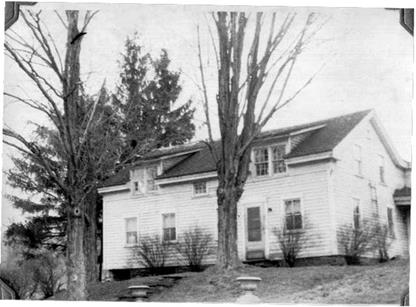
Farmhouse, Bundy Hollow Road, 1947-8
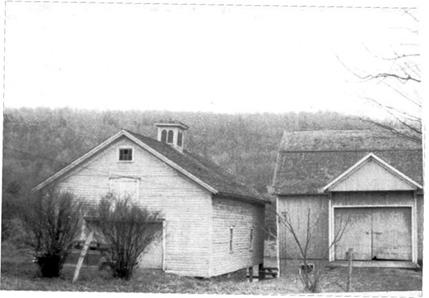
Across Bundy Hollow Road from house: Barn and
other outbuilding
It was so late in the year that we had no time to
make any improvements in the house, so we just let it freeze up. The water –
somehow I routed the water from going into the sink to going into the cellar,
and draining out of the cellar. There was an open hatch at the front of
the cellar since the house was on a hill, so the water just drained down into the
road gutter. Well, we just let it go and of course the house was frozen solid,
with no heat. We’d come up to visit it once in a while during the winter, and
the water froze in the cellar, and it piled up and piled up, until by spring
there was something like two feet of ice in the cellar of the house.
Come spring, I started working every spare minute
in the house. Without a toilet – we didn’t want to use the outhouse – I bought
a chemical toilet from Sears or Wards, which we installed in a small room in
the middle of the house, and then I proceeded to change the walls in such a way
that we could use that room for a bathroom. I had to saw vertical timbers from the ceiling to the floor in order to
create a hallway, and then we took another wall out between two small bedrooms
in order to make a usable-size bedroom.
At the same time, I ordered a coal hot-air
furnace from Wards. At the time deliveries were mostly by freight train,
railway express. Sears and Wards were in their heyday, with their big catalogues,
so we bought practically everything by mail-order. Our furnace came by
freighter express and I would haul my trailer down to the freight yard and pick
up all of the orders.
When we bought the farm, we also bought all of
the machinery with it, what there was. But it was horse-drawn machinery, so
most of it was of no use to me. I was able to hook up the dump rake and
use that behind the tractor.
About that time, the International Harvester
Company had developed a mini farm tractor called the Farmall Cub. It was designed right around the tractor,
usual lines, high wheels, high frame, and a manual lift on the back for your
draw-behind tools, place for a mower, even a pusher blade for the front. So we
bought one of them, it was about an eight or ten horsepower. It could do almost
everything as a big tractor but on a smaller scale, and it cost all of eight
hundred dollars.
I’m going to backtrack a little bit, to fill out
the descriptions of the farm and our thinking in choosing this particular one.
We didn’t have much money and my pay was something less than two hundred
dollars a month, which was a little more than I’d seen, but it wasn’t enough to
have anything left over after ordinary living expenses. So in picking a farm
out we had to stay within a reasonable distance of my work in Sidney. This
prevented us from buying really good farms – those were down in the valleys on
the river flats.
So what we ended up with in Bundy Hollow was a
hundred-acre farm, at least forty percent wooded. The woods were second-growth but
still had a lot of big, usable trees. In the lower third was a brook running
straight across the short side of the farm. There was another small farmstead
less than a quarter of a mile away, which included a triangular corner of our
farm because his spring, his water supply, was on this piece of land. There
were probably not more than two or three acres of actual flat, level land, down
near the brook, below the barn. Most of the arable land was on the upper side
of the road, to the north.
The town road went right across the farm, from
one side to the other, dividing it into two-thirds and one-third. The wet land
was all on the hillside, up to the very west of the farm, and the pasture began
about two or three hundred yards down from the western boundary of the farm.
The pasture was open but sloping. The hayfield was reasonably clear, there was
a hedgerow running right across the middle of the main hayfield, which was the
result of collecting stones off the field and piling them in sort of a wind row,
and then allowing the trees and brush to grow through them.
There had been very little maintenance done on
any of the buildings on the farm, all the roofs were in bad shape, there was no
toilet, there was an outhouse about a hundred feet from the farmhouse, and
there was a barn with a cement stable for cows underneath with wooden
stanchions, and a carriage house built almost up to the road on the east side.
There was electricity in the house, but it was very rudimentary; there was only
about one outlet per room, and I think it was a sixty-amp limit, no hot water
heater, and no telephone. There had been telephone service in the valley some
years earlier, possibly before the Depression, but it deteriorated and all that
was left was a few poles and no wire.
The pasture was in very poor shape. It had not
been maintained and brush was beginning to grow up here and there. Also, it
tended to be wet; water drained to a low area that wandered down through the
pasture to the road, and at the bottom of the hill, below the house, was a
small pond that had been bulldozed out probably for drinking water for the
cattle. Then from the pond, it went under the road and across the end of our
property and into the brook.
At a hundred acres, the farm was rectangular in
shape. It measured a little more than a half-mile from east to west and more
than a quarter-mile from north to south. The spring was roughly a quarter of a
mile from the house, up the hill, and into the woods by maybe a hundred yards.
It was a stone, cemented-up box in the ground, with a wood cover, a little shed
over it. It showed evidence of animals chewing on it, a great deal was in very
poor shape.
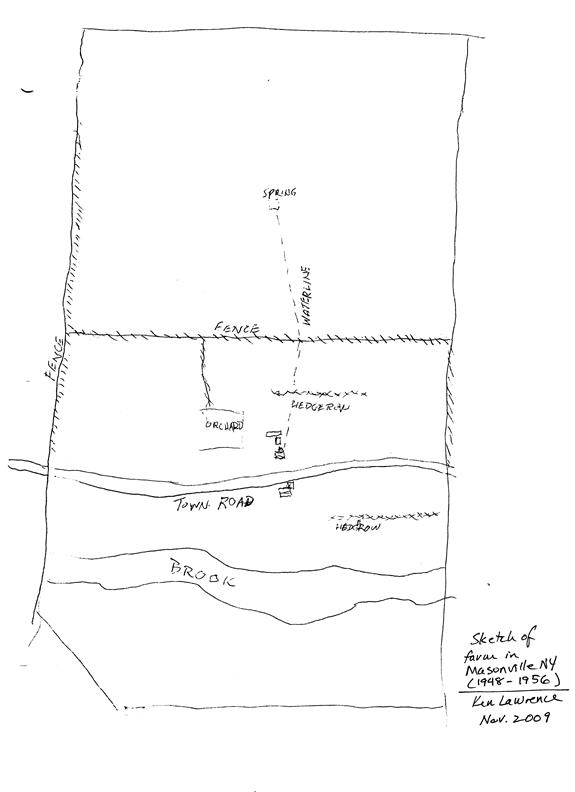
The pipe that carried the water from the spring to the house was originally a
lead pipe. When we bought the house it was still lead from the spring house
down to the pasture line. From there down to the house, probably two or three
hundred yards, it was half-inch copper pipe. But whoever laid the pipe did it
with a plow, so it was down only four, five, six inches in many spots, and
subject to damage from plowing and freezing.
The fences were in very poor shape. Neither
neighbor was very energetic about maintaining their fences, so cows could get onto
our land from the next-door neighbor. During the winter I wanted to get started
on raising livestock, so I met a fellow at Scintilla, Lou Elliot, who lived up
in the hollow on the other side of Sidney; he had a dairy farm. He was an
engineer, although he didn’t have a degree, but he was a hard-working person,
he loved farming. He agreed to raise a calf for me, so we bought a pure-bred
Holstein calf and he kept it all winter, feeding it. When spring came, we moved
to the farm and had to take over. I had to get out and do some fence repairing
and also clean up the barn and make it usable.
My mother had been raised on a farm, and she
didn’t want any part of it, and Madeleine’s mother knew nothing about farms,
and she didn’t want any part of it. So they were both horror-stricken that we
should make such a decision and tie ourselves to a rundown farm. Part of the
reason I was so insistent on this was, I knew my father had always loved the
outdoors and loved the Smiths’ farm, at least as a place to visit. I think he
always had it in his mind that he would retire to a small place in the country.
Well, unfortunately, he didn’t live that long, he died in 1942.
As for me, I hated the city and couldn’t quite
visualize myself being tied to an office job where I would have to commute to
work; and if we lived in the country, it would be a long commute, and we would
be really in the suburbs. And not knowing my lifespan either, thinking about my
father, I decided the time to do it was then, when we could do it--when we had
the youth and the energy. And if it didn’t work out, well, we would change
someday.
So that was my philosophy, and it’s rather
surprising that Madeleine, being a creature from the comfortable suburbs, would
go along with it, but she was very adaptable.
The basement of the farm house was a typical
rural building, with a dry-laid stone foundation, and over the years, due to the
ground freezing and maple trees close to the house in front, the wall of the
house had been pushed in at the bottom. It was a good two feet thick, and it
sloped inward from the sill of the house to the bottom of the basement. There
was an open doorway on the left side of the basement in front, so any water
that ran in one side ran out the front side and down into the road. So we had a
lot of jobs ahead and only the summer to accomplish them in.
The lead pipe from the spring was so old it had
pinholes in it, and as the water flowed by gravity down the hill, it built up a
suction and drew air into the pipeline, and as it got to the bottom it would
compress it. So when Madeleine tried to wash dishes under the tap in the sink,
the water would flow and then stop and then there would be an air explosion and
the water would just slam out and sometimes knock the dishes out of her hands
and break them. We couldn’t live with that very long.
So I bought a stock watering tank, a long galvanized
tank about two and a half feet deep and six feet long and two feet wide, and I
laid some stones and built up a base for it in the basement. Then I plumbed the
water pipe so that instead of coming to the sink it came through the basement
and drained into the stock watering tank. Then we bought a shallow-well
electric pump and mounted that over the tank. The pump drew water from the tank
and pumped it into the plumbing system of the house (which included a small
pressure tank), which then I had to create.
Another project: the cellar of the house was only
a semi-cellar. That is, the front half was excavated down to maybe six and a
half feet so you had a little headroom, but the back half was a stone wall laid
up and it was not excavated at all. So the back of the house was just laid on
laid-up stones on top of the ground, not a very substantial foundation. So I
hollowed out a place in the left side of the cellar and I think I poured a
little concrete, and bought a hot water tank – electric – and hooked that up
into the electrical entrance box. After a while, I had to expand on the box to
get more connections for the various installations I was making.
Also, I needed to make a place for the furnace.
The floor of the cellar was just mud and dirt, so I dug it out somewhat to make
about a five- or six-foot flat spot, put in some gravel and then poured a
concrete pad for the furnace. I had to build a coal pen to store the coal for
feeding the furnace. We bought a furnace from Wards, and I assembled it – the
firebox and the sheet metal surround and so forth – on the floor there, and we knew it was a gravity-feed, that is
with no blower, and we put in duct work to the various rooms as best we
could. The ducts were six, eight, or ten-inch diameter. In the hallway I had
created near the bathroom, we put a return-air duct that went into the wall and
straight down into the top of the furnace.
For the flue for the furnace, there was a chimney
running up through the center of the house. This was laid on a poured concrete
shelf in the cellar, so the chimney actually started about four feet off the
ground. There was no connection, no opening into the chimney for the flue, but
up on the first floor, where the old oak parlor stove was, the pipe from the
stove went into the chimney, four or five feet above the floor. So that was the
only opening in the chimney for exhaust. Well, we couldn’t use that, so we
covered that up with a metal plate, and then with a cold chisel and hammer I
cut a hole in the side of the chimney, maybe a foot or so above the very
bottom, the very base of the chimney. I put the smoke pipe from the furnace
into the chimney at that point. We did have a thermostat and a motorized draft
control on the furnace, so even though it was a basic coal furnace that had to
be fed by hand shoveling and the ashes removed daily, there was some automatic control of the draft,
which made it a lot easier to maintain.
To create a bathroom, I had taken out a partition
and created a room about, five by seven feet, big enough for a tub and a
lavatory and a toilet. To buy the plumbing, I had been talking to some of the
people at Margaretville, that is, at Smiths’ farm, and Harold Smith was at this
time not doing much building but was in the hardware and plumbing business. He
had a store in Margaretville which he and his wife operated, and he had some
help there. He sold plumbing equipment of all sorts, as well as linoleum
flooring, wallpaper, and so on. So I had contacted him and he said, well, come
on over and I’ll sell you some stuff and give you a good deal.
This was soon after we bought the farm, but we
hadn’t started renovations. I told him
Madeleine and I would visit at Thanksgiving and tow the trailer to pick the
supplies up. As soon as we got started,
it began to snow, and by the time we got to Masonville, we couldn’t go any
further. So I parked the trailer in some farmer’s front yard and we went on
with just the car. We got over there and had Thanksgiving with Harold and
Rhoda, and came home, but we had to leave the trailer there for about a week
because we couldn’t move it. Eventually we recovered the trailer and took it
back to Sidney with us. I was keeping it in the barn of the Houghtalings’ house
where we had rented the apartment.
So, it was springtime before we actually got the
bathtub, sink, and toilet out of Margaretville, and we stored them on the farm,
in the carriage house.
In the early summer, the work piled up
horrendously. We had the calf, and we had lousy fences everywhere so I had to
begin a fence-rebuilding program. I couldn’t keep ahead of it, so I started
using electric fence, I bought an electric fence charger and put electric fence
here and there to keep the calf in the pasture. At the same time, I had to
start thinking about haying, because I had to have hay come winter, to feed the
calf. So I interspersed projects, getting only part of one job done before
starting another. I bought a four or four and a half foot mower for mounting on
the Farmall Cub tractor.
We worked on the bathroom as well. The chemical
toilet had to be dumped and cleaned frequently. So we installed the fixtures and
I did a little bit of false tiling around the lower part of the bathroom wall
and cut holes for the drainage from the toilet and the tub. I had to crawl up
under the house on the unexcavated part, and pull all this drainage together
and run a pipe outside the house.
This was before builders began to use one hundred
percent PVC for sewer plumbing, so we were still using iron pipe and lead
jointing. We decided to put the septic tank behind the house, about ten or
fifteen feet away from the back wall. I had to dig it by hand, and the tank I
bought was a very minimum sort of a thing --a four hundred gallon cylindrical
steel tank. I had to dig a round hole; the tank was about four or five feet in
diameter and four feet deep. So the hole needed to be at least five or six feet
deep for the septic system to work.

I started digging by hand, and the first foot down went quite fast, then I ran
into hardpan. Hardpan, you know, is semi-rock; it’s clay full of stone that’s
so hard you can hardly pick it. Some time
earlier, I had bought what they called a rail-splitter; it was a machine, a
tubular piece of steel that could be used with blasting powder for blasting
whatever you wanted. The objective of it was to take a log to be made into fence
rails, and drive this thing into the end of the log; it had a serrated lip to
hold it in place. Before driving the tube into the log, you loaded it with
blasting powder and stoppered up the end with wadded newspaper. Then you drove
it into the end of the log and put a fuse through a touchhole in the side, then
you would light the fuse and get out of the way.
Well, it was a lot of fun for me because I always
loved fireworks, and it was very loud. So I thought, well maybe I could blast
this hardpan, so I’d take the crowbar and work a hole vertically down into the
base of the hole I was digging for the septic tank. I’d load it up, put it down
in there, and then get a rock that weighed about 50 pounds and balance it on
top of this blasting tool, then light the fuse and get out of the hole.
It really worked. It wasn’t like dynamite, but
still it would churn up enough soil that I could go back with a pick and shovel
and clean up the loosened soil. This worked fine until we got down four or five
feet deep, and I couldn’t scramble out of the hole very fast. So I had to put
in a longer fuse and a ladder in the hole. It took several weeks but we got the
hole dug.
To get the tank in the hole, we laid some planks across the hole and
rolled the tank up on top of the planks, and then installed a tripod with a
pulley over the hole. We tied ropes around the tank and pulled the rope through
a pulley over the tripod and attached it to the draw bar of the tractor.
Then I pulled the tank up off the planks with the tractor. I had
Madeleine pull the planks away from over the hole, and then I backed up with
the tractor and lowered the tank down to the bottom of the hole.
I installed cast iron pipe from under the bathroom to the tank which
had proper septic tank connections -- an entrance hole and a baffle, and on the
opposite side of the tank was an exit hole a few inches below, to carry the
effluent from the tank down toward the orchard which was where I intended to
distribute the sewage.
I had a friend at Bendix Scintilla, Bob Curran, who loved to come out
to the farm and sometimes gave me a hand. So, I hooked up the plow. This was
before I had a regular tractor-mounted plow, we had an old horse-drawn plow. So
I towed the plow with the tractor and Bob guided the plow away from the tank
and down toward the orchard.

Septic tank in position

Trench from house for sewage pipe
Since this was before the days of plastic sewage plumbing, we had to
lay 4-inch orangeburg pipes away from the tank and then around a bend and down
to the orchard. Down at the orchard, I built a box to distribute the sewage in
a trench on the uphill side of the orchard so it would filter down through the
orchard.
The distribution box had to be concrete, so I had built a form and
mixed concrete in our little one-cubic-foot concrete mixer. There was an old
man who lived on the next farm and he often came down to watch me work, and he
often insisted on helping me. But he was extremely elderly and unsure of his
footing. When I was trying to wheelbarrow a load of concrete down to the box,
he came and grabbed hold of the wheelbarrow to help me and dumped the whole
load.
I dug a two-ft trench about 60 feet east and west of the distribution
box and then installed in the trench clay tile pipe that didn’t fit together.
We laid it end to end and we put little strips of tarpaper over the joints to
keep the dirt out and then covered the trench. That was the distribution system
for the tank. It worked extremely well, we never had any problem with it. And
although the apples trees were quite old, they flourished very well with this
added nutrition.
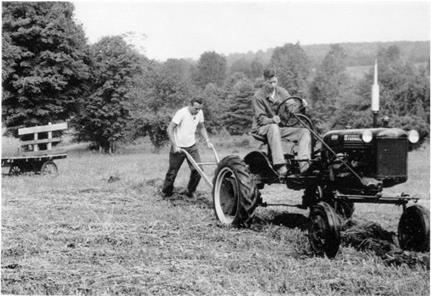
Bob Curran and Ken using hand plow to cut path for sewage distribution
pipe
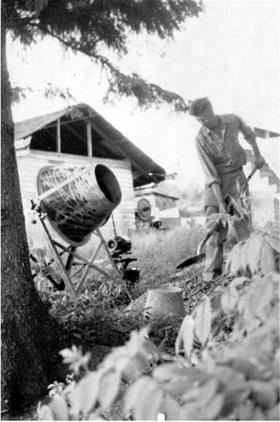
Making concrete
I had bought a new 40-gallon electric hot water tank and dug an access
for it somewhere under the middle of the house near the chimney. Then I
connected up the water plumbing from the pump to the hot water tank and to the
bathroom.
When we finally had the bathroom actually working with cold and hot
water we retired the chemical toilet. We had been using the outhouse as a place
to dispose of the liquid from the chemical toilet. So some time later, when
everything was working and we no longer needed the outhouse, we had a ceremony
which we called the “burning of the outhouse.” And we all got together and
stood outside and set a torch to the outhouse and burned it up.
As the summer progressed, I did a little bit of haying now and then,
using the Cub tractor to mow the grass. I converted the dump rake so it could
be towed behind the tractor, and then used the trailer to load the hay and
carry it back to the barn where I just threw it up into the hay mow.
You can understand the pressure we were under, to make the place
livable for the winter, because all this while Madeleine was pregnant and we
had to set up for having a baby in the house. Sometime before Madeleine was
due, in early October, my mother decided to come up and help out as much as she
could. So she took a train from Patterson NJ up to Deposit, New York, and then
I went down with the car and got her.
After my mother settled in, the weather turned a bit cool and I was
anxious to find out just how well the furnace would do. In early October,
Madeleine began to have labor pains so I drove her to the hospital. I took some
time off from work, and when I came back to the house I decided to try the
furnace. I built a wood fire in the furnace and opened up all the drafts and I
was going to try to start a coal fire, but then I realized the furnace was not
drawing at all. Smoke began to fill the cellar and then the whole house. I
tried various things, but eventually became desperate and I decided to go over
to the general store in Masonville and see if they had any ideas about what my
problem was.
Fortunately one of the men in the store knew all about furnaces and
old chimneys. He advised me that since
the house had been operated for decades with a wood stove up in the living
room, that I should worry about whether there might be a plug in the chimney
below the pipe connection to the old wood stove. With that information I went
back to the house and got out my ladder and arranged a heavy crowbar on the end
of a chain. I climbed up to the roof of the house to the chimney and let this
heavy weight down the chimney flue until hit solid bottom. Then I jerked it up
and down, until lo and behold, there was a breakthrough, and the chain and
crowbar went on down to the bottom of the chimney.
With all those decades of fires in the wood stove in the living room,
soot had collected and eventually formed a plug just below the smoke pipe from
the stove. So after letting the fire go
out in the furnace and clearing the smoke out of the house, I disconnected the
smoke pipe from the furnace at the chimney. Then I went up in there with a
small wrecking bar and cleared the remaining plug in the chimney so we had a
clear path.
The smoke had driven both me and my mother out of the house. So after
things had settled down, I decided to try the furnace again. I built a new fire
in the furnace and opened all the drafts and - lo and behold - it worked like a
charm. I was able to add some coal to the fire, and finally there was a coal
fire going in the house. Each heat pipe coming from the furnace to each room
terminated in a grill in the floor. The grill had an adjustable opening, so you
could control the amount of heat going into each room. This worked fine as long
as there was no strong wind outside in one direction.
But after using it for awhile, we finally realized that when there was
a strong wind from one side of the house, it changed the way the air flowed,
and sometimes it was impossible to balance the heat out when it was a windy
day.
Madeleine was in the hospital for several days with the baby and when
I finally was able to bring them home, we were able to have the house
comfortably warm.
Initially we had some trouble naming the baby but eventually we
settled on Anne with an “E.” Mother stayed for a couple of weeks to help
Madeleine out, and that was a great help to us. Madeleine was having trouble
nursing the baby even though we knew it was important. Her nipples couldn’t
stand the chewing, I guess. So we had to switch over to mixed milk for the baby
using the bottle.
About the same time Anne was born, Nancy Kilquist had a baby and they
named her Jean. Not being able to nurse the baby (Anne) made a big difference
in the baby’s disposition. She tended to be constipated and cried a great deal,
so we spent a lot of time walking her and holding her. In February when it was
still mid-winter, George

Ken holding Anne, born October 1948
and Nancy walked over the hill between their farm and our place,
through the woods and through the pastures, carrying the baby. This was rather
remarkable, and they stayed for supper.
I had a second cousin June, on the Lawrence side, and she had married
Herb Crumb from Oxford, New York. Herb had been in the service and when he was
discharged, instead of going to work, he took over his father’s farm in Oxford,
which his father had started with his eye to retiring on the farm.
During the winter in good weather we drove over to June and Herb’s
farm. Some time in the first couple of years there, they built a new house on
the father’s farm which made everything very nice and convenient and nothing
like our circumstances.
As the winter went on I continued working at Scintilla. It was kind of
boring and not much of a challenge, and at that time it didn’t seem to have
much future. However some time after about the first year there, the head of a
group in the laboratory that was developing electrical connectors got promoted
to the sales department. So they took him out of there and offered me his job,
which was all new to me but was a good challenge. In this job, I had one man
working for me who lived in Sidney.
Electrical connectors were a product developed by Scintilla during the
war and it grew very rapidly through the war, and continued afterward, because
they had come up with a design that used a neoprene insert instead of the usual
plastic which was the standard at the time. The benefit of the neoprene insert
was that the connector was tight sealed and could be pressurized and was
essentially waterproof.
At the time all of Scintilla’s connectors were developed for the
military. They were used in aircraft, on the ground, and in the Navy. They were
built to military standards so there was a standard list of configurations, and
they ranged anywhere from one to 18 contacts per connector. The role of the
laboratory where I was in charge was testing under various conditions,
including environmental – water, heat, and vibration, and so on, and testing
the plating for corrosion resistance and electrical characteristics of the
contacts and also of the dielectric. My immediate supervisor was Dick Coates,
another mechanical engineer. In my job I had to write reports summing up the
results of the various test programs. And his supervisor was a Jack Tyne,
another mechanical engineer.
Back on the farm we were kept busy, caring for the heifer and for
Anne. We had named the heifer Hannah. We were buying milk from our neighbors,
the Williams; we would pasteurize the milk ourselves by heating it on the
stove. The furnace, of course, kept us busy, because we had to feed coal to it
several times a day. But it wasn’t too difficult to keep the fire going and
then when we shook the furnace, the ashes would drop to the bottom of the
furnace at the cleanout, and then we had to remove the ashes from there
periodically.
Of course we didn’t have any kind of garbage service. So to get rid of
the ashes we spread them on the road out in front of the house. As it
approached our house, the road had a rather steep but short hill. In the
wintertime this became very icy, so it was quite helpful to have the ashes to
scatter on the road.
Not having a telephone was quite a handicap. So our only “out” in an
emergency was to drive the half mile to the highway where a neighbor living
there did have a telephone.
Sidney had an airport that consisted of a grass runway and a hangar
where Bendix Scintilla kept two airplanes. As far as I know there were no other
airplanes there. The airplanes were primarily used by officials of the company.
But after a couple of years there was an occasion where I had to make use of
one of them, when the company contracted with some test labs down near NYC to
test our connectors.
I was instructed to take the connectors there in the company's smaller
airplane, an Avion two-seater with plastic cover on it. The pilot was a young
fellow about my age. When we realized we going to fly over the farm house he
asked if I’d like to circle over it and Madeleine and the children could see
us. So we did, we circled the plane over the farm and then flew down to the
laboratory in Pleasantville, NY.
At Pleasantville New York, I went through my tests. When they were
complete and it was time to return home, the weather had changed somewhat. It was
summer, and it had become stormy. So the pilot, rather than fly over the
mountains, had to keep the airplane below the clouds so that he could guide
himself by sight of land. We had to get home before dark because the airport
had no lighting system.
So we flew across New Jersey to the Delaware River and then up the
Delaware River Valley keeping the plane below the clouds, which was somewhat
scary. We flew all the way to Deposit and then up the river (don’t remember the
name) towards Sidney and scraped over the hill and the cow pastures and down
into the Susquehanna Valley where Sidney was.
After that exciting and unusual day away from the labs I went back to
my normal routine at work. I had an assistant in the laboratory, who had worked
for the previous supervisor, whose name was Bud Booth. He was a local boy who
lived in Sidney. He was perfectly capable of doing most of the work I was
doing, but he was not capable of writing reports. That’s where my experience
and judgment were necessary.
On the farm, to carry out my plan for the dairy, I kept my eyes open
for calves to be purchased. I learned after a while it didn’t pay to buy local
calves except from farmers who were highly motivated to raise quality cows with
good milk production.
I had decided early on, never to keep a bull on the premises. The cows
had to be bred once a year to maintain full milk production, so I had to find
an alternative to owning a bull. I joined an artificial breeders association based
at Cornell University. Whenever I had a cow or calf to be bred, I called them
and they would schedule a man to come and breed the cow. This meant I had to be
able to tell when the cow was in heat. This was something that took a bit of
practice. I became pretty good at this. When the cows were loose in the
barnyard, I could tell by their actions which one was in heat. So I was able to
keep the herd bred without any serious errors as far as I remember.
In the remaining years when I was in production, whenever one of my
cows had a calf that turned out to be a bull calf, we had no need to keep him.
So the easiest thing to do was to call the veterinarian to castrate the calf.
Well, that was expensive. After a while I learned from Farm Journal there was a tool to be bought with a heavy plastic
ring so that you could castrate the calf by yourself. I did this several times
and it worked--after a while, the testicle would drop off. But occasionally the
calf had a testicle that had not descended from the calf’s inside and then you
couldn’t do it yourself. This happened once, and I ended up having to call the
veterinarian to do the job anyway.
Because of the poor fencing we had a problem with a cow that was not
mature enough to be bred. One of the neighbors’ bulls got through the fence and
bred her anyway.
Later I went to auctions of high-grade cattle sometimes a long distance
away. I bought a cow at one of these auctions, having to pay a good price, and
trucked her back on the Chevy truck my friend George Kilquist, a General Motors
mechanic, had fixed up.
George Kilquist had bought the old Chevy truck and overhauled it and
we started using it together. The truck's metal parts were okay, but it was a
stake body truck with rotted-out wood bed. So we started by cutting down one or two oak
trees, taking the logs to the mill about 15 miles away where they were cut to
dimension lumber that would fit the truck. After we got the lumber we had to
stack it and dry it in the shed in order to make it usable. I had earlier
bought a table saw, eight-inch diameter, to use in all our construction work.
The eight-inch blade was really too small but we had to live with it. At the
time, saw blades were made of just plain steel and they were subject to warping
from heating. Fortunately soon after I bought it they came out with a new blade
with tungsten carbide teeth that was not subject to overheating. So I bought
one of these new blades and used it to rebuild the truck.
[Even though that eight-inch saw blade was minimal for the kind of
work we were trying to do, that saw is still in use up at the cabin on the lake
(at Wildwood, Tolland, Massachusetts).
And the only thing that has been done to it is to replace the motor.]
The table saw was stored in the woodshed shop to protect it from the
weather. After the truck bed was completed I cut a good many logs, cutting the
trees down all by myself in the woods. I was always very careful and never had
an accident. I would park the truck in the driveway alongside the house and
load the logs from there onto the truck. I had cant-hooks and peaveys that I
had learned to use at the Smiths’ farm so that one man could handle the logs by
himself.


Eventually we ended up with a large stack of green lumber curing in the woodshed. A good deal of it was pine that I wanted to use for rebuilding the interior of the farmhouse.
In the summer following Anne’s birth (summer 1949) we needed a garden for growing vegetables for the coming year. The
previous owner had tried to have a garden behind the house, in front of the hen
house. However that spot was solid and damp and I knew it wouldn’t work.
Instead, I chose a spot along the road up the hill a little bit that
was dry and well drained. I plowed it up with the Cub tractor and harrowed it
and, although I had to pick loads of rocks out of it, it made a good place for
a vegetable garden, which I fertilized using animal manure from the barn.
I had begun attending farm auctions held on weekends so that it didn’t
interfere with my work. I was looking for farm equipment that was suitable for
a larger tractor. Eventually I found a Ford Ferguson tractor that was very much
like the original Ford tractor, and I bought it and drove it home to the farm.
Then I was stuck with two tractors, so I sold the Farmall Cub tractor
to George Kilquist who had a small farm and he needed to garden too. The Ford
tractor was much larger, with very large tires, and the tires were weighted
with antifreeze liquid, in order to reduce slippage. It was also much more
comfortable to drive because it didn’t jolt. I had developed a chronic neck
ache from the jolting of the small tractor.
One incident worth mentioning is that I had started painting the side
of the house where the Norway pines were. Norway pines have a root system that
projects above the ground – like knobby things. I put the ladder up against the
painted surface, and while I was on it, it slipped. I fell to the ground and
hit the end of my spine on one of these tree roots. It was very painful.
It was a couple of days before I felt well enough to go to the doctor,
which we did, however, Madeleine had to drive. On the way to Sidney we got
almost into town when one of the tires went flat. We had no choice but to
change the tire. Because I was in such severe back pain I couldn’t help her. So
I got out of the car and stood beside her and told her how to jack up the car
and use the tire wrench and remove the wheel. She did this, but people drove by
and looked at us, likely wondering what was wrong, why wasn’t I helping. We
survived that and apparently my back injury was not permanent. I soon recovered
and was back at work.
At one farm auction I saw a tool that I had never heard of before. It
was a cast steel rooter and was called a sub-soiler. It was used to help drain
wet spots by plowing a deep furrow. I bought it for a song even though it was
an expensive tool, because no one else at the auction knew what it was for.
Another advantage of the Ford tractor was that it had a 3-point hitch
that had become a standard on tractors and could attach and lift and operate
most tools.
At time went by, my responsibilities at Scintilla grew. Bendix-Scintilla
had joined a group of industries that worked with a community technical school
in Binghamton, where high school students could advance their technical skills.
A feature of the program was sending students to local industries for several
months so they could gain experience in local industries.
So every few months a new intern would work with us. I was assigned
some of these interns -- I would keep the intern busy and keep records on his
work. This was ok. The first student I had was a boy whose father was a funeral
director and he was aiming for that.
Later, someone at Scintilla decided I needed an assistant engineer.
They recruited someone who turned out to be a graduate of the same college that
(my brother-in-law) John Dyson had attended. This was really a secondary,
inferior college, and whatever they learned there depended on their own
initiative.
The man they assigned to me was married. His situation was somewhat
similar to mine in that he had married a beautiful woman and brought her up to
one of the distant hollows and bought a farm and installed her on the farm and
just left her there. However, he turned out to be a truly second rate engineer.
No matter what I assigned him to do, I had to go over it and rectify it.
Consequently the arrangement didn’t last very long. He could see no future in
his work there. He resigned and disappeared. And I often wondered what happened
to him and his wife in that unfortunate situation.
As time went by, Madeleine had become pregnant again. She had a story
that she would tell. When she went to the dentist, she would tell him, “Every
time I come to the dentist, I’m pregnant.” The dentist said “I don’t mind that,
as long as you don’t say, when I leave the dentist, I’m pregnant.”
I had been going to a doctor in Sidney named Dr. Danforth and we got
along fine. However Madeleine didn’t like him because he seemed a little
backward about how women should raise their children. So she found her own
doctor, Dr. Burien, a recent immigrant from Europe. His philosophy on raising
babies was old fashioned enough so they got along fine.
At one point I decided we could raise a pig to supplement our food
supply. So we plowed up half an acre of the hay field and planted field corn in
order to feed the pig.
Later I contacted Pa Smith in Dunraven, New York, and arranged to come
over and buy one of his piglets. So in late summer we drove the 50 miles to
Dunraven along with Anne to pick up the piglet. Coming home there were
Madeleine and me and Anne and the piglet in a flour bag on the floor of the
car. The two of them were about the same size. They weighed probably 15 or 20
pounds.
In the meantime we allowed the field corn to ripen and then dry in the
field. Then we had a picking outing where we went out with the truck and
harvested the ears of the corn which were quite dry by that time. We stored the
corn on the upper floor of the barn where it was quite dry.
We installed the piglet in one side of the hen house behind our house,
where Madeleine was keeping chickens. We had to feed the piglet carefully for a
while because it couldn’t handle eared corn. But after a while it became a
simple matter of husking the corn and throwing it in the feed trough in the
piglet’s pen.
The pig grew very fast, and by early winter weighed 200 pounds. I
contracted with my neighbor to slaughter the pig for me in exchange for some of
the meat, because I didn’t want to get involved in the slaughtering process.
I acquired a Morton Salt Company booklet that detailed the process of
cutting up the carcass and curing ham and bacon, operations I knew nothing about. So in early
winter I spent a good deal of time learning to be a butcher, with the Morton's
instruction book in front of me and a knife and an axe by my side.
We had a large freezer by this time -- about 20-cubic feet – stored in
the back of the kitchen. Also I had bought a second-hand gas stove and had it
converted to operate with bottled gas. In Masonville there was a general store
that sold bottled gas –tanks were stored outside the back of the store. A
problem with bottled gas was you never knew when your gas tank was going to run
out. Consequently I started buying a second tank of gas that could be stored against
the house in case the first ran out of gas while we were cooking.
For Christmas my mother and my sister Jean came for several days’
visit. They would come up on the Erie Railroad to Deposit, NY, and I would go
down with the car and pick them up. When Madeleine was preparing meals and decided
to serve ham, Jean refused to eat any of it because I had prepared it and grown
it myself. However my mother had no problem with it.
Some time in Anne’s second year, Madeleine and the baby went to
Montclair to visit her mother. On those occasions Madeleine went down by train
from Deposit, and came back the same way. I would go down to Deposit and pick
them up. On one of those occasions I recall that Anne became ill and had to
stay for a week or so.
During the years in Bundy Hollow, Madeleine raised chickens for eggs
and sold them locally. I sold some eggs at Bendix Scintilla. However on one
occasion some jokers in the laboratory took our eggs and hard boiled them. That
was of course a great disappointment to the people that had bought them and
after that they didn’t want eggs brought in for sale.
Another activity that took a lot of work in the fall was the apple
harvest. I collected good apples from
the Northern Spy trees, bagged them and took them to a local cider mill where
they could be pressed for cider. I took 10-gal milk cans to bring the cider
back. I sold the cider locally and also to anyone at Bendix that would buy it.
Although the work at Bendix was steady and somewhat growing, the work
on the farm was very pressing and was getting harder and harder. I had
developed a digestive condition that I called colitis. Eventually the doctor
put me in the hospital in Cooperstown for observation. Well, nothing came of
this. Nothing was wrong with me that they could fix.
There was an odd situation in town. There was an organization called
the Sidney Engineering Society. Naturally 99 percent of the people in it were
Bendix employees. It was understood you would become a member if you worked at
Bendix. At one time I was appointed Vice President. About all we did was put on
little celebrations like parties and dances.
I continued to try to turn the farm into a working arrangement where I
would be able to ship milk and develop an income that way. To do that, I needed
a milk house. So on the side of the barn I designed and built a milk house that
consisted of a concrete platform and a space for a milk cooler and a parking
deck where a truck could come in and you could lower the milk onto the truck.
Over the years I had raised, bred and accumulated quite a few milk
cows. By the time I was ready to quit my job I had 16 head of cattle. During
the last summer that I was working I had Dick Coats send his son over to help
me get ready to ship milk. However he turned out to be a very inept helper – he
was breaking tools right and left and was not very satisfactory.
By that time we had three children and I was shipping two cans of milk
a day, and I decided to give up my job at Bendix and concentrate on the farm.
The first winter was extremely rough because I was shipping milk and I
had to keep the barn and basement very clean. That meant cleaning it out every
day and spreading manure, sometimes in the snow. One particular day I was
driving the manure spreader with the tractor and spreading it over the snow. I
remember the manure spreader broke and I had to quickly unload all the manure.
Then I cleaned off the spreader with a fork and hoe, and parked it in the barn
where it wouldn’t freeze. Finally I had to go to Oneonta and buy repair parts
for the spreader so that I could keep up with it the rest of the winter.
Other things that happened in the winter were extremely exhausting.
For example, one of the cows would produce a calf down in the pasture across
the brook. That meant I had to drag the trailer down and across the brook and
load the calf onto the trailer and drive it back up where I could put it in the
barn and take care of it.

Anne and Ken eating corn on the cob
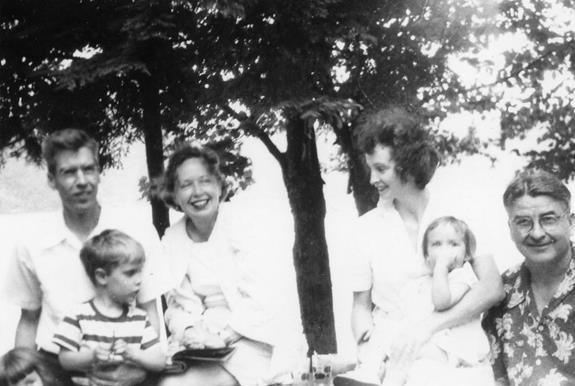
1953: L to R: Ken
holding Dick; Rhoda Smith; Madeleine holding Sally; and Harold Smith, one of
Olney (Pa) Smith’s 12 children

1952. L to R: Ken, Dick, Anne, Sally (born December 1951), Madeleine

Charles; Richard Lawrence (Ken’s brother and father of Charles); Judy
Bulck (oldest daughter of Ken’s sister Adelaide)

1950, L to R: Ken with Anne; his sister Jean; Grace and Irene
Mitchell; Gladys Lawrence holding Dick

Ken and sister Adelaide, about 1950

About 1951. L to R:
Helen (?) Kilquist holding Dick; Anne; and Nancy Kilquist holding her daughter
Jean

February 1956. L to R:
Jip, Anne, Dick, Sally
THE MOVE TO FLORIDA
By the time
we had three children, it became clear to me that making a living on that farm
wasn’t going to be successful. I concluded we would have to give up the farm
and I was tired of being cold so much of the time. So it occurred to me that I
could look for a job further south, like Florida.
I arranged
to sell the herd of cattle to Howard Cutting, who lived on the same road. The
herd would be a big benefit to him, because my livestock was much higher
quality and higher producing than his. So he bought the herd, paying me on a
long term basis which helped me do it. As I remember, we drove the herd of
cattle up the road to his farm, and he and his children then managed the herd.
Since we
had a car and a truck, I left the truck with Madeleine and drove the car to
Florida to look for another job. My objective was to get a job and then arrange
things so that I could come back and leave it for Madeleine to sell the farm
while I went back and looked for a place to live.
I drove all
the way to Florida, starting in the north on the east coast and proceeding
south, stopping at likely places for engineering jobs and found quite a few
opportunities. It was obvious that my degree from Stevens Tech was helpful. I
started near St. Augustine and went down to Cape Canaveral, which looked like a
good place. But I visualized the space program as a temporary thing. I went to
Miami and had a chance for a job there but I didn’t think that was a good place
to raise a family.
So then I
proceeded up the west coast. When I got to St. Petersburg, I found that the
Hamilton Standard division of United Aircraft had rented the airport. They were
working on a particular aircraft project and needed many engineers to carry it
out. I accepted a job without knowing exactly what it involved.
Then I drove
all the way back to Sidney, New York, in order to make arrangements to move to
Florida and take up the job. When I got back to Sidney, I had to make
arrangements so Madeleine could carry on alone and take care of the family while
I went back to Florida to find a place to live. So I left the car with
Madeleine and packed what I needed for an extended stay, and used public
transportation to get myself back to Florida.
In Florida
the company had obtained temporary housing for me in a nearby motel, which was
walking distance to the job. I proceeded to look for more permanent housing. It
was a real learning experience to use public transportation and sit in the
right end of the bus because of the segregation rules. There was a small
restaurant near the airport --Aunt Hattie’s – that I began to use as a regular
place to eat.
There at
the restaurant, I started to learn my job, trying to understand the details of
the project and read the blueprints to see what they were doing. It took me
quite a while to understand the device they were working on. It was called a
constant speed drive which was a transmission between the engine and the
generator. It was a device they had licensed from a German engineer.

House at 11160 Sixth St E, Treasure Island, near St Petersburg, FL

19-ft cabin cruiser ‘Salandic’ that Ken built in the garage from a kit
BUILDING THE CABIN
AT WILDWOOD, 1966
When
Madeleine and I first looked at Wildwood, there were not many lots to choose
from, because few of the planned roads had been built. So I chose a small lot with
100 feet of shoreline, about a quarter of a mile from the dam. The lot was set
back about 100 feet from the existing road around the lake. I agreed to buy the
lot on a time payment for around $5,000. And we went home to plan the cabin.
The
development rules required a minimum size for buildings, which was good, but
there was a prohibition on log cabins. They didn’t want any log cabins, they
wanted everything modern, which screwed up my plan. So I had a plan in mind,
but there were strict setbacks from all the lines. I had to change the planned
orientation of the house to fit the rules of the development.
We planned
a building 24 ft x 40 ft with a 24 ft porch facing the lake. There was a 16 x
24 ft livingroom, with bathroom and bedrooms in the rear. The kitchen was in a
corner of the livingroom against the bathroom. The bedrooms were very small,
but with space on the second floor for small beds. We wanted the livingroom to be
airy and wide open. So it had no ceiling, it went to the rafters. But over the
porch, there was a ceiling, which was a floor for a storage space that could be
reached from the living room. The bedrooms had a 7 ft ceiling which left space
for a second floor that could be accessed by a ladder from the livingroom.
Later I
added a skylight in the livingroom to give more light. We planned eventually to
put a fireplace in the livingroom. Electrical wiring would terminate in an
entrance box/fuse box in the wall between the bath and the bedroom.
We made a
drawing of the plan and submitted it to Jack Galanek, the developer, and he
approved it. Of course we needed a sewage system for the bathroom and kitchen.
I think I suggested where it should be, but I kind of left it up to the
developer. We knew there was a lot of ledge rock in the area, and it was
impossible to tell ahead of time whether there was depth enough for a septic
tank.
The
developer hired a contractor to put in the sewage system. He chose the location
for the septic tanks. But as usual he ran into ledge rock down around less than
6 ft, so there wasn’t room for a full septic tank. So he ended up putting two
half top-half concrete tanks and putting them on the ledge rock, side by side.
Fortunately for us, the ledge was level and flat. So each tank was only half
the normal size. He put them in side by side, and connected the outlet of the
first to inlet of the second tank. So all I had to do was run a sewage pipe
from the house from the bathroom and the kitchen, to the inlet of the first
septic tank.
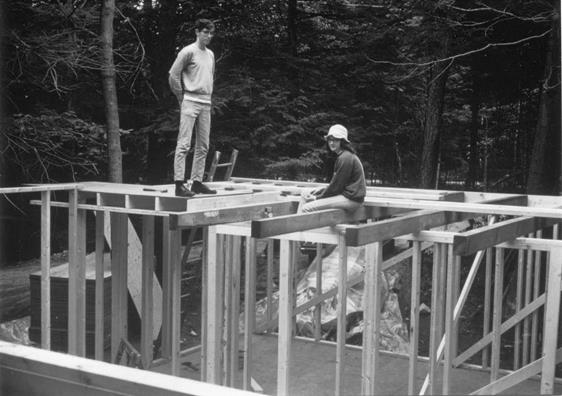
Dick and Sal working on Wildwood cabin, summer 1967
As far as I
know, he ran a discharge line from the second septic tank down to a
distribution field. For the distribution field, he laid out a bed of gravel
parallel to the cabin and aiming toward the lake. There was ledge rock
everywhere, so I decided against trying to put in a cellar.
I hired a
local contractor to dig holes for piers and build the piers on which we would
build the house. There were 15 concrete block piers, and the sixteenth was on
bedrock that actually came up to the surface on one corner of the cabin. The
top of the piers were finished off with a heavy bolt so that we had something
to attach the beam system to, so it wouldn’t shift.
Theoretically
each pier was started on a concrete pad that was poured on a cleared ledge
rock. Unfortunately the contractor was sloppy about it. There had been a
rainstorm after he prepared the hole, so mud slid in on some of the concrete
pads. As a result some of the piers were not on a solid surface. In later years
we had problems with the piers shifting.
I ordered
building materials from a dealer in Southwick. Because the orders were large,
the dealer was willing to truck them out to Wildwood and unload them at our
building site.
We began
the actual construction when Dick and Sally were on summer vacations. The basic
floor frame was made up of two 2x 10s and in some places three laps to avoid
weak spots. The floor joists were 2 x 8s throughout. The livingroom joists were
cut out and framed to accommodate a future fireplace and chimney.
Earlier, we
had bought a small generator to protect us from shut downs from occasional
power outages during thunderstorms and hurricanes. So we brought the generator
up to Wildwood and used that intermittently to power an electric saw.

Beth was born in 1961

1970, Beth Lawrence at
lake, Wildwood
--End—
Lawrence Genealogy
|
Parents |
Grandparents |
Great-grandparents |
|
|
|
William
Henry Lawrence |
||
|
Arnette
Royce Lawrence |
Arnette
Odell Lawrence |
Maria
Elizabeth Back (Bach) |
|
|
|
|||
|
Kenneth
Hoyt Lawrence |
Nellie
Royce Carr |
William
Schatzell Carr |
|
|
born
1920 |
|
Annie
Royce |
|
|
|
|||
|
|
William
Hoyt Allen |
Martin
Allen |
|
|
Gladys
Elizabeth Allen |
|
Lucy
Maria Fitch |
|
|
Eunice
(Ella) Brooke |
George
W. Brooke |
||
|
|
Adelaide
Carter |
||
Lawrence genealogy. Information in Bible belonging to Uncle Ken Lawrence born 1892
|
Ken’s generation |
The four children
of Arnette Odell Lawrence and Nellie Royce Carr |
Ken’s grandparents |
Ken’s
great-grandparents |
|
Adelaide Royce Lawrence b. 6/4/1917 Richard Allen Lawrence b. 9/24/1918 Kenneth Hoyt Lawrence b. 6/29/1920 Jean Carr Lawrence b. 4/3/1922 |
Arnette Royce Lawrence b. 10/21/1888 d. 12/1/1942 md 6/24/16 Gladys Elizabeth Allen b. 9/24/1892 d. 7/16/1972 |
Arnette Odell Lawrence b. 11/3/1850 d. 6/16/1920 md 12/7/1887 Nellie Royce Carr b. 5/4/1865 d. 7/29/1920 |
William Henry Lawrence and Maria Elizabeth Back (Bach) |
|
William Schatzell Carr and Annie Royce |
|||
|
Nellie Royce Carr siblings See next page |
|
||
|
William Hoyt Allen and Eunice (Ella) Brooke |
Martin Allen and Lucy Maria Fitch |
||
|
George W. Brooke and Adelaide Carter |
|||
|
Barbara Sue Lawrence b. 10/10/1922 md 4/15/44 Charles Harvey Andrews |
Kenneth Lawrence b. 7/29/1892 md 5/3/1918 Elena Viola Allen |
|
|
|
No children |
Dorothy Lawrence b. 8/29/97 d. 6/19/45 md 5/30/1928 Werner Grover Van Klebe |
|
|
|
Roger Carr Lawrence b. 4/12/1936 md 6/9/1962 Virginia Cromwell David Reed Lawrence b. 10/11/1939 md Ashley Compau |
Philip Lawrence b. 3/24/1902 md 11/23/1932 Dorothy Rebecca Reed b. 6/9/1908 |
|
|
Bible of Uncle Ken Lawrence (born 1892) also includes information about his mother (Nellie Royce Carr)’s siblings:
|
|
|
Nellie Royce Carr
siblings |
|
|
|
|
||
|
|
|
William Shatzell Carr, Jr b. 3/10/1870 d. 7/26/1896 |
|
|
|
|
Edwin Irving Carr* b. 6/16/1872 *Uncle Phil Lawrence (b. 1902) in 1978 told Madeleine that Irving ran away and his fate unknown |
|
|
|
Constance Clements Carr b. 12/9/1902 md. 8/18/1933 Carleton Earle Saunders, Jr. |
Arthur Royce Carr b. 3/22/1875 md 4/11/1899 Florence May Clements |
|
|
James Edward Kelly, Jr. b. 12/22/1936 |
Florence Clements Carr b. 9/22/1913 md. 11/22/1935 James Edward Kelly |
|
|
|
|
|
Anne Royce Carr b. 1/11/1877 d. 4/1/1913 md 1905 Edward Hill McCray d. 6/1/1914 |
|
Descendants of Ken Lawrence
(as of 2016)
|
Children |
Grandchildren |
Great- and great-great- grandchildren |
|
|
Anne Lawrence del Campo |
Christine del Campo Cianfarani |
Angelina Cianfarani |
|
|
b. 1948 md 1966 George del Campo |
b. 1966 md David Cianfarani |
b. 2003 |
|
|
April del Campo |
Thomas Welch b. 1991 |
||
|
Kenneth Hoyt
Lawrence |
b. 1970 md 1990 Robert Welch (div.) |
daughter Aurora Lavely b. 2012 |
|
|
b. 1920 |
|
Timothy Welch b. 1992 |
|
|
md 1945 Madeleine Hulst |
Douglas del Campo b. 1976 |
||
|
b. 1923 |
Alexander del Campo b. 1978 |
Caleb Jutras b. 2013 |
|
|
George del Campo Jr b. 1980 |
Sofia b. 2013 |
||
|
md 2009 Sarah Witkiewicz |
Isobel b. 2015 |
||
|
Richard Hulst Lawrence |
Emily Lawrence b. 1985 |
||
|
b. 1950 md 1979 Patrice McCabe |
Hannah Lawrence b. 1986 |
||
|
Sarah Allen Lawrence |
Alice Lai b. 1989 |
||
|
b. 1951 md 1983 David Lai |
Philip Lai b. 1991 |
||
|
Elizabeth Lawrence Gasho |
Alexandra Gasho b. 1992 |
||
|
b. 1961 md 1988 James Gasho |
Keith Gasho b. 1994 |
||
|
Victoria Gasho b. 1996 |
Obituaries of Arnette Royce Lawrence
and Arnette Odell Lawrence
Ken’s
father, Arnette Royce Lawrence
(Obituary
from the Casualty Actuarial Society)
OBITUARY
ARNETTE ROYCE LAWRENCE
1888 - 1942
Arnette
Royce Lawrence, a Fellow of this Society for twenty years, died at his home in
Montclair, New Jersey, on December 1, 1942. Mr. Lawrence was born October 21,
1888 in Yonkers, New York and graduated from Stevens Institute of Technology in
1911 with the degree of Mechanical Engineer. Almost his entire business career
was devoted to workmen's compensation rate administration, a field in which he
distinguished himself. After brief periods of employment with the New York
Edison Company and the Fidelity and Casualty Company, he was employed in 1914
by the Compensation Insurance Rating Board shortly after its organization,
becoming its Assistant Chief Inspector. In 1917 he became Assistant General
Manager of the Pennsylvania Compensation Rating and Inspection Bureau, and the
following year organized and became Manager of the Workmen's Compensation
Inspection Rating Bureau of Virginia. In 1921 he was appointed Manager of the
Compensation Rating and Inspection Bureau of New Jersey, as well as Special
Deputy Commissioner of Banking and Insurance, and continued until his death in
this dual capacity. As such he shaped the course of compensation rate
regulation in New Jersey and built up the Bureau into one of the outstanding
rating organizations. He was a pioneer in the compensation business and a
leader in its development from the beginning. His broad experience in this field
and his thorough knowledge of the subject made him especially valuable in helping
solve many of the problems which have arisen in this branch of insurance.
Ken’s grandfather
Arnette Odell Lawrence, 1850 - 1920
